Results by title
192 books match the query 'Popular music' and 3 start with k
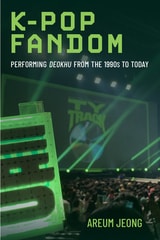
K-Pop Fandom
Performing Deokhu from the 1990s to TodayAreum Jeong
University of Michigan Press, 2026
K-Pop Fandom insists that K-pop fan practices and activities constitute a central productive force, shaping not only K-pop’s explosive global popularity, but also K-pop’s cultural impacts, politics, and horizons of possibility. Over the past three decades, the K-pop fandom and its activities have expanded, intensified, and diversified along myriad dimensions, assuming novel social, technological, and economic forms, some of which are unique to K-pop, and some of which reflect broader cultural and industrial logics of globalized mass entertainment culture. Areum Jeong argues that K-pop fans, in performing deokhu—a Korean term connoting an “avid fan”—perform a materialization of affective labor that also seeks to produce good relationships between asymmetrically positioned actors in the K-pop ecosystem.
Through an autoethnography of becoming a K-pop deokhu, Jeong connects their experiences to generations of K-pop fans, showing simultaneously how fandom practices have shifted over time and the intricacies of fan labor participation. This personal connection paved the way for participant-observation and co-performer witnessing methodologies in the study, which crucially allowed for collaborating with fans whose communal pursuits have been stigmatized by dominant discourses that denigrate their activities as solely addictive, uncritical, and wasteful. Jeong’s genre-spanning corpus of fan activities and analyzing its contexts and contents represents an important contribution to the making of a fan archive that is also an archive of affective labor.
Through an autoethnography of becoming a K-pop deokhu, Jeong connects their experiences to generations of K-pop fans, showing simultaneously how fandom practices have shifted over time and the intricacies of fan labor participation. This personal connection paved the way for participant-observation and co-performer witnessing methodologies in the study, which crucially allowed for collaborating with fans whose communal pursuits have been stigmatized by dominant discourses that denigrate their activities as solely addictive, uncritical, and wasteful. Jeong’s genre-spanning corpus of fan activities and analyzing its contexts and contents represents an important contribution to the making of a fan archive that is also an archive of affective labor.
[more]

Karaoke Idols
Popular Music and the Performance of IdentityKevin Brown
Intellect Books, 2015
Most ethnographers don’t achieve what Kevin Brown did while conducting their research: in his two years spent at a karaoke bar near Denver, Colorado, he went from barely able to carry a tune to someone whom other karaoke patrons requested to sing. Along the way, he learned everything you might ever want to know about karaoke and the people who enjoy it.
The result is Karaoke Idols, a close ethnography of life at a karaoke bar that reveals just what we’re doing when we take up the mic—and how we shape our identities, especially in terms of gender, ethnicity, and class, through performances in everyday life. Marrying a comprehensive introduction to the history of public singing and karaoke with a rich analysis of karaoke performers and the community that their shared performances generate, Karaoke Idols is a book for both the casual reader and the scholar, and a fascinating exploration of our urge to perform and the intersection of technology and culture that makes it so seductively easy to do so.
The result is Karaoke Idols, a close ethnography of life at a karaoke bar that reveals just what we’re doing when we take up the mic—and how we shape our identities, especially in terms of gender, ethnicity, and class, through performances in everyday life. Marrying a comprehensive introduction to the history of public singing and karaoke with a rich analysis of karaoke performers and the community that their shared performances generate, Karaoke Idols is a book for both the casual reader and the scholar, and a fascinating exploration of our urge to perform and the intersection of technology and culture that makes it so seductively easy to do so.
[more]
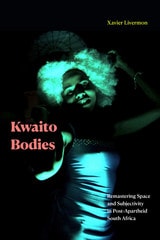
Kwaito Bodies
Remastering Space and Subjectivity in Post-Apartheid South AfricaXavier Livermon
Duke University Press, 2020
In Kwaito Bodies Xavier Livermon examines the cultural politics of the youthful black body in South Africa through the performance, representation, and consumption of kwaito, a style of electronic dance music that emerged following the end of apartheid. Drawing on fieldwork in Johannesburg's nightclubs and analyses of musical performances and recordings, Livermon applies a black queer and black feminist studies framework to kwaito. He shows how kwaito culture operates as an alternative politics that challenges the dominant constructions of gender and sexuality. Artists such as Lebo Mathosa and Mandoza rescripted notions of acceptable femininity and masculinity, while groups like Boom Shaka enunciated an Afrodiasporic politics. In these ways, kwaito culture recontextualizes practices and notions of freedom within the social constraints that the legacies of colonialism, apartheid, and economic inequality place on young South Africans. At the same time, kwaito speaks to the ways in which these legacies reverberate between cosmopolitan Johannesburg and the diaspora. In foregrounding this dynamic, Livermon demonstrates that kwaito culture operates as a site for understanding the triumphs, challenges, and politics of post-apartheid South Africa.
[more]