Results by title
1325 books match the query 'Psychology' and 5 start with k

Kaskaskia
The Lost Capital of IllinoisDavid MacDonald and Raine Waters
Southern Illinois University Press, 2019
At the outset the Kaskaskia tribe, along with Jesuit missionaries and French traders, settled near the confluence of the Kaskaskia and Mississippi rivers, about sixty miles south of modern-day St. Louis. The town quickly became the largest French town and most prosperous settlement in the Illinois Country. After French control ended, Kaskaskia suffered under corrupt British and then inept American rule. In the 1790s the town revived and became the territorial capital, and in 1818 it became the first state capital. Along the way Kaskaskia was beset by disasters: crop failures, earthquakes, tornadoes, floods, epidemics, and the loss of the capital-city title to Vandalia. Likewise, human activity and industry eroded the river’s banks, causing the river to change course and eventually wash away the settlement. All that remains of the state’s first capital today is a village several miles from the original site.
MacDonald and Waters focus on the town’s growth, struggles, prosperity, decline, and obliteration, providing an overview of its domestic architecture to reveal how its residents lived. Debunking the notion of a folklore tradition about a curse on the town, the authors instead trace those stories to late nineteenth-century journalistic inventions. The result is a vibrant, heavily illustrated, and highly readable history of Kaskaskia that sheds light on the entire early history of Illinois.

Kierkegaard as Psychologist
Vincent A. McCarthy
Northwestern University Press, 2015
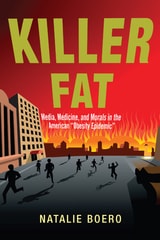
Killer Fat
Media, Medicine, and Morals in the American "Obesity Epidemic”Boero, Natalie
Rutgers University Press, 2013
In the past decade, obesity has emerged as a major public health concern in the United States and abroad. At the federal, state, and local level, policy makers have begun drafting a range of policies to fight a war against fat, including body-mass index (BMI) report cards, “snack taxes,” and laws to control how fast food companies market to children. As an epidemic, obesity threatens to weaken the health, economy, and might of the most powerful nation in the world.
In Killer Fat, Natalie Boero examines how and why obesity emerged as a major public health concern and national obsession in recent years. Using primary sources and in-depth interviews, Boero enters the world of bariatric surgeries, Weight Watchers, and Overeaters Anonymous to show how common expectations of what bodies are supposed to look like help to determine what sorts of interventions and policies are considered urgent in containing this new kind of disease.
Boero argues that obesity, like the traditional epidemics of biological contagion and mass death, now incites panic, a doomsday scenario that must be confronted in a struggle for social stability. The “war” on obesity, she concludes, is a form of social control. Killer Fat ultimately offers an alternate framing of the nation’s obesity problem based on the insights of the “Health at Every Size” movement.

Kinship by Design
A History of Adoption in the Modern United StatesEllen Herman
University of Chicago Press, 2008
Beginning in the early 1900s, when children were still transferred between households by a variety of unregulated private arrangements, Ellen Herman details efforts by the U.S. Children’s Bureau and the Child Welfare League of America to establish adoption standards in law and practice. She goes on to trace Americans’ shifting ideas about matching children with physically or intellectually similar parents, revealing how research in developmental science and technology shaped adoption as it navigated the nature-nurture debate.
Concluding with an insightful analysis of the revolution that ushered in special needs, transracial, and international adoptions, Kinship by Design ultimately situates the practice as both a different way to make a family and a universal story about love, loss, identity, and belonging. In doing so, this volume provides a new vantage point from which to view twentieth-century America, revealing as much about social welfare, statecraft, and science as it does about childhood, family, and private life.

Knot of the Soul
Madness, Psychoanalysis, IslamStefania Pandolfo
University of Chicago Press, 2018
Knot of the Soul moves from the experience of psychosis in psychiatric hospitals, to the visionary torments of the soul in poor urban neighborhoods, to the melancholy and religious imaginary of undocumented migration, culminating in the liturgical stage of the Qur’anic cure. Demonstrating how contemporary Islamic cures for madness address some of the core preoccupations of the psychoanalytic approach, she reveals how a religious and ethical relation to the “ordeal” of madness might actually allow for spiritual transformation.
This sophisticated and evocative work illuminates new dimensions of psychoanalysis and the ethical imagination while also sensitively examining the collective psychic strife that so many communities endure today.