753 books match the query 'Race' and 6 start with k

cover of Katrina's Imprint: Race and Vulnerability in America

Katrina's Imprint

Race and Vulnerability in America

Wailoo, Keith

Rutgers University Press, 2010

Katrina's Imprint highlights the power of this sentinel American event and its continuing reverberations in contemporary politics, culture, and public policy. Published on the fifth anniversary of Hurricane Katrina, the multidisciplinary volume reflects on how history, location, access to transportation, health care, and social position feed resilience, recovery, and prospects for the future of New Orleans and the Gulf region. Essays examine the intersecting vulnerabilities that gave rise to the disaster, explore the cultural and psychic legacies of the storm, reveal how the process of rebuilding and starting over replicates past vulnerabilities, and analyze Katrina's imprint alongside American's myths of self-sufficiency. A case study of new weaknesses that have emerged in our era, this book offers an argument for why we cannot wait for the next disaster before we apply the lessons that should be learned from Katrina.
[more]
cover of Keepin' It Real: Essays on Race in Contemporary America

Keepin' It Real

Essays on Race in Contemporary America

Elwood David Watson

Intellect Books, 2019

The past decade has been one of the most racially turbulent periods in the modern era, as the complicated breakthrough of the Obama presidency gave way to the racially charged campaigning and eventual governing of Donald Trump. Keepin’ It Real presents a wide-ranging group of essays that take on key aspects of the current landscape surrounding racial issues in America, including the place of the Obamas, the rise of the alt-right and White nationalism, Donald Trump, Colin Kaepernick and the backlash against his protests, Black Lives Matter, sexual politics in the black community, and much more. 
America’s racial problems aren’t going away any time soon. Keepin’ It Real will serve as a marker of the arguments we’re having right now, and an argument for the changes we need to make to become the better nation we’ve long imagined ourselves to be.

 
[more]
cover of Keeping Heart: A Memoir of Family Struggle, Race, and Medicine

Keeping Heart

A Memoir of Family Struggle, Race, and Medicine

Otis Trotter

Ohio University Press, 2015

“After saying our good-byes to friends and neighbors, we all got in the cars and headed up the hill and down the road toward a future in Ohio that we hoped would be brighter,” Otis Trotter writes in his affecting memoir, Keeping Heart: A Memoir of Family Struggle, Race, and Medicine.

Organized around the life histories, medical struggles, and recollections of Trotter and his thirteen siblings, the story begins in 1914 with his parents, Joe William Trotter Sr. and Thelma Odell Foster Trotter, in rural Alabama. By telling his story alongside the experiences of his parents as well as his siblings, Otis reveals cohesion and tensions in twentieth-century African American family and community life in Alabama, West Virginia, and Ohio.

This engaging chronicle illuminates the journeys not only of a black man born with heart disease in the southern Appalachian coalfields, but of his family and community. It fills an important gap in the literature on an underexamined aspect of American experience: the lives of blacks in rural Appalachia and in the nonurban endpoints of the Great Migration. Its emotional power is a testament to the importance of ordinary lives.

[more]
cover of Keith Haring's Line: Race and the Performance of Desire

Keith Haring's Line

Race and the Performance of Desire

Ricardo Montez

Duke University Press, 2020
In the thirty years since his death, Keith Haring—a central presence on the New York downtown scene of the 1980s—has remained one of the most popular figures in contemporary American art. In one of the first book-length treatments of Haring’s artistry, Ricardo Montez traces the drawn and painted line that was at the center of Haring’s artistic practice and with which the artist marked canvases, subway walls, and even human flesh. Keith Haring’s Line unites performance studies, critical race studies, and queer theory in an exploration of cross-racial desire in Haring’s life and art. Examining Haring’s engagements with artists such as dancer and choreographer Bill T. Jones, graffiti artist LA II, and iconic superstar Grace Jones, Montez confronts Haring’s messy relationships to race-making and racial imaginaries, highlighting scenes of complicity in order to trouble both the positive connotations of inter-racial artistic collaboration and the limited framework of appropriation. 
[more]
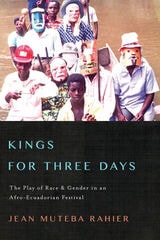
cover of Kings for Three Days: The Play of Race and Gender in an Afro-Ecuadorian Festival

Kings for Three Days

The Play of Race and Gender in an Afro-Ecuadorian Festival

Jean Muteba Rahier

University of Illinois Press, 2013

 
With its rich mix of cultures, European influences, colonial tensions, and migration from bordering nations, Ecuador has long drawn the interest of ethnographers, historians, and political scientists. In this book, Jean Muteba Rahier delivers a highly detailed, thought-provoking examination of the racial, sexual, and social complexities of Afro-Ecuadorian culture, as revealed through the annual Festival of the Kings. During the Festival, the people of various villages and towns of Esmeraldas--Ecuador's province most associated with blackness--engage in celebratory and parodic portrayals, often donning masks, cross-dressing, and disguising themselves as blacks, indigenous people, and whites, in an obvious critique of local, provincial, and national white, white-mestizo, and light-mulatto elites. Rahier shows that this festival, as performed in different locations, reveals each time a specific location's perspective on the larger struggles over identity, class, and gender relations in the racial-spacial order of Esmeraldas, and of the Ecuadorian nation in general.

[more]
cover of Kuxlejal Politics: Indigenous Autonomy, Race, and Decolonizing Research in Zapatista Communities

Kuxlejal Politics

Indigenous Autonomy, Race, and Decolonizing Research in Zapatista Communities

By Mariana Mora

University of Texas Press, 2017

Over the past two decades, Zapatista indigenous community members have asserted their autonomy and self-determination by using everyday practices as part of their struggle for lekil kuxlejal, a dignified collective life connected to a specific territory. This in-depth ethnography summarizes Mariana Mora’s more than ten years of extended research and solidarity work in Chiapas, with Tseltal and Tojolabal community members helping to design and evaluate her fieldwork. The result of that collaboration—a work of activist anthropology—reveals how Zapatista kuxlejal (or life) politics unsettle key racialized effects of the Mexican neoliberal state.

Through detailed narratives, thick descriptions, and testimonies, Kuxlejal Politics focuses on central spheres of Zapatista indigenous autonomy, particularly governing practices, agrarian reform, women’s collective work, and the implementation of justice, as well as health and education projects. Mora situates the proposals, possibilities, and challenges associated with these decolonializing cultural politics in relation to the racialized restructuring that has characterized the Mexican state over the past twenty years. She demonstrates how, despite official multicultural policies designed to offset the historical exclusion of indigenous people, the Mexican state actually refueled racialized subordination through ostensibly color-blind policies, including neoliberal land reform and poverty alleviation programs. Mora’s findings allow her to critically analyze the deeply complex and often contradictory ways in which the Zapatistas have reconceptualized the political and contested the ordering of Mexican society along lines of gender, race, ethnicity, and class.

[more]