Results by title
1095 books match the query 'Rhetoric' and 4 start with k
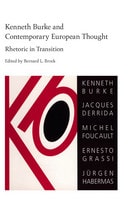
Kenneth Burke and Contemporary European Thought
Rhetoric in TransitionBernard L. Brock
University of Alabama Press, 1995
Kenneth Burke and Contemporary European Thought: A Rhetoric in Transition reflects the present transitional nature of rhetoric and society. Its purpose is to relate the rhetorical theory of Burke to the theories of four major European philosophers—Jürgen Habermas, Ernesto Grassi, Foucault, and Jacques Derrida—as they discuss the nature of language and its central role in society.
This book describes a rhetorical world in transition but not a world in chaos. It points to the centrality of symbolism in theories of language and rhetoric and illustrates Burke’s influence as a pivotal things and theorist in the communication arts and sciences, suggesting that the observations regarding shifting paradigms and perspectives made by other scholars are indeed emergent in the realm of rhetoric. It also regards the powerful impact of language and symbolic action in both the critique and construction of human knowledge and augurs a central role for rhetoric in the intellectual and social transformations of this and the next century.
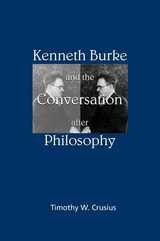
Kenneth Burke and the Conversation after Philosophy
Timothy W. Crusius
Southern Illinois University Press, 1999
Throughout much of his long life (1897–1993), Kenneth Burke was recognized as a leading American intellectual, perhaps the most significant critic writing in English since Coleridge. From about 1950 on, rhetoricians in both English and speech began to see him as a major contributor to the New Rhetoric. But despite Burke's own claims to be writing philosophy and some notice from reviewers and critics that his work was philosophically significant, Timothy W. Crusius is the first to access his work as philosophy.
Crusius traces Burke's commitment and contributions to philosophy prior to 1945, from Counter-Statement (1931) through The Philosophy of Literary Form (1941). While Burke might have been a late modernist thinker, Crusius shows that Burke actually starts from a position closely akin to such postmodern figures as Michel Foucault and Richard Rorty.
Crusius then examines Burke's work from A Grammar of Motives (1945) up to his last published essays, drawing most heavily on A Rhetoric of Motives, The Rhetoric of Religion, and uncollected essays from the 1970s. This part concerns Burke's contributions to human activities always closely associated with rhetoric-hermeneutics, dialectic, and praxis. Burke's highly developed notion of our species as the "symbol-using animal," argues Crusius, draws together the various strands of his later philosophy—his concern with interpretation, with dialectic and dialogue, with a praxis devoted to awareness and control of the self-deceiving and potentially self-destructive motives inherent in language itself.
Keywords in Creative Writing
Wendy Bishop and David Starkey
Utah State University Press, 2006
Keywords in Writing Studies
Paul Heilker
Utah State University Press, 2015
Keywords in Writing Studies is an exploration of the principal ideas and ideals of an emerging academic field as they are constituted by its specialized vocabulary. A sequel to the 1996 work Keywords in Composition Studies, this new volume traces the evolution of the field’s lexicon, taking into account the wide variety of theoretical, educational, professional, and institutional developments that have redefined it over the past two decades.
Contributors address the development, transformation, and interconnections among thirty-six of the most critical terms that make up writing studies. Looking beyond basic definitions or explanations, they explore the multiple layers of meaning within the terms that writing scholars currently use, exchange, and question. Each term featured is a part of the general disciplinary parlance, and each is a highly contested focal point of significant debates about matters of power, identity, and values. Each essay begins with the assumption that its central term is important precisely because its meaning is open and multiplex.
Keywords in Writing Studies reveals how the key concepts in the field are used and even challenged, rather than advocating particular usages and the particular vision of the field that they imply. The volume will be of great interest to both graduate students and established scholars.