Results by title
857 books match the query 'Schools' and 5 start with k
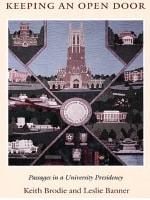
Keeping An Open Door
Passages in a University PresidencyKeith Brodie and Leslie Banner
Duke University Press, 1996
During the 1980s, many of America’s most respected colleges and universities suffered financial crises, athletic scandals, a troubling upsurge of racial conflict, and the divisiveness of political correctness “wars.” Yet Duke University not only avoided these dangers but changed dramatically from a very good regional university to one of the nation’s top research institutions. Its undergraduate campus was hailed as a “hot college”; its Blue Devils basketball team was pronounced a model for student athletes; its graduate and professional schools gained new national prominence; and its scholars were quoted frequently in the popular press on both sides of the political correctness debates.
In Keeping an Open Door, Duke chancellor (1982-1985) and president (1985-1993) Keith Brodie and coauthor Leslie Banner recount what it was like to lead Duke during an era of change for research universities across the country: how Brodie reached some of his most controversial decisions, including the “Black Faculty Initiative”; his strategy for precluding abuse in Division I athletics at Duke; how his training as a psychiatrist shaped his leadership style and influenced how he dealt with trustees, deans, faculty, and students; and the avenues of power still open to today’s university presidents. The history and feeling of life on the Duke campus during the Brodie era are vividly evoked in photographs and key speeches introduced by the former president’s personal recollections.
Keeping an Open Door provides an insider’s view of issues critical to modern research universities and will interest anyone concerned with the history and future of higher education.
[more]
Keywords in Creative Writing
Wendy Bishop and David Starkey
Utah State University Press, 2006
Keywords in Creative Writing provides a brief but comprehensive introduction to the field of creative writing through its landmark terms, exploring concerns as abstract as postmodernism and identity politics alongside very practical interests of beginning writers, like contests, agents, and royalties. This approach makes the book ideal for the college classroom, and unique in the field, combining the pragmatic accessibility of popular writer's handbooks, with a wider, more scholarly vision of theory and research.
[more]
Kid Cops
What Communities Gain and Lose from Junior Police in SchoolsMai Thai
University of Chicago Press, 2026
An on-the-ground study of junior police academies—contentious school-police partnerships that provide educational resources, career opportunities, and hope for social mobility.
Some might see police officers as benevolent sources of protection, but in many communities, they are often perceived as a threat due to a legacy of violent interactions and arrests for arbitrary offenses. How, then, do police sustain their presence in places where people might distrust them? In Kid Cops, sociologist Mai Thai offers one answer: junior police academies, high school programs in which police officers provide courses, mentorship, and job training to students in communities with high rates of juvenile delinquency and poverty. These school-police partnerships have expanded rapidly in the United States over the last few decades, largely in response to political unrest and police violence in the 1990s. Programs vary in their offerings, but they generally aim to ease tensions between communities and law enforcement, while also providing needed resources in neighborhoods where education and job opportunities are scarce.
Kid Cops draws on years of observations and interviews with educators, police officers, and, of course, kids. The junior police programs at each high school may have different emphases, but their common goal is for students to graduate from high school and enter college or the workforce. A second goal of the program is to cultivate a positive image of the police. Ultimately, however, Thai finds that these programs tighten the relationship between marginalized youth, schools, and the criminal justice system and strain the students’ relationships with their peers, families, and each other. These programs also distract residents from systemic issues of policing and suppress opportunities for meaningful change.
Written in an accessible tone that balances the seriousness of inequality with the playfulness of the study’s youth, Kid Cops moves beyond the narrative of detentions, suspensions, and arrests to tell a less conventional story about police in schools. It asks, does good, friendly policing exist—especially if it continues to tether low-income communities of color to the criminal justice system?
[more]
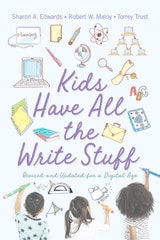
Kids Have All the Write Stuff
Revised and Updated for a Digital AgeRobert W. Maloy
University of Massachusetts Press, 2019
You can open up a world of imagination and learning for children when you encourage the expression of ideas through writing. Kids Have All the Write Stuff: Revised and Updated for a Digital Age shows you how to support children's development as confident writers and communicators, offering hundreds of creative ways to integrate writing into the lives of toddlers, preschoolers, and elementary school students—whether at home or at school.
You'll discover:
· how to implement writing as a part of daily life with family and friends;
· processes and invitations fit for young writers;
· strategies for connecting writing to math and coding;
· writing materials and technologies; and
· creative and practical writing ideas, from fiction, nonfiction, and videos to blogs and emails.
In order to connect writing to today's digital revolution, veteran educators Sharon A. Edwards, Robert W. Maloy, and Torrey Trust reveal how digital tools can inspire children to write, and a helpful companion website brings together a range of resources and technologies. This essential book offers enjoyment and inspiration to young writers!
[more]
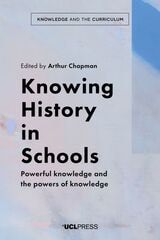
Knowing History in Schools
Powerful Knowledge and the Powers of KnowledgeEdited by Arthur Chapman
University College London, 2021
A dialogue among leading figures in history education research and practice.
The “knowledge turn” in curriculum studies has drawn attention to the central role that the knowledge of the disciplines plays in education and the need for fresh perspectives on knowledge-building. Knowing History in Schools explores these issues in the context of the discipline of history through a dialogue between the eminent sociologist of curriculum Michael Young, and leading figures in history education research and practice from a range of traditions and contexts. Focusing on Young’s “powerful knowledge” theorization of the curriculum, and on his more recent articulations of the “powers” of knowledge, this dialogue explores the many complexities facing history education. The book attempts to clarify how educators can best conceptualize knowledge-building in history education, and it will be of interest to history education students, history teachers, teacher educators, and history curriculum designers, as they navigate the challenges that knowledge-building processes pose for learning history in schools.
The “knowledge turn” in curriculum studies has drawn attention to the central role that the knowledge of the disciplines plays in education and the need for fresh perspectives on knowledge-building. Knowing History in Schools explores these issues in the context of the discipline of history through a dialogue between the eminent sociologist of curriculum Michael Young, and leading figures in history education research and practice from a range of traditions and contexts. Focusing on Young’s “powerful knowledge” theorization of the curriculum, and on his more recent articulations of the “powers” of knowledge, this dialogue explores the many complexities facing history education. The book attempts to clarify how educators can best conceptualize knowledge-building in history education, and it will be of interest to history education students, history teachers, teacher educators, and history curriculum designers, as they navigate the challenges that knowledge-building processes pose for learning history in schools.
[more]