Results by title
862 books match the query 'Social History' and 7 start with k
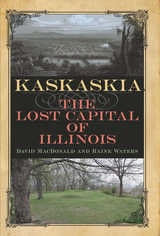
Kaskaskia
The Lost Capital of IllinoisDavid MacDonald and Raine Waters
Southern Illinois University Press, 2019
At the outset the Kaskaskia tribe, along with Jesuit missionaries and French traders, settled near the confluence of the Kaskaskia and Mississippi rivers, about sixty miles south of modern-day St. Louis. The town quickly became the largest French town and most prosperous settlement in the Illinois Country. After French control ended, Kaskaskia suffered under corrupt British and then inept American rule. In the 1790s the town revived and became the territorial capital, and in 1818 it became the first state capital. Along the way Kaskaskia was beset by disasters: crop failures, earthquakes, tornadoes, floods, epidemics, and the loss of the capital-city title to Vandalia. Likewise, human activity and industry eroded the river’s banks, causing the river to change course and eventually wash away the settlement. All that remains of the state’s first capital today is a village several miles from the original site.
MacDonald and Waters focus on the town’s growth, struggles, prosperity, decline, and obliteration, providing an overview of its domestic architecture to reveal how its residents lived. Debunking the notion of a folklore tradition about a curse on the town, the authors instead trace those stories to late nineteenth-century journalistic inventions. The result is a vibrant, heavily illustrated, and highly readable history of Kaskaskia that sheds light on the entire early history of Illinois.

Kebalian
The Dialogic Construction of Balinese IdentityMichel Picard
National University of Singapore Press, 2024
Over the past one hundred years, the Balinese have been challenged by colonial occupation, political turbulence, and, most recently, tourism. In response, they have come to rely on the idea of “Kebalian,” or Balinese-ness. Kebalian is likened to a tree whose roots are religion (agama), the trunk is tradition (adat), and the fruits, Balinese culture (budaya). To understand how this sense of Balinese-ness came to be, Michel Picard examines the dialogues that the Balinese have engaged in both among themselves and with outsiders by conducting over a hundred interviews with Balinese opinion leaders, officials, and religious reformers. A key throughline in the construction of Kebalian is what Picard identifies as a twofold process of “religionization” and “Hinduization.” This process began with the first years of the incorporation of Bali into the Dutch East Indies and became more urgent with Indonesia’s independence. Kebalian today encompasses the tension between those Balinese eager to defend their customary ritual practices and advocates of Hinduism who deny that such local traditions qualify as agama. Kebalian presents a fascinating picture of religious change, identities in motion, and culture. Scholars of religion, cultural change, and Southeast Asian area studies will find this to be a fascinating and important book.
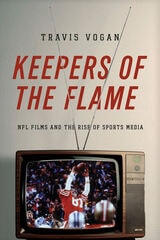
Keepers of the Flame
NFL Films and the Rise of Sports MediaTravis Vogan
University of Illinois Press, 2014
Drawing on research at the NFL Films Archive and the Pro Football Hall of Fame and interviews with media pioneer Steve Sabol and others, Travis Vogan shows how NFL Films has constructed a consistent, romanticized, and remarkably visible mythology for the National Football League. The company packages football as a visceral and dramatic sequence of violent, beautiful, graceful, and heroic gridiron battles. Historically proven formulas for presentation--such as the dramatic voiceovers once provided by John Facenda's baritone, the soaring scores of Sam Spence's rousing background music, and the epic poetry found in Steve Sabol's scripts--are still used today.
From the Vincent Price-narrated Strange but True Football Stories to the currently running series Hard Knocks, NFL Films distinguishes the NFL from other sports organizations and from other media and entertainment. Vogan tells the larger story of the company's relationship with and vast influence on our culture's representations of sport, the expansion of sports television beyond live game broadcasts, and the emergence of cable television and Internet sports media.
Keepers of the Flame: NFL Films and the Rise of Sports Media presents sports media as an integral facet of American popular culture and NFL Films as key to the transformation of professional football into the national obsession commonly known as America's Game.
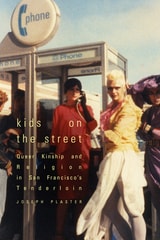
Kids on the Street
Queer Kinship and Religion in San Francisco's TenderloinJoseph Plaster
Duke University Press, 2023

Kiss the Blood Off My Hands
On Classic Film NoirEdited by Robert Miklitsch
University of Illinois Press, 2014
But a new generation of writers is pushing aside the fog of cigarette smoke surrounding classic noir scholarship. In Kiss the Blood Off My Hands: On Classic Film Noir, Robert Miklitsch curates a bold collection of essays that reassesses the genre's iconic style, history, and themes. Contributors analyze the oft-overlooked female detective and little-examined aspects of filmmaking like love songs and radio aesthetics, discuss the significance of the producer and women's pulp fiction, and investigate topics as disparate as Disney noir and the Fifties heist film, B-movie back projection and blacklisted British directors. At the same time the writers' collective reconsideration shows the impact of race and gender, history and sexuality, technology and transnationality on the genre.
As bracing as a stiff drink, Kiss the Blood Off My Hands writes the future of noir scholarship in lipstick and chalk lines for film fans and scholars alike.
Contributors: Krin Gabbard, Philippa Gates, Julie Grossman, Robert Miklitsch, Robert Murphy, Mark Osteen, Vivian Sobchack, Andrew Spicer, J. P. Telotte, and Neil Verma.

Knish
In Search of the Jewish Soul FoodLaura Silver
Brandeis University Press, 2014

Krúdy's Chronicles
Turn-of-the-Century Hungary in Gyula Krudy's JournalismJohn Batki
Central European University Press, 2000
Written during the 1910s '20s and '30s, these articles offer a wistful and nostalgic image of the waning years of the Austro-Hungarian empire, with portraits of the Habsburgs, culminating in first-hand reports in 1916, from Vienna on the funeral of Emperor Francis Joseph I, and from Budapest on the coronation of Charles IV, the last king of Hungary. Krúdy's reports follow the bloodless democratic revolution of 1918, the Károlyi government and the short-lived Soviet Republic, and present cameos of the leading political figures of the day such as Ferenc Kossuth, Mihály Károlyi and Béla Kun.
In his lively, casual pieces Krúdy displays his intimate knowledge of Hungarian society with a special emphasis on literature and publishing.