Results by title
479 books match the query 'Sources' and 4 start with k
Kansas’s War
The Civil War in DocumentsPearl T. Ponce
Ohio University Press, 2011
When the Civil War broke out in April 1861, Kansas was in a unique position. It had been a state for mere weeks, and already its residents were intimately acquainted with civil strife. Since its organization as a territory in 1854, Kansas had been the focus of a national debate over the place of slavery in the Republic. By 1856, the ideological conflict developed into actual violence, earning the territory the sobriquet “Bleeding Kansas.” Because of this steady escalation in violence, the state’s transition from peace to war was not as abrupt as that of other states.
Kansas’s War illuminates the new state’s main preoccupations: the internal struggle for control of policy and patronage; border security; and issues of race—especially efforts to come to terms with the burgeoning African American population and Native Americans’ coninuing claims to nearly one-fifth of the state’s land. These documents demonstrate how politicians, soldiers, and ordinary Kansans were transformed by the war.
Kaqchikel Chronicles
The Definitive EditionWith translation and exegesis by Judith M. Maxwell and Robert M. Hill II
University of Texas Press, 2006
The collection of documents known as the Kaqchikel Chronicles consists of rare highland Maya texts, which trace Kaqchikel Maya history from their legendary departure from Tollan/Tula through their migrations, wars, the Spanish invasion, and the first century of Spanish colonial rule. The texts represent a variety of genres, including formal narrative, continuous year-count annals, contribution records, genealogies, and land disputes.
While the Kaqchikel Chronicles have been known to scholars for many years, this volume is the first and only translation of the texts in their entirety. The book includes two collections of documents, one known as the Annals of the Kaqchikels and the other as the Xpantzay Cartulary. The translation has been prepared by leading Mesoamericanists in collaboration with Kaqchikel-speaking linguistic scholars. It features interlinear glossing, which allows readers to follow the translators in the process of rendering colonial Kaqchikel into modern English. Extensive footnoting within the text restores the depth and texture of cultural context to the Chronicles. To put the translations in context, Judith Maxwell and Robert Hill have written a full scholarly introduction that provides the first modern linguistic discussion of the phonological, morphological, syntactic, and pragmatic structure of sixteenth-century Kaqchikel. The translators also tell a lively story of how these texts, which derive from pre-contact indigenous pictographic and cartographic histories, came to be converted into their present form.
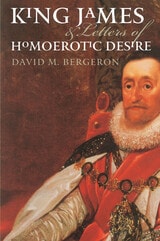
King James and Letters of Homoerotic Desire
David M. Bergeron
University of Iowa Press, 1999
What can we know of the private lives of early British sovereigns? Through the unusually large number of letters that survive from King James VI of Scotland/James I of England (1566-1625), we can know a great deal. Using original letters, primarily from the British Library and the National Library of Scotland, David Bergeron creatively argues that James' correspondence with certain men in his court constitutes a gospel of homoerotic desire. Bergeron grounds his provocative study on an examination of the tradition of letter writing during the Renaissance and draws a connection between homosexual desire and letter writing during that historical period.
King James, commissioner of the Bible translation that bears his name, corresponded with three principal male favorites—Esmé Stuart (Lennox), Robert Carr (Somerset), and George Villiers (Buckingham). Esmé Stuart, James' older French cousin, arrived in Scotland in 1579 and became an intimate adviser and friend to the adolescent king. Though Esmé was eventually forced into exile by Scottish nobles, his letters to James survive, as does James' hauntingly allegorical poem Phoenix. The king's close relationship with Carr began in 1607. James' letters to Carr reveal remarkable outbursts of sexual frustration and passion.
A large collection of letters exchanged between James and Buckingham in the 1620s provides the clearest evidence for James' homoerotic desires. During a protracted separation in 1623, letters between the two raced back and forth. These artful, self-conscious letters explore themes of absence, the pleasure of letters, and a preoccupation with the body. Familial and sexual terms become wonderfully intertwined, as when James greets Buckingham as "my sweet child and wife."
King James and Letters of Homoerotic Desire presents a modern-spelling edition of seventy-five letters exchanged between Buckingham and James. Across the centuries, commentators have condemned the letters as indecent or repulsive. Bergeron argues that on the contrary they reveal an inward desire of king and subject in a mutual exchange of love.
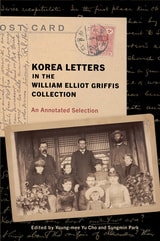
Korea Letters in the William Elliot Griffis Collection
An Annotated SelectionYoung-mee Yu Cho
Rutgers University Press, 2024
The Korean materials in the Griffis Collection at Rutgers University consist of journals, correspondence, articles, maps, prints, photos, postcards, manuscripts, scrapbooks, and ephemera. These papers reflect Griffis's interests and activities in relation to Korea as a historian, scholar, and theologian. They provide a rare window into the turbulent period of late nineteenth- and twentieth-century Korea, witnessed and evaluated by Griffis and early American missionaries in East Asia. The Korea Letters in the William Elliot Griffis Collection are divided into two parts: letters from missionaries and letters from Japanese and Korean political figures. Newly available and accessible through this collection, these letters develop a multifaceted history of early American missionaries in Korea, the Korean independence movement, and Griffis's views on Korean culture.