Results by title
2284 books match the query 'Women' and 8 start with k
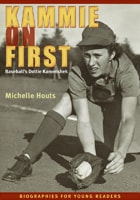
Kammie on First
Baseball’s Dottie KamenshekMichelle Houts
Ohio University Press, 2014
Dorothy Mary Kamenshek was born to immigrant parents in Norwood, Ohio. As a young girl, she played pickup games of sandlot baseball with neighborhood children; no one, however, would have suspected that at the age of seventeen she would become a star athlete at the national level.
The outbreak of World War II and the ensuing draft of able-bodied young men severely depleted the ranks of professional baseball players. In 1943, Philip K. Wrigley, owner of the Chicago Cubs, led the initiative to establish a new league—a women’s league—to fill the ballparks while the war ground on in Europe and the Pacific. Kamenshek was selected and assigned to the Rockford Peaches in their inaugural season and played first base for a total of ten years, becoming a seven-time All-Star and holder of two league batting titles. When injuries finally put an end to her playing days, she went on to a successful and much quieter career in physical therapy. Fame came again in 1992, when Geena Davis portrayed a player loosely based on Kamenshek in the hit movie A League of Their Own.
Kammie on First is a real-life tale that will entertain and inspire young readers, both girls and boys. It is the first book in a new series, Biographies for Young Readers, from Ohio University Press.
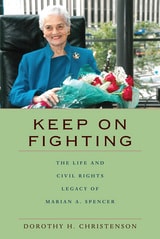
Keep On Fighting
The Life and Civil Rights Legacy of Marian A. SpencerDorothy H. Christenson
Ohio University Press, 2015
Marian Alexander Spencer was born in 1920 in the Ohio River town of Gallipolis, Ohio, one year after the “Red Summer” of 1919 that saw an upsurge in race riots and lynchings. Following the example of her grandfather, an ex-slave and community leader, Marian joined the NAACP at thirteen and grew up to achieve not only a number of civic leadership firsts in her adopted home city of Cincinnati, but a legacy of lasting civil rights victories.
Of these, the best known is the desegregation of Cincinnati’s Coney Island amusement park. She also fought to desegregate Cincinnati schools and to stop the introduction of observers in black voting precincts in Ohio. Her campaign to raise awareness of industrial toxic-waste practices in minority neighborhoods was later adapted into national Superfund legislation.
In 2012, Marian’s friend and colleague Dot Christenson sat down with her to record her memories. The resulting biography not only gives us the life story of remarkable leader but encapsulates many of the twentieth century’s greatest struggles and advances. Spencer’s story will prove inspirational and instructive to citizens and students alike.
Kenya's Running Women
A HistoryMichelle M Sikes
Michigan State University Press, 2023
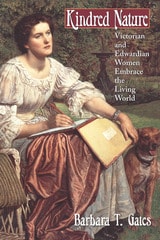
Kindred Nature
Victorian and Edwardian Women Embrace the Living WorldBarbara T. Gates
University of Chicago Press, 1999
Some of these women discovered previously unknown species, others wrote and illustrated natural histories or animal stories, and still others educated women, the working classes, and children about recent scientific advances. A number of women also played pivotal roles in the defense of animal rights by protesting overhunting, vivisection, and habitat destruction, even as they demanded their own rights to vote, work, and enter universities.
Kindred Nature shows the enormous impact Victorian and Edwardian women had on the natural sciences and the environmental movement, and on our own attitudes toward nature and human nature.
Kinshasa in Transition
Women's Education, Employment, and FertilityDavid Shapiro and B. Oleko Tambashe
University of Chicago Press, 2003
In this book, David Shapiro and B. Oleko Tambashe trace the impact of these changes on the lives of women, and their findings add dramatically to the field's limited knowledge of African demographic trends. They find that fertility has declined significantly in Kinshasa since the 1970s, and that women's increasing access to secondary education has played a key role in this decline. Better access to education has also given women greater access to employment opportunities. And by examining the impact of such factors as economic well-being and household demographic composition on the schooling of children, Shapiro and Tambashe reveal how one generation's fertility affects the next generation's education.
This book will be a valuable guide for anyone who wants to understand the complex and ongoing social, demographic, economic, and developmental changes in contemporary sub-Saharan Africa.

Kissed By
Alexandra Chasin
University of Alabama Press, 2007
"Alexandra Chasin is a hugely brave writer. She dares to push the extremes of style, while daring to push the extremes of emotion" —Jonathan Safran Foer
Alexandra Chasin’s remarkable stories employ forms as diverse as cryptograms (in "ELENA=AGAIN") and sentence diagrams (in "Toward a Grammar of Guilt") to display her interest in fiction as a form constituted by print on the page, every bit as much as poetry.
In "They Come From Mars," the words are arrayed on the page like troops, embodying the xenophobic image of invading armies of immigrant and illegal aliens that animates the narrative. One story incorporates personal ads ("Lynette, Your Uniqueness"), another is organized alphabetically ("2 Alphabets"), while another leaves sentences unfinished ("Composer and I"). A number of stories take metafictional turns, calling attention to the process of writing itself. The last piece in the collection plays with genre distinctions, including an index of first lines and a general index. Set in New York, New England, Paris, and Morocco, these tales are narrated by men and women, old and young, gay, straight, and bisexual; one narrator is not a person at all, but a work of art. Each of these deft, playful, and sometimes anarchic fictions is different from the others, yet all are the unmistakable offspring of the same wildly inventive imagination.
Kitchenspace
Women, Fiestas, and Everyday Life in Central MexicoBy Maria Elisa Christie
University of Texas Press, 2008
Throughout the world, the kitchen is the heart of family and community life. Yet, while everyone has a story to tell about their grandmother's kitchen, the myriad activities that go on in this usually female world are often devalued, and little scholarly attention has been paid to this crucial space in which family, gender, and community relations are forged and maintained. To give the kitchen the prominence and respect it merits, Maria Elisa Christie here offers a pioneering ethnography of kitchenspace in three central Mexican communities, Xochimilco, Ocotepec, and Tetecala.
Christie coined the term "kitchenspace" to encompass both the inside kitchen area in which everyday meals for the family are made and the larger outside cooking area in which elaborate meals for community fiestas are prepared by many women working together. She explores how both kinds of meal preparation create bonds among family and community members. In particular, she shows how women's work in preparing food for fiestas gives women status in their communities and creates social networks of reciprocal obligation. In a culture rigidly stratified by gender, Christie concludes, kitchenspace gives women a source of power and a place in which to transmit the traditions and beliefs of older generations through quasi-sacramental food rites.
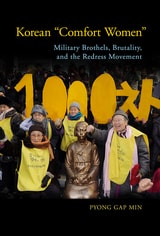
Korean "Comfort Women"
Military Brothels, Brutality, and the Redress MovementPyong Gap Min
Rutgers University Press, 2021
Korean “Comfort Women” synthesizes the previous major findings about Japanese military sexual slavery and legal recommendations, and provides new findings about the issues “comfort women” faced for an English-language audience. It also examines the transnational redress movement, revealing that the Japanese government has tried to conceal the crime of sexual slavery and to resolve the women’s human rights issue with diplomacy and economic power.