Results by title
2194 books match the query 'Women's Studies' and 9 start with k

Kaija Saariaho
Pirkko Moisala
University of Illinois Press, 2008
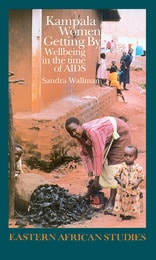
Kampala Women Getting By
Wellbeing in the Time of AIDSSandra Wallman
Ohio University Press, 1996
What do ordinary women in an African city do in the face of “serious enough” infections in themselves and signs of acute illness in their young children? How do they manage? What does it take to get by? How do they maintain the wellbeing of the household in a setting without what would be considered as basic health provision in an American or European city?
Professor Wallman focuses on women in a densely-populated part of Kampala called Kamwokya. With the help of a team of Ugandans and non-Ugandans, a vivid picture emerges, enhanced by color photographs, sketches and maps.
Women are largely responsible for the management of illness in all members of the family. Young children are at particular risk and the women have to take the first crucial decisions about treatment. Formal health resources are scarce and so they most often resort to an extraordinary range of treatments provided in the informal economy. A holistic picture of all the options that local people recognize is drawn, and an enriched understanding of problems and opportunities for health care in tropical cities emerges.
Multidisciplinary work on sexually transmitted disease is rare, even in this time of AIDS, and the book effectively maps the social contexts of its perception and management. Moreover, it focuses on women as ordinary citizens, selected by residence and not by reference to known medical conditions or high risk behavior. It is important too that the field strategies have encouraged local informants to become active participants in the definition of local problems and their solutions.

Kicking Center
Gender and the Selling of Women's Professional SoccerAllison, Rachel
Rutgers University Press, 2018
Girls and young women participate in soccer at record levels and the Women’s National Team regularly draws media, corporate, and popular attention. Yet despite increased representation and visibility, gender disparities in opportunity, compensation, training resources, and media airtime persist in soccer, and two professional leagues for women have failed since 2000.
In Kicking Center, Rachel Allison investigates a women’s soccer league seeking to break into the male-dominated center of U.S. professional sport. Through an examination of the challenges and opportunities identified by those working for and with this league, she demonstrates how gender inequality is both constructed and contested in professional sport. Allison details the complex constructions of race, class, gender, and sexuality in the selling and marketing of women’s soccer in a half-changed sports landscape characterized by both progress and backlash, and where professional sports are still understood to be men’s territory.
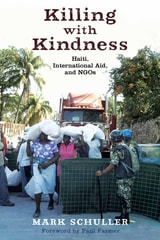
Killing with Kindness
Haiti, International Aid, and NGOsSchuller, Mark
Rutgers University Press, 2012
Winner of the 2015 Margaret Mead Award from the American Anthropological Association and the Society for Applied Anthropology
After Haiti’s 2010 earthquake, over half of U.S. households donated to thousands of nongovernmental organizations (NGOs) in that country. Yet we continue to hear stories of misery from Haiti. Why have NGOs failed at their mission?
Set in Haiti during the 2004 coup and aftermath and enhanced by research conducted after the 2010 earthquake, Killing with Kindness analyzes the impact of official development aid on recipient NGOs and their relationships with local communities. Written like a detective story, the book offers rich ethnographic comparisons of two Haitian women’s NGOs working in HIV/AIDS prevention, one with public funding (including USAID), the other with private European NGO partners. Mark Schuller looks at participation and autonomy, analyzing donor policies that inhibit these goals. He focuses on NGOs’ roles as intermediaries in “gluing” the contemporary world system together and shows how power works within the aid system as these intermediaries impose interpretations of unclear mandates down the chain—a process Schuller calls “trickle-down imperialism.”

Kindred Nature
Victorian and Edwardian Women Embrace the Living WorldBarbara T. Gates
University of Chicago Press, 1999
Some of these women discovered previously unknown species, others wrote and illustrated natural histories or animal stories, and still others educated women, the working classes, and children about recent scientific advances. A number of women also played pivotal roles in the defense of animal rights by protesting overhunting, vivisection, and habitat destruction, even as they demanded their own rights to vote, work, and enter universities.
Kindred Nature shows the enormous impact Victorian and Edwardian women had on the natural sciences and the environmental movement, and on our own attitudes toward nature and human nature.
Kinshasa in Transition
Women's Education, Employment, and FertilityDavid Shapiro and B. Oleko Tambashe
University of Chicago Press, 2003
In this book, David Shapiro and B. Oleko Tambashe trace the impact of these changes on the lives of women, and their findings add dramatically to the field's limited knowledge of African demographic trends. They find that fertility has declined significantly in Kinshasa since the 1970s, and that women's increasing access to secondary education has played a key role in this decline. Better access to education has also given women greater access to employment opportunities. And by examining the impact of such factors as economic well-being and household demographic composition on the schooling of children, Shapiro and Tambashe reveal how one generation's fertility affects the next generation's education.
This book will be a valuable guide for anyone who wants to understand the complex and ongoing social, demographic, economic, and developmental changes in contemporary sub-Saharan Africa.

Klondike Women
True Tales of the 1897–1898 Gold RushMelanie J. Mayer
Ohio University Press, 1989
Challenging the myth that the only women who participated in gold rushes were prostitutes and gold-diggers of the euphemistic sort, Melanie Mayer shows us that Klondike women came from all walks of life—socialites to poor immigrants, single women, wives, widows, and children. They planned to make their money through many different undertakings including mining, business, entertainment, professional, and service enterprises. Their approaches to life were as varied as their roles—optimistic or skeptical; cautious or adventuresome; gregarious or self-contained; contemplative or active. There was no typical Klondike woman. Individually, their stories can be funny, hopeful, tragic, or poignant. Taken together, they give rich, complex images of the people, times, and places of the gold rush.
A visually exciting book, Klondike Women features over 150 photographs and illustrations. This volume should appeal not only to the general reader, but to those interested in history, women’s studies, and the Pacific Northwest as well.
Knowing What We Know
African American Women's Experiences of Violence and ViolationGarfield, Gail
Rutgers University Press, 2005
In recent years there has been an attempt by activists, service providers, and feminists to think about violence against women in more inclusive ways. In Knowing What We Know, activist and sociologist Gail Garfield argues that this effort has not gone far enough and that in order to understand violence, we must take the lived experiences of African American women seriously. Doing so, she cautions, goes far beyond simply adding voices of black women to existing academic and activist discourses, but rather, requires a radical shift in our knowledge of these women’s lives and the rhetoric used to describe them.
Bringing together a series of life-history interviews with nine women, this unique study urges a departure from established approaches that position women as victims of exclusively male violence. Instead, Garfield explores what happens when women’s ability to make decisions and act upon those choices comes into conflict with cultural and social constraints. Chapters explore how women experience racialized or class-based violence, how these forms of violence are related to gendered violence, and what these violations mean to a woman’s sense of identity. By showing how women maintain, sustain, and in some instances regain their sense of human worth as a result of their experiences of violation, Garfield complicates the existing dialogue on violence against women in new and important ways.
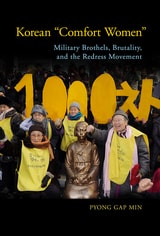
Korean "Comfort Women"
Military Brothels, Brutality, and the Redress MovementPyong Gap Min
Rutgers University Press, 2021
Korean “Comfort Women” synthesizes the previous major findings about Japanese military sexual slavery and legal recommendations, and provides new findings about the issues “comfort women” faced for an English-language audience. It also examines the transnational redress movement, revealing that the Japanese government has tried to conceal the crime of sexual slavery and to resolve the women’s human rights issue with diplomacy and economic power.