Results by title
1441 books match the query 'World' and 7 start with k

Keep True
A Life in PoliticsHoward Pawley
University of Manitoba Press, 2011
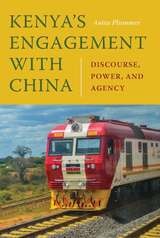
Kenya's Engagement with China
Discourse, Power, and AgencyAnita Plummer
Michigan State University Press, 2022

King of the World
The Life of Louis XIVPhilip Mansel
University of Chicago Press, 2020
Philip Mansel’s King of the World is the most comprehensive and up-to-date biography in English of this hypnotic, flawed figure who continues to captivate our attention. This lively work takes Louis outside Versailles and shows the true extent of his global ambitions, with stops in London, Madrid, Constantinople, Bangkok, and beyond. We witness the importance of his alliance with the Spanish crown and his success in securing Spain for his descendants, his enmity with England, and his relations with the rest of Europe, as well as Asia, Africa, and the Americas. We also see the king’s effect on the two great global diasporas of Huguenots and Jacobites, and their influence on him as he failed in his brutal attempts to stop Protestants from leaving France. Along the way, we are enveloped in the splendor of Louis’s court and the fascinating cast of characters who prostrated and plotted within it.
King of the World is exceptionally researched, drawing on international archives and incorporating sources who knew the king intimately, including the newly released correspondence of Louis’s second wife, Madame de Maintenon. Mansel’s narrative flair is a perfect match for this grand figure, and he brings the Sun King’s world to vivid life.
This is a global biography of a global king, whose power was extensive but also limited by laws and circumstances, and whose interests and ambitions stretched far beyond his homeland. Through it all, we watch Louis XIV progressively turn from a dazzling, attractive young king to a belligerent reactionary who sets France on the path to 1789. It is a convincing and compelling portrait of a man who, three hundred years after his death, still epitomizes the idea of le grand monarque.
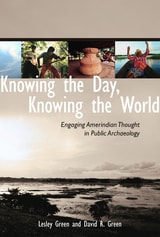
Knowing the Day, Knowing the World
Engaging Amerindian Thought in Public ArchaeologyLesley Green and David R. Green
University of Arizona Press, 2013
The structure of the book reflects a gradual comprehension of Palikur ways of knowing during the course of field research. The text enters into the ethnographic material from the perspective of familiar disciplines—history, geography, astronomy, geometry, and philosophy—and explores the junctures in which conventional disciplinary frameworks cannot adequately convey Palikur understandings. Beginning with reflections on questions of personhood, ethics, and ethnicity, the authors rethink assumptions about history and geography. They learn and recount an alternative way of thinking about astronomy from the Palikur astronomical narratives, and they show how topological concepts embedded in everyday Palikur speech extend to different ways of conceptualizing landscape. In conclusion, they reflect on the challenges of comprehending alternative cosmologies and consider the insights that come from allowing ethnographic material to pose questions of modernist frameworks.
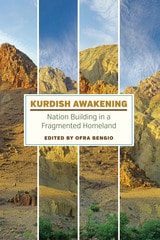
Kurdish Awakening
Nation Building in a Fragmented HomelandEdited by Ofra Bengio
University of Texas Press, 2014
Kurdish Awakening examines key questions related to Kurdish nationalism and identity formation in Syria, Iraq, Iran, and Turkey. The world’s largest stateless ethnic group, Kurds have steadily grown in importance as a political power in the Middle East, particularly in light of the “Arab Spring.” As a result, Kurdish issues—political, cultural, and historical alike—have emerged as the subject of intense scholarly interest. This book provides fresh ways of understanding the historical and sociopolitical underpinnings of the ongoing Kurdish awakening and its already significant impact on the region.
Rather than focusing on one state or angle, this anthology fills a gap in the literature on the Kurds by providing a panoramic view of the Kurdish homeland’s various parts. The volume focuses on aspects of Kurdish nationalism and identity formation not addressed elsewhere, including perspectives on literature, gender, and constitution making. Further, broad thematic essays include a discussion of the historical experiences of the Kurds from the time of their Islamization more than a millennium ago up until the modern era, a comparison of the Kurdish experience with other ethno-national movements, and a treatment of the role of tribalism in modern nation building. This collection is unique in its use of original sources in various languages. The result is an analytically rich portrayal that sheds light on the Kurds’ prospects and the challenges they confront in a region undergoing sweeping upheavals.
Kurdish Women's Stories
Houzan Mahmoud
Pluto Press, 2020
'A fascinating, inspiring journey' - Meredith Tax, author of A Road Unforeseen
Kurdistan has had a tumultuous history, and the women who lived there have experienced life like no other. From Saddam Hussein’s reign of terror beginning in the 1960s, to the fight against ISIS today, violence, revolution, and questions around identity, agency, survival, and resistance have been at the forefront of women’s lives for decades.
This book is a collection of these women’s stories written in their own words. Each story reveals a tapestry of experiences, including political activism under Saddam and armed resistance in Rojava’s PKK and YPG and Komala in Rojhalat. This is in addition to experiences of FGM and overcoming victimhood, life under extreme conservatism, as well as a look into the work of artists, poets, novelists, and performers whose work represents a complicated relationship with Kurdistan.
These rich and nuanced insights come from a group of women from a nation without a state, who are now scattered across the world. Collectively, they take the reader on a journey that will inspire feminist, anti-fascist, and anti-racist people across the world.
Kuxlejal Politics
Indigenous Autonomy, Race, and Decolonizing Research in Zapatista CommunitiesBy Mariana Mora
University of Texas Press, 2017
Over the past two decades, Zapatista indigenous community members have asserted their autonomy and self-determination by using everyday practices as part of their struggle for lekil kuxlejal, a dignified collective life connected to a specific territory. This in-depth ethnography summarizes Mariana Mora’s more than ten years of extended research and solidarity work in Chiapas, with Tseltal and Tojolabal community members helping to design and evaluate her fieldwork. The result of that collaboration—a work of activist anthropology—reveals how Zapatista kuxlejal (or life) politics unsettle key racialized effects of the Mexican neoliberal state.
Through detailed narratives, thick descriptions, and testimonies, Kuxlejal Politics focuses on central spheres of Zapatista indigenous autonomy, particularly governing practices, agrarian reform, women’s collective work, and the implementation of justice, as well as health and education projects. Mora situates the proposals, possibilities, and challenges associated with these decolonializing cultural politics in relation to the racialized restructuring that has characterized the Mexican state over the past twenty years. She demonstrates how, despite official multicultural policies designed to offset the historical exclusion of indigenous people, the Mexican state actually refueled racialized subordination through ostensibly color-blind policies, including neoliberal land reform and poverty alleviation programs. Mora’s findings allow her to critically analyze the deeply complex and often contradictory ways in which the Zapatistas have reconceptualized the political and contested the ordering of Mexican society along lines of gender, race, ethnicity, and class.