Results by title
991 books match the query 'Writing' and 5 start with k
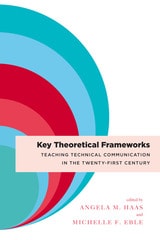
Key Theoretical Frameworks
Teaching Technical Communication in the Twenty-First CenturyAngela M. Haas
Utah State University Press, 2018
The collection provides a valuable resource for teachers new to translating social justice theories to the classroom by presenting concrete examples related to technical communication. Each contribution adopts a particular theoretical approach, explains the theory, situates it within disciplinary scholarship, contextualizes the approach from the author’s experience, and offers additional teaching applications.
The first volume of its kind, Key Theoretical Frameworks for Teaching Technical Communication in the Twenty-First Century links the theoretical with the pedagogical in order to articulate, use, and assess social justice frameworks for designing and teaching courses in technical communication.
Contributors: Godwin Y. Agboka, Matthew Cox, Marcos Del Hierro, Jessica Edwards, Erin A. Frost, Elise Verzosa Hurley, Natasha N. Jones, Cruz Medina, Marie E. Moeller, Kristen R. Moore, Donnie Johnson Sackey, Gerald Savage, J. Blake Scott, Barbi Smyser-Fauble, Kenneth Walker, Rebecca Walton
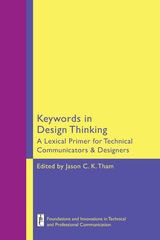
Keywords in Design Thinking
A Lexical Primer for Technical Communicators and DesignersJason C. K. Tham
University Press of Colorado, 2023
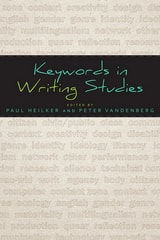
Keywords in Writing Studies
Paul Heilker
Utah State University Press, 2015
Keywords in Writing Studies is an exploration of the principal ideas and ideals of an emerging academic field as they are constituted by its specialized vocabulary. A sequel to the 1996 work Keywords in Composition Studies, this new volume traces the evolution of the field’s lexicon, taking into account the wide variety of theoretical, educational, professional, and institutional developments that have redefined it over the past two decades.
Contributors address the development, transformation, and interconnections among thirty-six of the most critical terms that make up writing studies. Looking beyond basic definitions or explanations, they explore the multiple layers of meaning within the terms that writing scholars currently use, exchange, and question. Each term featured is a part of the general disciplinary parlance, and each is a highly contested focal point of significant debates about matters of power, identity, and values. Each essay begins with the assumption that its central term is important precisely because its meaning is open and multiplex.
Keywords in Writing Studies reveals how the key concepts in the field are used and even challenged, rather than advocating particular usages and the particular vision of the field that they imply. The volume will be of great interest to both graduate students and established scholars.
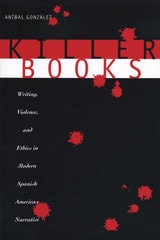
Killer Books
Writing, Violence, and Ethics in Modern Spanish American NarrativeBy Aníbal González
University of Texas Press, 2002
Writing and violence have been inextricably linked in Spanish America from the Conquest onward. Spanish authorities used written edicts, laws, permits, regulations, logbooks, and account books to control indigenous peoples whose cultures were predominantly oral, giving rise to a mingled awe and mistrust of the power of the written word that persists in Spanish American culture to the present day.
In this masterful study, Aníbal González traces and describes how Spanish American writers have reflected ethically in their works about writing's relation to violence and about their own relation to writing. Using an approach that owes much to the recent "turn to ethics" in deconstruction and to the works of Jacques Derrida and Emmanuel Levinas, he examines selected short stories and novels by major Spanish American authors from the late nineteenth through the twentieth centuries: Manuel Gutiérrez Nájera, Manuel Zeno Gandía, Teresa de la Parra, Jorge Luis Borges, Alejo Carpentier, Gabriel García Márquez, and Julio Cortázar. He shows how these authors frequently display an attitude he calls "graphophobia," an intense awareness of the potential dangers of the written word.
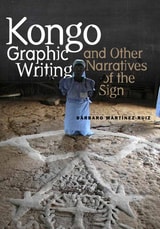
Kongo Graphic Writing and Other Narratives of the Sign
Barbaro Martinez-Ruiz
Temple University Press, 2013
Author Bárbaro Martínez-Ruiz, a practitioner of the Palo Monte devotional arts, illustrates with graphics and rock art how the Bakongo’s ideographic and pictographic signs are used to organize daily life, enable interactions between humans and the natural and spiritual worlds, and preserve and transmit cosmological and cosmogonical belief systems.
Exploring cultural diffusion and exchange, collective memory and identity, Kongo Graphic Writing and Other Narratives of the Sign artfully brings together analyses of the complex interconnections among Kongo traditions of religion, philosophy and visual/gestural communication on both sides of the African Atlantic world.