Results by title
482 books match the query '17th Century' and 10 start with l
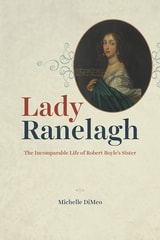
Lady Ranelagh
The Incomparable Life of Robert Boyle's SisterMichelle DiMeo
University of Chicago Press, 2021
Philosophers, mathematicians, politicians, and religious authorities sought her opinion on everything from decimalizing the currency to producing Hebrew grammars. She practiced medicine alongside distinguished male physicians, treating some of the most elite patients in London. Her medical recipes, political commentaries, and testimony concerning the philosophers’ stone gained international circulation. She was an important influence on Boyle and a formidable thinker in her own right.
Drawing from a wealth of new archival sources, Michelle DiMeo fills out Lady Ranelagh’s legacy in the context of a historically sensitive and nuanced interpretation of gender, science, and religion. The book re-creates the intellectual life of one of the most respected and influential women in seventeenth-century Europe, revealing how she managed to gain the admiration of diverse contemporaries, effect social change, and shape contemporary science.
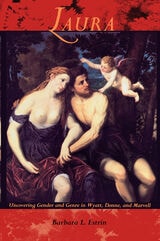
Laura
Uncovering Gender and Genre in Wyatt, Donne and MarvellBarbara L. Estrin
Duke University Press, 1994
Through close readings of the Rime sparse and the works of Wyatt, Donne, and Marvell, Estrin uncovers three Lauras: Laura-Daphne, who denies sexuality; Laura-Eve, who returns the poet’s love; and Laura-Mercury, who reinvents her own life. Estrin claims that in these three guises Laura subverts both genre and gender, thereby introducing multiple desires into the many layers of the poems. Drawing upon genre and gender theories advanced by Jean-François Lyotard and Judith Butler to situate female desire in the poem’s framework, Estrin shows how genre and gender in the Petrarchan tradition work together to undermine the stability of these very concepts.
Estrin’s Laura constitutes a fundamental reconceptualization of the Petrarchan tradition and contributes greatly to the postmodern reassessment of the Renaissance period. In its descriptions of how early modern poets formulate questions about sexuality, society and poetry, Laura will appeal to scholars of the English and Italian Renaissance, of gender studies, and of literary criticism and theory generally.
Lear’s Other Shadow
A Cultural History of Queen LearThomas G. Olsen
University of Delaware Press, 2025
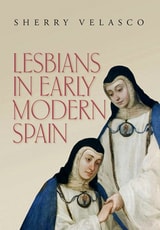
Lesbians in Early Modern Spain
Sherry Velasco
Vanderbilt University Press, 2011
The women in these accounts, stories, and cases range from internationally famous transgendered celebrities to lesbian criminals, from those suspected of "special friendships" in the convent to ordinary villagers.
Velasco argues that the diverse and recurrent representations of lesbian desire provide compelling evidence of how different groups perceived intimacy between women as more than just specific sex acts. At times these narratives describe complex personal relationships and occasionally characterize these women as being of a certain "type," suggesting an early modern precursor to what would later be recognized as divergent lesbian, bisexual, and transgender identities.
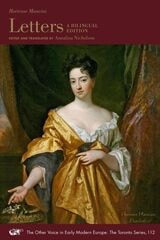
Letters
A Bilingual EditionHortense Mancini
Iter Press, 2025
During the seventeenth century, Hortense Mancini, Duchess of Mazarin (1646–99), became an icon of women’s emancipation. In 1668, she shocked Europe when she fled her coercive husband and began a nomadic exile. Her notoriety increased in 1675 with the publication of her memoir—one of the first to appear in French by a woman—and was later magnified by her stint as the royal mistress of Charles II of England and by her establishment of a freethinking salon in London. As a salonnière, an exile, and a litigant fighting for legal separation from her husband, Mancini’s letters were a means of connection, collusion, and survival as well as cultural collaboration. Collected and translated here for the first time, this correspondence charts her struggle for autonomy in her own words.
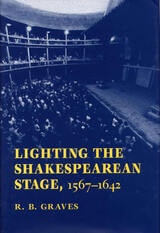
Lighting the Shakespearean Stage, 1567 - 1642
R. B. Graves
Southern Illinois University Press, 1999
In Lighting the Shakespearean Stage, 1567–1642,R. B. Graves examines the lighting of early modern English drama from both historical and aesthetic perspectives. He traces the contrasting traditions of sunlit amphitheaters and candlelit hall playhouses, describes the different lighting techniques, and estimates the effect of these techniques both indoors and outdoors.
Graves discusses the importance of stage lighting in determining the dramatic effect, even in cases where the manipulation of light was not under the direct control of the theater artists. He devotes a chapter to the early modern lighting equipment available to English Renaissance actors and surveys theatrical lighting before the construction of permanent playhouses in London. Elizabethan stage lighting, he argues, drew on both classical and medieval precedents.
Lines of Thought
Discourse, Architectonics, and the Origin of Modern PhilosophyClaudia Brodsky Lacour
Duke University Press, 1996
While Cartesianism has long served as a synonym for rationalism, the contents of Descartes’s method and cogito have remained infamously resistant to rational analysis. Similarly, although modern phenomenological analyses descend from Descartes’s notion of intuition, the “things” Cartesian intuitions represent bear no resemblance to phenomena. By returning to what Descartes calls the construction of his “foundation” in the Discours, Brodsky Lacour identifies the conceptual problems at the root of Descartes’s literary and aesthetic theory as well as epistemology. If, for Descartes, linear extension and “I” are the only “things” we can know exist, the Cartesian subject of thought, she shows, derives first from the intersection of discourse and drawing, representation and matter. The crux of that intersection, Brodsky Lacour concludes, is and must be the cogito, Descartes’s theoretical extension of thinking into material being. Describable in accordance with the Géométrie as a freely constructed line of thought, the cogito, she argues, extends historically to link philosophy with theories of discursive representation and graphic delineation after Descartes. In conclusion, Brodsky Lacour analyzes such a link in the writings of Claude Perrault, the architectural theorist whose reflections on beauty helped shape the seventeenth-century dispute between “the ancients and the moderns.”
Part of a growing body of literary and interdisciplinary considerations of philosophical texts, Lines of Thought will appeal to theorists and historians of literature, architecture, art, and philosophy, and those concerned with the origin and identity of the modern.

Literal Figures
Puritan Allegory and the Reformation Crisis in RepresentationThomas H. Luxon
University of Chicago Press, 1995
Why did Puritan Christianity repeatedly turn to allegorical forms of representation in spite of its own intolerance of "Allegorical fancies?" Luxon demonstrates that Protestant doctrine itself was a kind of allegory in hiding, one that enabled Puritans to forge a figural view of reality while championing the "literal" and the "historical". He argues that for Puritanism to survive its own literalistic, anti-symbolic, and millenarian challenges, a "fall" back into allegory was inevitable. Representative of this "fall," The Pilgrim's Progress marks the culminating moment at which the Reformation's war against allegory turns upon itself. An essential work for understanding both the history and theory of representation and the work of John Bunyan, Literal Figures skillfully blends historical and critical methods to describe the most important features of early modern Protestant and Puritan culture.
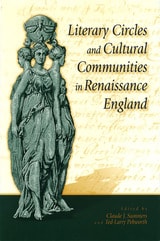
Literary Circles and Cultural Communities in Renaissance England
Edited by Claude J. Summers & Ted-Larry Pebworth
University of Missouri Press, 2001
Although the literary circle is widely recognized as a significant feature of Renaissance literary culture, it has received remarkably little examination. In this collection of essays, the authors attempt to explain literary circles and cultural communities in Renaissance England by exploring both actual and imaginary ways in which they were conceived and the various needs they fulfilled. The book also pays considerable attention to larger theoretical issues relating to literary circles.
The essayists raise important questions about the extent to which literary circles were actual constructs or fictional creations. Whether illuminating or limiting, the circle metaphor itself can be extended or reformulated. Some of the authors discuss how particular circles actually operated, and some question the very concept of the literary circle. Literary Circles and Cultural Communities in Renaissance England will be an important addition to seventeenth-century studies.
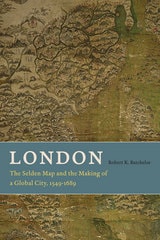
London
The Selden Map and the Making of a Global City, 1549-1689Robert K. Batchelor
University of Chicago Press, 2013