Results by title
60 books match the query '1947-' and 5 start with l

Landscape of Fear
Stephen King's American GothicTony Magistrale
University of Wisconsin Press, 1988
One of the very first books to take Stephen King seriously, Landscape of Fear (originally published in 1988) reveals the source of King's horror in the sociopolitical anxieties of the post-Vietnam, post-Watergate era. In this groundbreaking study, Tony Magistrale shows how King's fiction transcends the escapism typical of its genre to tap into our deepest cultural fears: "that the government we have installed through the democratic process is not only corrupt but actively pursuing our destruction, that our technologies have progressed to the point at which the individual has now become expendable, and that our fundamental social institutions-school, marriage, workplace, and the church-have, beneath their veneers of respectability, evolved into perverse manifestations of narcissism, greed, and violence."
Tracing King's moralist vision to the likes of Twain, Hawthorne, and Melville, Landscape of Fear establishes the place of this popular writer within the grand tradition of American literature. Like his literary forbears, King gives us characters that have the capacity to make ethical choices in an imperfect, often evil world. Yet he inscribes that conflict within unmistakably modern settings. From the industrial nightmare of "Graveyard Shift" to the breakdown of the domestic sphere in The Shining, from the techno-horrors of The Stand to the religious fanaticism and adolescent cruelty depicted in Carrie, Magistrale charts the contours of King's fictional landscape in its first decade.
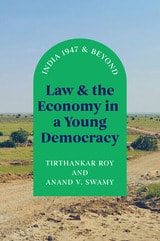
Law and the Economy in a Young Democracy
India 1947 and BeyondTirthankar Roy and Anand V. Swamy
University of Chicago Press, 2022
Economists have long lamented how the inefficiency of India's legal system undermines the country’s economic capacity. How has this come to be? The prevailing explanation is that the postcolonial legal system is understaffed and under-resourced, making adjudication and contract enforcement slow and costly.
Taking this as given, Law and the Economy in a Young Democracy examines the contents and historical antecedents of these laws, including how they have stifled economic development. Economists Roy and Swamy argue that legal evolution in independent India has been shaped by three factors: the desire to reduce inequality and poverty; the suspicion that market activity, both domestic and international, can be detrimental to these goals; and the strengthening of Indian democracy over time, giving voice to a growing fraction of society, including the poor.
Weaving the story of India's heralded economic transformation with its social and political history, Roy and Swamy show how inadequate legal infrastructure has been a key impediment to the country's economic growth during the last century. A stirring and authoritative history of a nation rife with contradictions, Law and the Economy in a Young Democracy is essential reading for anyone seeking to understand India's current crossroads—and the factors that may keep its dreams unrealized.
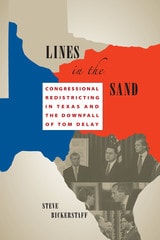
Lines in the Sand
Congressional Redistricting in Texas and the Downfall of Tom DeLayBy Steve Bickerstaff
University of Texas Press, 2007
The events of 2003 in Texas were important to the political history of this country. Congressman Tom DeLay led a Republican effort to gerrymander the state's thirty-two congressional districts to defeat all ten of the Anglo Democratic incumbents and to elect more Republicans; Democratic state lawmakers fled the state in an effort to defeat the plan. The Lone Star State uproar attracted attention worldwide. The Republicans won this showdown, gaining six additional seats from Texas and protecting the one endangered Republican incumbent. Some of the methods used by DeLay to achieve this result, however, led to his criminal indictment and ultimately to his downfall.
With its eye-opening research, readable style, and insightful commentary, Lines in the Sand provides a front-line account of what happened in 2003, often through the personal stories of members of both parties and of the minority activist groups caught in a political vortex. Law professor Steve Bickerstaff provides much-needed historical perspective and also probes the aftermath of the 2003 redistricting, including the criminal prosecutions of DeLay and his associates and the events that led to DeLay's eventual resignation from the U.S. House of Representatives. As a result, Bickerstaff graphically shows a dark underside of American politics—the ruthless use of public institutional power for partisan gain.

Love and Fatigue in America
Roger King
University of Wisconsin Press, 2012
Love and Fatigue in America records an Englishman’s decade-long journey through his newly adopted country in the company of a mystifying illness and a charismatic dog.
When he receives an unexpected invitation from an unfamiliar American university, he embraces it as a triumphant new beginning. Instead, on arrival, he is stricken with a persistent inability to stand up or think straight, and things quickly go wrong. Diagnosed with ME disease—chronic fatigue syndrome—he moves restlessly from state to state, woman to woman, and eccentric doctor to eccentric doctor, in a search for a love and a life suited to his new condition. The journey is simultaneously brave, absurd, and instructive.
Finding himself prostrate on beds and couches from Los Alamos to Albany, he hears the intimate stories offered by those he encounters—their histories, hurts, and hopes—and from these fragments an unsentimental map emerges of the inner life of a nation. Disability has shifted his interest in America from measuring its opportunities to taking the measure of its humanity. Forced to consider for himself the meaning of a healthy life and how best to nurture it, he incidentally delivers a report on the health of a country.
By turns insightful, comic, affecting, and profound, Roger King’s Love and Fatigue in America briskly compresses an illness, a nation, and an era through masterly blending of literary forms. In a work that defies categorization, and never loses its pace or poise, the debilitated narrator is, ironically, the most lively and fully awake figure in the book.
“As the disease drives the narrator city to city, woman to woman, and doctor to doctor, it brings into relief many of America’s follies and excesses, most notably our health-care system, which King portrayed as antiquated, bureaucratic, and inhumane. After more than fifteen years, America brings the narrator ‘not aspiration realized, nor a largeness of life fitting to its open spaces, but the nascent ability to be satisfied with less.’”—The New Yorker
Lying On The Postcolonial Couch
The Idea Of IndifferenceRukmini Bhaya Nair
University of Minnesota Press, 2002
Exposes the complicity of language and its uses in the colonial project
A revealing look into the long afterlife of colonial conquest, Lying on the Postcolonial Couch offers an original, overarching concept that informs—and helps to explain—the workings of postcoloniality. This concept, "indifference," is a play on the key critical term "difference." Indifference is a cognitive stance invented during the colonial period for the purpose of organizing the complex domain of the Indian subcontinent, one that created its own brand of poetics. Considering postcoloniality as a symptomatic condition, this book proposes a cure involving a return to buried memories of colonial trauma before the phenomenon itself succumbs to the absolute indifference of the slowly gathering amnesia of the new millennium.
Rukmini Bhaya Nair traces a paper trail beginning in 1757 with the Battle of Plassey, winding through the contentious Mutiny of 1857, and ending with Salman Rushdie’s Satanic Verses predicament. Along this trail, she uncovers hidden residues of feeling, from guilt and mistrust to wonder and pleasure, and analyzes the linguistic pillars that hold up the institution of bureaucratic indifference that she exposes.