87 books match the query 'AIDS (Disease)' and 4 start with l
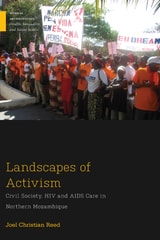
cover of Landscapes of Activism: Civil Society, HIV and AIDS Care in Northern Mozambique

Landscapes of Activism

Civil Society, HIV and AIDS Care in Northern Mozambique

Reed, Joel Christian

Rutgers University Press, 2018
AIDS activists are often romanticized as extremely noble and selfless. However, the relationships among HIV support group members highlighted in Landscapes of Activism are hardly utopian or ideal. At first, the group has everything it needs, a thriving membership, and support from major donors. Soon, the group undergoes an identity crisis over money and power, eventually fading from the scene. As government and development institutions embraced activist demands—decentralizing AIDS care through policies of health systems strengthening—civil society was increasingly rendered obsolete. Charting this transition—from subjects, to citizens, and back again—reveals the inefficacy of protest, and the importance of community resilience. The product of in-depth ethnography and focused anthropological inquiry, this is the first book on AIDS activists in Mozambique. AIDS activism’s strange decline in southern Africa, rather than a reflection of citizen apathy, is the direct result of targeted state and donor intervention.
[more]
cover of Lethal Decisions: The Unnecessary Deaths of Women and Children from HIV/AIDS

Lethal Decisions

The Unnecessary Deaths of Women and Children from HIV/AIDS

Arthur J. Ammann

Vanderbilt University Press, 2017

This first-person account by one of the pioneers of HIV/AIDS research chronicles the interaction among the pediatric HIV/AIDS community, regulatory bodies, governments, and activists over more than three decades. After the discovery of AIDS in a handful of infants in 1981, the next fifteen years showed remarkable scientific progress in prevention and treatment, although blood banks, drug companies, and bureaucrats were often slow to act. 1996 was a watershed year when scientific and clinical HIV experts called for treating all HIV-infected individuals with potent triple combinations of antiretroviral drugs that had been proven effective. Aggressive implementation of prevention and treatment in the United States led to marked declines in the number of HIV-related deaths, fewer new infections and hospital visits, and fewer than one hundred infants born infected each year.

Inexplicably, the World Health Organization recommended withholding treatment for the majority of HIV-infected individuals in poor countries, and clinical researchers embarked on studies to evaluate inferior treatment approaches even while the pandemic continued to claim the lives of millions of women and children. Why did it take an additional twenty years for international health organizations to recommend the treatment and prevention measures that had had such a profound impact on the pandemic in wealthy countries? The surprising answers are likely to be debated by medical historians and ethicists.

At last, in 2015, came a universal call for treating all HIV-infected individuals with triple-combination antiretroviral drugs. But this can only be accomplished if the mistakes of the past are rectified. The book ends with recommendations on how the pediatric HIV/AIDS epidemic can finally be brought to an end.

[more]
cover of Life with AIDS

Life with AIDS

Rose Weitz

Rutgers University Press, 1991

Rose Weitz presents a holistic picture of the experiences of people with HIV disease, using their own words and focusing on the issues that they consider important. Her information comes from in-depth interviews with women and men who have HIV disease--from those who are asymptomatic but infected to those who have full-blown AIDS--and from interviews with doctors who treat persons with HIV disease.

Weitz describes how these people are affected by and respond to the changes in their bodies and their social relationships, from the time when they realize that they are at risk of infection to the time when death approaches. It covers such issues as how individuals obtain diagnoses, develop their initial ideas about what the future will bring, and come to terms with their impending deaths. To put this into a broader context, she also explores the moral status of illness in general and looks at why some illnesses, including HIV disease, have become especially stigmatized.

The author also explores how doctors are affected by and cope with the unique pressures of treating persons with HIV disease. The concluding chapter theorizes about how changes in the social construction, demographic distribution, and treatment of HIV disease are changing the lives of people with AIDS.
[more]
cover of Loss within Loss: Artists in the Age of AIDS

Loss within Loss

Artists in the Age of AIDS

Edited by Edmund White; In Cooperation with the Estate Project for Artists with AIDS, a project of the Alliance for the Arts

University of Wisconsin Press, 2002

When an artist dies we face two great losses: the person and the work he did not live to do. Loss within Loss  is a moving collaboration by some of America's most eloquent writers, who supply wry, raging, sorrowful, and buoyant accounts of artist friends and lovers struck down by AIDS. These essayists include Maya Angelou, Alan Gurganus, Brad Gooch, John Berendt, Craig Lucas, Robert Rosenblum, and eighteen others. Many of the subjects of the essays were already prominent—James Merrill, Paul Monette, David Wojnarowicz—but many others died young, before they were able to fulfil the promise of their lives and art. Loss within Loss spans all of the arts and includes portraits of choreographers, painters, poets, actors, playwrights, sculptors, editors, composers, and architects.

This landmark book is published in association with the Estate Project for Artists with AIDS, a national organization that preserves art works created by artists living with HIV or lost to AIDS. Loss within Loss stands as a powerful reminder of the devastating impact of the AIDS epidemic on the arts community and as the first real survey of that devastation. Though these accounts are often intensely sad, Loss within Loss is an invigorating, sometimes even exuberant, testimony to the sheer joy of being an artist . . . and being alive.

[more]