Results by title
314 books match the query 'African' and 6 start with l
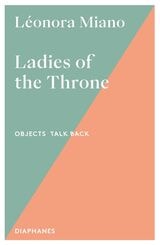
Ladies of the Throne
Léonora Miano
Diaphanes, 2025
“Most of the time, it is the power of men that we remember.” With these words, which open Léonora Miano’s text for Objects Talk Back, an astonishing new narrative unfurls around Mandu Yenu, a throne from the ancient Kingdom of Bamum (present day Cameroon).
The Germans long claimed the object was a gift from King Njoya to Kaiser Wilhelm II. Miano reads “between the lines of beads and cowrie shells” to show the complex intricacies of colonial and gender relations. Dismissing all pretense of egalitarianism between colonizer and colonized, she hones in on the very nature of power—how and by whom it is defined-wielded-subverted.
King Njoya said he “felt like a woman in his relationship with the Germans.” Miano takes this as a prompt to examine contrasting cultural notions of femininity and thus reveals how central women are to the story of the throne. As the very name of the object suggests, it is the power of women we should remember.
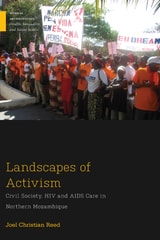
Landscapes of Activism
Civil Society, HIV and AIDS Care in Northern MozambiqueReed, Joel Christian
Rutgers University Press, 2018

Learning From Robben Island
Govan Mbeki’s Prison WritingsGovan Mbeki
Ohio University Press, 1991
In the late fifties and early sixties, Govan Mbeki was a central figure in the African National Congress and director of the ANC campaigns from underground. Born of a chief and the daughter of a Methodist minister in the Transkei of South Africa in 1910, he worked as a teacher, journalist, and tireless labor organizer in a lifetime of protest against the government policy of apartheid. Over two decades of imprisonment on Robben Island did not consign him to obscurity. Along with Nelson Mandela and Walter Sisulu, his name has become a symbol of resistance, not only to the oppressed people of South Africa, but also to the international community who have conferred on him many honors and awards.

Les Matériaux
Une autre histoire de l’art moderneMonika Wagner
Diaphanes, 2025
Utilizing exemplary works, Monika Wagner considers traditional materials, as well as materials that have been newly developed or are originally foreign to art, placing them beyond the personal mythologies of individual artists and in the context of their ordinary uses and attributes. This critical reconstruction of their meaning opens up a new avenue for understanding modern art. The materials discussed and studied are at the heart of twentieth-century art, from color in painting to everyday and natural objects, and even the most intangible materials such as air and light. The examples chosen by Wagner reveal what these materials tell us in the conjunction of their uses throughout history and their assignments to society or gender. Numerous illustrations complement and illuminate the analyses of the works studied.
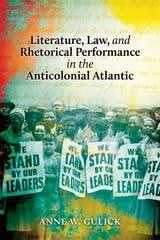
Literature, Law, and Rhetorical Performance in the Anticolonial Atlantic
Anne W. Gulick
The Ohio State University Press, 2016
Responses to this question take shape across the black Atlantic from Haiti to South Africa, in texts ranging from Haiti’s Declaration of Independence and work by C. L. R. James to South Africa’s Freedom Charter, Aimé Césaire’s poem Notebook of a Return to the Native Land, and Ngugi wa Thiong’o’s A Grain of Wheat. These texts constitute a robust transatlantic tradition of challenging colonial and imperial authority through rhetorical performance. Drawing on the cosmopolitan aspirations and emancipatory energies of the political declaration, this tradition aims to radically reinvent the possibilities for law and political belonging in the postcolonial future.
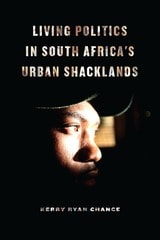
Living Politics in South Africa’s Urban Shacklands
Kerry Ryan Chance
University of Chicago Press, 2018
Tracking everyday practices and interactions between poor residents and state agents in South Africa’s shack settlements, Chance investigates the rise of nationwide protests since the late 1990s. Based on ethnography in Durban, Cape Town, and Johannesburg, the book analyzes the criminalization of popular forms of politics that were foundational to South Africa’s celebrated democratic transition. Chance argues that we can best grasp the increasingly murky line between “the criminal” and “the political” with a “politics of living” that casts slum and state in opposition to one another. Living Politics shows us how legitimate domains of politics are redefined, how state sovereignty is forcibly enacted, and how the production of new citizen identities crystallize at the intersections of race, gender, and class.