Results by title
209 books match the query 'Alaska' and 11 start with l
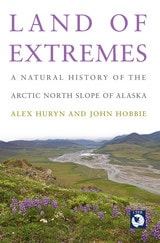
Land of Extremes
A Natural History of the Arctic North Slope of AlaskaAlex Huryn and John Hobbie
University of Alaska Press, 2012
This book is a comprehensive guide to the natural history of the North Slope, the only arctic tundra in the United States. The first section provides detailed information on climate, geology, landforms, and ecology. The second provides a guide to the identification and natural history of the common animals and plants and a primer on the human prehistory of the region from the Pleistocene through the mid-twentieth century. The appendix provides the framework for a tour of the natural history features along the Dalton Highway, a road connecting the crest of the Brooks Range with Prudhoe Bay and the Arctic Ocean, and includes mile markers where travelers may safely pull off to view geologic formations, plants, birds, mammals, and fish. Featuring hundreds of illustrations that support the clear, authoritative text, Land of Extremes reveals the arctic tundra as an ecosystem teeming with life.
Leavetakings
EssaysCorinna Cook
University of Alaska Press, 2020
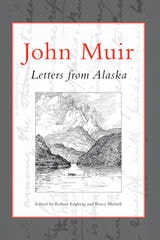
Letters From Alaska
John Muir
University of Alaska Press, 2009
John Muir (1838–1914), founder of the Sierra Club, was one of the most famous and influential environmental conservationists of all time. From 1879 to 1880 Muir traveled the waters of southeastern Alaska in a Tlingit Indian dugout canoe and reported his encounters in a series of letters published in the San Francisco Daily Evening Bulletin. Collected here are Muir’s original letters, bearing the immediacy and candor of his best work and providing a rare account of southeastern Alaska history, alongside breathtaking observations of glaciers and the untamed landscape. Through Muir we encounter gold miners, rogue towns, Taku Inlet, Glacier Bay, profiles of Tlingit Indians, and the infancy of the tourist industry. This collection of work by one of America’s foremost naturalists provides a magnificent look into early conservationist thought and one individual’s encounter with nature.

Life Woven with Song
Nora Marks Dauenhauer
University of Arizona Press, 2000
In prose, Dauenhauer presents stories such as "Egg Boat"--the tale of a twelve-year-old girl fishing the North Pacific for the first time alone--and an autobiographical piece that reveals much about Tlingit lifeways. Then in a section of short lyrical poems she offers crystalline tributes to her land and people. In a concluding selection of plays, Dauenhauer presents three Raven stories that were adapted as stage plays from oral versions told in Tlingit by three storytellers of her community. These plays were commissioned by the Naa Kahidi Theater and have been performed throughout America and Europe. They take the form of a storyteller delivering a narrative while other members of the cast act and dance in masks and costumes.
Collectively, Dauenhauer's writings form an "autoethnography," offering new insight into how the Tlingit have been affected by modernization and how Native American culture perseveres in the face of change. Despite the hardships her people have seen, this woman affirms the goodness of life as found in family and community, in daily work and play, and in tribal traditions.
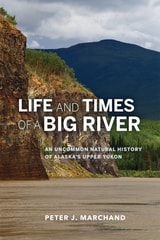
Life and Times of a Big River
An Uncommon Natural History of Alaska's Upper YukonPeter J. Marchand
University of Alaska Press, 2015
Life and Times of a Big River follows Peter J. Marchand and his team of biologists as they set out to explore the land that would ultimately become the Yukon-Charley Rivers National Preserve. Their encounters with strange plants, rare insects, and little-known mammals bring to life a land once thought to be static and monotonous. And their struggles to navigate and adapt to an unforgiving environment capture the rigorous demands of remote field work. Weaving in and out of Marchand's narrative is an account of the natural and cultural history of the area as it relates to the expedition and the region’s Native peoples. Life and Times of a Big River chorincles this riveting, one-of-a-kind journey of uncertainty and discovery from a disparate (and at one point desperate) group of biologists.
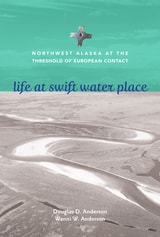
Life at Swift Water Place
Northwest Alaska at the Threshold of European ContactEdited by Doug D. Anderson and Wanni W. Anderson
University of Alaska Press, 2019
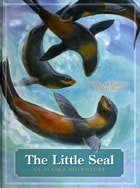
Little Seal
An Alaska AdventureWritten and Illustrated by Ram Papish
University of Alaska Press, 2009
The northern fur seal spends most of its life in the open ocean of the North Pacific, from California up through Alaska and down to Japan. These seals travel hundreds of miles, farther than any other seal or sea lion, to reach their remote breeding grounds. Most fur seals go to the Pribilof Islands of Alaska, where, historically, several million fur seals converged annually, but the population counted in the Pribilofs in 2008 was less than one million and dropping rapidly. Ram Papish’s richly illustrated story follows these magnificent—and increasingly vulnerable—creatures through the most important part of their lives.
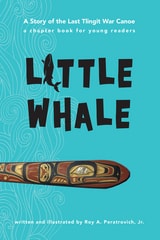
Little Whale
A Story of the Last Tlingit War CanoeRoy A. Peratrovich, Jr.
University of Alaska Press, 2016
And it’s mostly true. Roy Peratrovich here builds a wonderful children’s tale on the bones of a story his own grandfather passed down. His accompanying illustrations bring the people and landscapes of Alaska—to say nothing of the adventures!—to stunning life, drawing young readers into a long-gone time when the whims of nature and man could suddenly test a boy’s courage.

Living with the Coast of Alaska
Owen Mason, William Neal, and Orrin H. Pilkey
Duke University Press, 1997
Facing two oceans and three seas, Alaska's coastline stretches through bays, fjords, and around islands for 45,000 miles. Living with the Coast of Alaska, a new volume in the Living with the Shore series, is a user's guide for both present and future inhabitants of Alaska. Providing individual property owners in all regions of the state with the fundamentals of hazard recognition and mitigation strategy, the authors discuss the geological history of Alaska and its relation to the area's cultural history and present customized hazard risk assessments for coastal communities.
Describing the dynamic nature of natural seismic events and coastal processes in Alaska, the authors emphasize the multiplicity of potential effects that result from a unique combination of geology, climate, and the sea. Earthquakes, volcanic eruptions, tsunami waves, avalanches, glacial advances, storm surges, flash flooding, wind channeling, and shoreline erosion combined with human-induced hazards such as oil spills, fire, and beach and offshore mining accidents make living with danger a way of life in Alaska. The authors provide information on federal and state laws and programs regarding natural disasters and coastal zone management as well as practical suggestions for the design and construction of buildings. For private, commercial, and public developments, this book offers a manual to help Alaskans make informed decisions to minimize, if not avoid, damage and danger.

Lucy's Dance
Deb Vanasse
University of Alaska Press, 2011

Lugiim Yuraa
Deb Vanasse
University of Alaska Press, 2011