Results by title
51 books match the query 'American Sign Language' and 7 start with l
Language and the Law in Deaf Communities
Ceil Lucas
Gallaudet University Press, 2003
Language in Hand
Why Sign Came Before SpeechWilliam C. Stokoe
Gallaudet University Press, 2001
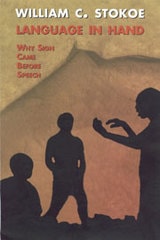
In Language in Hand: Why Sign Came Before Speech, William C. Stokoe begins his exploration of the origin of human language with a 2400-year-old quote by Democritus: “Everything existing in the universe is the fruit of chance and necessity.” Stokoe capitalizes upon this simple credo in this far-ranging examination of the scholarly topography to support his formula for the development of language in humans: gesture-to-language-to-speech. Intrinsic to this is the proposition that speech is sufficient for language, but not necessary. Chance brought human ancestors down from the trees to the ground, freeing their hands for gesture, and then sign language, a progression that came from the necessity to communicate.
Stokoe recounts in Language in Hand how inspiration grew out of his original discovery in the 1950s and ’60s that deaf people who signed were using a true language with constructions that did not derive from spoken English. This erudite, highly engaging investigation calls upon decades of personal experience and published research to refute the recently entrenched principles that humans have a special, innate learning faculty for language and that speech equates with language. Integrating current findings in linguistics, semiotics, and anthropology, Stokoe fashions a closely-reasoned argument that suggests how our human ancestors’ powers of observation and natural hand movements could have evolved into signed morphemes.
Stokoe also proposes how the primarily gestural expression of language with vocal support shifted to primarily vocal language with gestural accompaniment. When describing this transition, however, he never loses sight of the significance of humans in the natural world and the role of environmental stimuli in the development of language. Stokoe illustrates this contention with fascinating observations of small, contemporary ethnic groups such as the Assiniboin Nakotas, a Native American group from Montana that intermingle their spoken and signed languages depending upon cultural imperatives.
Language in Hand also presents innovative thoughts on classifiers in American Sign Language and their similarity to certain spoken languages, convincing evidence that speech originally copied sign language forms before developing unrelated conventions through usage. Stokoe concludes with a hypothesis on how the acceptance of sign language as the first language of humans could revolutionize the education of infants, both deaf and hearing, who, like early humans, have the full capacity for language without speech.

Learning American Sign Language in High School
Motivation, Strategies, and AchievementRussell S. Rosen
Gallaudet University Press, 2015
Author Russell S. Rosen begins with the history of ASL as a foreign language in high schools, including debates about the foreign language status of ASL, the situation of deaf and hard of hearing students in classes, and governmental recognition of ASL as a language. Based on his study of five high school ASL programs, he defines the factors that motivate students, including community and culture, and analyzes strategies for promoting language processing and learning. Learning American Sign Language in High School provides strategies for teaching ASL as a second language to students with learning disabilities as well. Its thorough approach ensures the best opportunity for high school students to attain high levels of achievement in learning ASL.
Learning To See
American Sign Language as a Second LanguageSherman Wilcox
Gallaudet University Press, 1997
Learning to See lays solid groundwork for teaching and studying ASL by outlining the structure of this unique visual language. Myths and misconceptions about ASL are laid to rest at the same time that the fascinating, multifaceted elements of Deaf culture are described. Students will be able to study ASL and gain a thorough understanding of the cultural background, which will help them to grasp the language more easily. An explanation of the linguistic basis of ASL follows, leading into the specific, and above all, useful information on teaching techniques.
This practical manual systematically presents the steps necessary to design a curriculum for teaching ASL, including the special features necessary for training interpreters. The new Learning to See again takes its place at the forefront of texts on teaching ASL as a second language, and it will prove to be indispensable to educators and administrators in this special discipline.
Linguistics of American Sign Language Text, 3rd Edition
An IntroductionClayton Valli
Gallaudet University Press, 2001
Linguistics of American Sign Language
An Introduction, 5th Ed.Clayton Valli
Gallaudet University Press, 2011
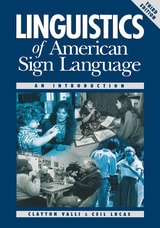
Completely reorganized to reflect the growing intricacy of the study of ASL linguistics, the 5th edition presents 26 units in seven parts. Part One: Introduction presents a revision of Defining Language and an entirely new unit, Defining Linguistics. Part Two: Phonology has been completely updated with new terminology and examples. The third part, Morphology, features units on building new signs, deriving nouns from verbs, compounds, fingerspelling, and numeral incorporation. Part Four: Syntax includes units on basic sentence types, lexical categories, word order, time and aspect, verbs, and the function of space. The fifth part, Semantics, offers updates on the meanings of individual signs and sentences.
Part Six: Language in Use showcases an entirely new section on Black ASL in the unit on Variation and Historical Change. The units on bilingualism and language and ASL discourse have been thoroughly revised and updated, and the Language as Art unit has been enhanced with a new section on ASL in film. Two new readings update Part Seven, and all text illustrations have been replaced by video stills from the expanded video content. Also, signs described only with written explanations in past editions now have both photographic samples in the text and full demonstrations in the video.
*** You can find the supplemental video content on the Gallaudet University Press YouTube channel. ***

Linguistics of American Sign Language
An Introduction, 6th Ed.Julie A. Hochgesang
Gallaudet University Press, 2026
Grounded in the scholarship and reflecting contemporary developments in the field of signed language linguistics, the sixth edition of Linguistics of American Sign Language provides a clear, comprehensive, and fresh introduction to the structure of ASL. Focusing on language in everyday contexts, this new edition treats ASL as a dynamic system shaped by the diversity of its communities.
Organized into two parts, Linguistics of American SignLanguage begins by exploring fundamental concepts of language within communities, addressing language features, registers, variation and historical change, multilingualism, ideologies, and discourse. This first section sets the stage for in-depth analysis into core areas of linguistic study: syntax, phonology, and morphology. New content provides depth, exploring topics such as the representation of signed languages in texts, corpus linguistics, heritage-language signers, and Black ASL. To show how language is used by multilingual and multimodal individuals within their communities, the book pairs discussion with “grounding texts,” videos of ASL within varied authentic settings.
Linguistics of American Sign Language is supported by a companion website that provides access to the grounding texts and supplementary materials, including downloadable resources for hands-on analysis such as annotated videos and readings. Designed for readers with no background in linguistics, each unit opens with guided questions to prompt reflection and concludes with exercises and recommended readings.
Refining the standard for sign language scholarship, the sixth edition of Linguistics of American Sign Language guides readers beyond technical analysis to explore ASL as a vibrant system rooted in community, culture, and language.