145 books match the query 'American Studies' and 6 start with l
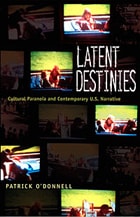
cover of Latent Destinies: Cultural Paranoia and Contemporary U.S. Narrative

Latent Destinies

Cultural Paranoia and Contemporary U.S. Narrative

Patrick O Donnell

Duke University Press, 2000

Latent Destinies examines the formation of postmodern sensibilities and their relationship to varieties of paranoia that have been seen as widespread in this century. Despite the fact that the Cold War has ended and the threat of nuclear annihilation has been dramatically lessened by most estimates, the paranoia that has characterized the period has not gone away. Indeed, it is as if—as O’Donnell suggests—this paranoia has been internalized, scattered, and reiterated at a multitude of sites: Oklahoma City, Waco, Ruby Ridge, Bosnia, the White House, the United Nations, and numerous other places.

O’Donnell argues that paranoia on the broadly cultural level is essentially a narrative process in which history and postmodern identity are negotiated simultaneously. The result is an erasure of historical temporality—the past and future become the all-consuming, self-aware present. To explain and exemplify this, O’Donnell looks at such books and films as Libra, JFK, The Crying of Lot 49, The Truman Show, Reservoir Dogs, Empire of the Senseless, Oswald’s Tale, The Executioner’s Song, Underworld, The Killer Inside Me, and Groundhog Day. Organized around the topics of nationalism, gender, criminality, and construction of history, Latent Destinies establishes cultural paranoia as consonant with our contradictory need for multiplicity and certainty, for openness and secrecy, and for mobility and historical stability.

Demonstrating how imaginative works of novels and films can be used to understand the postmodern historical condition, this book will interest students and scholars of American literature and cultural studies, postmodern theory, and film studies.


[more]
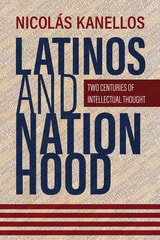
cover of Latinos and Nationhood: Two Centuries of Intellectual Thought

Latinos and Nationhood

Two Centuries of Intellectual Thought

Nicolás Kanellos

University of Arizona Press, 2023

Spanning from the early nineteenth century to today, this intellectual history examines the work of Latino writers who explored the major philosophic and political themes of their day, including the meaning and implementation of democracy, their democratic and cultural rights under U.S. dominion, their growing sense of nationhood, and the challenges of slavery and disenfranchisement of women in a democratic republic that had yet to realize its ideals.

Over the course of two centuries, these Latino or Hispanic intellectuals were natural-born citizens of the United States, immigrants, or political refugees. Many of these intellectuals, whether citizens or not, strove to embrace and enliven such democratic principles as freedom of speech and of the press, the protection of minorities in the Bill of Rights and in subsequent laws, and the protection of linguistic and property rights, among many others, guaranteed by treaties when the United States incorporated their homelands into the Union.

The first six chapters present the work of lesser-known historical figures—most of whom have been consistently ignored by Anglo- and Euro-centric history and whose works have been widely inaccessible until recently—who were revolutionaries, editors of magazines and newspapers, and speechmakers who influenced the development of a Latino consciousness. The last three chapters deal with three foundational figures of the Chicano Movement, the last two of whom either subverted the concept of nationhood or went beyond it to embrace internationalism in an outreach to humanity as a whole.

Latinos and Nationhood sheds new light on the biographies of Félix Varela, José Alvarez de Toledo y Dubois, Francisco Ramírez, Tomás Rivera, Rolando Hinojosa-Smith, and Gloria E. Anzaldúa, among others.
[more]
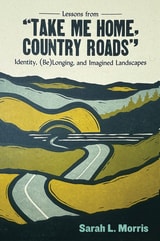
cover of Lessons from "Take Me Home, Country Roads": Identity, (Be)Longing, and Imagined Landscapes

Lessons from "Take Me Home, Country Roads"

Identity, (Be)Longing, and Imagined Landscapes

Sarah L. Morris

West Virginia University Press, 2025

You may have heard it at a football game, in an advertisement, or on the radio on a road trip far from home. You may have sung along on a rooftop in Thailand, at Oktoberfest in Belgium, or with a Japanese cover band. It may have moved you to dance at a wedding or cry at a funeral. Regardless of where it plays, the song “Take Me Home, Country Roads” is ubiquitous, unmistakable, universal. Written and recorded by Bill Danoff, Taffy Nivert, and John Denver in 1971, the song continues to resonate across cultures and audiences, carrying meaning beyond naming and inviting transformation for a range of rhetorical purposes in nearly 300 recorded English versions and in more than 20 languages. 

This book examines “Country Roads” as it illuminates a universal sense of belonging to place even as it obscures the literality of the place it names. In examining “Country Roads” as anthem, text, artifact, and rhetoric, this work untangles ideas related to place, belonging, identity, and pedagogy. Sarah L. Morris uses the Welsh term hiraeth, which is an existential longing for an idealized, sometimes imaginary home, as a governing framework for this work. She explores the song in various contexts, such as how it pertains to West Virginia geography and heritage and the diversity of these beliefs, external perceptions of the state, concepts of home and belonging, and the song as a phenomenon across different media platforms. “Take Me Home, Country Roads,” while being about West Virginia, has registered as a global phenomenon.
[more]
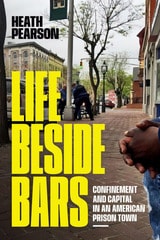
cover of Life beside Bars: Confinement and Capital in an American Prison Town

Life beside Bars

Confinement and Capital in an American Prison Town

Heath Pearson

Duke University Press, 2024
In Life beside Bars, Heath Pearson showcases dynamic, interdependent community as the best hope for undoing the systems of confinement that reproduce capital in Cumberland County, New Jersey—a place that is home to three state prisons, one federal prison, and the regional jail. Pearson places today’s prisons within the region’s longer history of Lenape genocide, chattel slavery, Japanese American labor camps, and other forms of racialized punishment and carceral control. From this vantage, prisons appear not as the structural fix for the region’s failed political economy but as a continuation of the carceral principle that has always sustained it. This ongoing use of confinement, though, is merely the backdrop. Through ethnographic vignettes written in story form, Pearson offers an alternative history of the unruly and unexpected ways that people resist, get by, make money, find joy, and build radical social life in the small, unseen spaces beside large-scale confinement. As such, Pearson enriches our understanding of daily life in and around prisons—in any American community—while providing a kaleidoscope of possibilities for theorizing and organizing alternative paths.
[more]
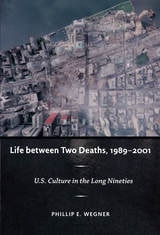
cover of Life between Two Deaths, 1989-2001: U.S. Culture in the Long Nineties

Life between Two Deaths, 1989-2001

U.S. Culture in the Long Nineties

Phillip E. Wegner

Duke University Press, 2009

Through virtuoso readings of significant works of American film, television, and fiction, Phillip E. Wegner demonstrates that the period between the fall of the Berlin Wall in November 1989 and the terrorist attacks of September 11, 2001 fostered a unique consciousness and represented a moment of immense historical possibilities now at risk of being forgotten in the midst of the “war on terror.” Wegner argues that 9/11 should be understood as a form of what Jacques Lacan called the “second death,” an event that repeats an earlier “fall,” in this instance the collapse of the Berlin Wall. By describing 9/11 as a repetition, Wegner does not deny its significance. Rather, he argues that it was only with the fall of the towers that the symbolic universe of the Cold War was finally destroyed and a true “new world order,” in which the United States assumed disturbing new powers, was put into place.

Wegner shows how phenomena including the debate on globalization, neoliberal notions of the end of history, the explosive growth of the Internet, the efflorescence of new architectural and urban planning projects, developments in literary and cultural production, new turns in theory and philosophy, and the rapid growth of the antiglobalization movement came to characterize the long nineties. He offers readings of some of the most interesting cultural texts of the era: Don DeLillo’s White Noise; Joe Haldeman’s Forever trilogy; Octavia Butler’s Parable novels; the Terminator films; the movies Fight Club, Independence Day, Cape Fear, and Ghost Dog; and the television series Buffy the Vampire Slayer. In so doing, he illuminates fundamental issues concerning narrative, such as how beginnings and endings are recognized and how relationships between events are constructed.
[more]
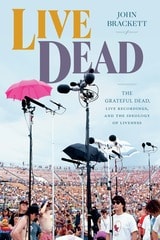
cover of Live Dead: The Grateful Dead, Live Recordings, and the Ideology of Liveness

Live Dead

The Grateful Dead, Live Recordings, and the Ideology of Liveness

John Brackett

Duke University Press, 2023

The Grateful Dead were one of the most successful live acts of the rock era. Performing more than 2,300 shows between 1965 and 1995, the Grateful Dead’s reputation as a “live band” was—and continues to be—sustained by thousands of live concert recordings from every era of the group’s long and colorful career. In Live Dead, musicologist John Brackett examines how live recordings—from the group’s official releases to fan-produced tapes, bootlegs to “Betty Boards,” and Dick’s Picks to From the Vault—have shaped the general history and popular mythology of the Grateful Dead for more than fifty years. Drawing on a diverse array of materials and documents contained in the Grateful Dead Archive, Live Dead details how live recordings became meaningful among the band and their fans not only as sonic souvenirs of past musical performances but also as expressions of assorted ideals, including notions of “liveness,” authenticity, and the power of recorded sound.
[more]