Results by title
95 books match the query 'Arab-Israeli conflict' and 2 start with l

Leila Khaled
Icon of Palestinian LiberationSarah Irving
Pluto Press, 2012
Dubbed 'the poster girl of Palestinian militancy', Leila Khaled's image flashed across the world after she hijacked a passenger jet in 1969. The picture of a young, determined looking woman with a checkered scarf, clutching an AK-47, was as era-defining as that of Che Guevara.
In this intimate profile, based on interviews with Khaled and those who know her, Sarah Irving gives us the life-story behind the image. Key moments of Khaled's turbulent life are explored, including the dramatic events of the hijackings, her involvement in the Marxist Popular Front for the Liberation of Palestine (a radical element within the PLO), her opposition to the Oslo peace process and her activism today.
Leila Khaled's example gives unique insights into the Palestinian struggle through one remarkable life – from the tension between armed and political struggle, to the decline of the secular left and the rise of Hamas, and the role of women in a largely male movement.
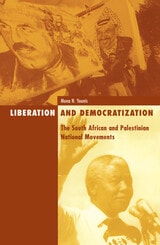
Liberation and Democratization
The South African and Palestinian National MovementsMona N. Younis
University of Minnesota Press, 2000
The first comprehensive comparison of two of the century’s most important liberation movements.
Arising in the 1910s and emerging as legitimate governing bodies in the 1990s, the South African and the Palestinian national liberation movements have exhibited remarkable parallels over the course of their development. The fortunes of the African National Congress and the Palestinian Liberation Organization, however, have proven strikingly different. How the movements, despite similar circumstances and experiences, have arrived at such dissimilar outcomes is described in Liberation and Democratization.
Younis traces the evolution of the movements, from early domination by elites to the ascendancy of mass-based forces in their last phases of expansion. She shows how this latest shift, accompanied by a democratization of the process of liberation, made the movements more effective in the 1980s. Liberation and Democratization also identifies dissimilarities—the balance of class forces and resources—that led to the A.N.C.’s greater success relative to the P.L.O.’s achievements. The first comprehensive comparison of two of the most significant liberation movements of this century, Younis’s work brings to light problems and dynamics that will remain at work well into the future.