Results by title
299 books match the query 'Arizona' and 10 start with l
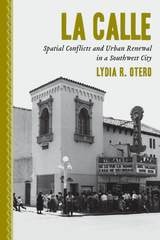
La Calle
Spatial Conflicts and Urban Renewal in a Southwest CityLydia R. Otero
University of Arizona Press, 2010
Otero examines conflicting claims to urban space, place, and history as advanced by two opposing historic preservationist groups: the La Placita Committee and the Tucson Heritage Foundation. Otero gives voice to those who lived in, experienced, or remembered this contested area, and analyzes the historical narratives promoted by Anglo American elites in the service of tourism and cultural dominance.
La Calle explores the forces behind the mass displacement: an unrelenting desire for order, a local economy increasingly dependent on tourism, and the pivotal power of federal housing policies. To understand how urban renewal resulted in the spatial reconfiguration of downtown Tucson, Otero draws on scholarship from a wide range of disciplines: Chicana/o, ethnic, and cultural studies; urban history, sociology, and anthropology; city planning; and cultural and feminist geography.
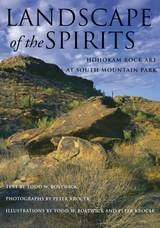
Landscape of the Spirits
Hohokam Rock Art at South Mountain ParkText by Todd W. Bostwick; Photographs by Peter Krocek; Illustrations by Todd W. Bostwick and Peter Krocek
University of Arizona Press, 2002
Todd Bostwick, an archaeologist who has studied the Hohokam for more than twenty years, and Peter Krocek, a professional photographer with a passion for archaeology, have combed the South Mountains to locate nearly all of the ancient petroglyphs found in the canyons and ridges. Their years of learning the landscape and investigating the ancient designs have resulted in a book that explores this wealth of prehistoric rock art within its natural and cultural contexts, revealing what these carvings might mean, how they got there, and when they were made.
Landscape of the Spirits is the first book to cover these ancient images and is one of the most comprehensive treatments of a rock art location ever published. It conveys the range of different rock art elements and compositions found in the South Mountains—animals, humans, and geometric shapes, as well as celestial and calendrical markings at key sites—through accurate descriptions, drawings, and photographs. Interpretations of the petroglyphs are based on Native American ethnographic accounts and consider the most recent theories concerning shamanism and archaeoastronomy.
Written in a simple and accessible style, Landscape of the Spirits is an indispensable volume for anyone exploring the South Mountains, and for rock art enthusiasts everywhere who wish to broaden their understanding of the prehistoric world. It is both an authoritative overview of these ancient wonders and an unprecedented benchmark in southwestern rock art research at a single geographic location.
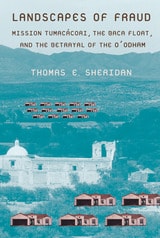
Landscapes of Fraud
Mission Tumacácori, the Baca Float, and the Betrayal of the O’odhamThomas E. Sheridan
University of Arizona Press, 2006
Landscapes of Fraud explores how the penetration of the evolving capitalist world-system created and destroyed communities in the Upper Santa Cruz Valley of Arizona from the late 1600s to the 1970s. Thomas Sheridan has melded history, anthropology, and critical geography to create a penetrating view of greed and power and their lasting effect on those left powerless.
Sheridan first examines how O’odham culture was fragmented by the arrival of the Spanish, telling how autonomous communities moving across landscapes in seasonal rounds were reduced to a mission world of subordination. Sheridan then considers the fate of the Tumacácori grant and Baca Float No. 3, another land grant. He tells the unbroken story of land fraud from Manuel María Gándara’s purchase of the “abandoned” Tumacácori grant at public auction in 1844 through the bankruptcy of the shady real estate developers who had fraudulently promoted housing projects at Rio Rico during the 1960s and ’70s.
As the Upper Santa Cruz Valley underwent a wrenching transition from a landscape of community to a landscape of fraud, the betrayal of the O’odham became complete when land, that most elemental form of human space, was transformed from a communal resource into a commodity bought and sold for its future value. Today, Mission Tumacácori stands as a romantic icon of the past while the landscapes that supported it lay buried under speculative schemes that continue to haunt our history.

Language of the Gun
Youth, Crime, and Public PolicyBernard E. Harcourt
University of Chicago Press, 2006
Home to over 150 repeat offenders ranging in age from twelve to seventeen, the Catalina Mountain School is made up of a particular stratum of boys—those who have committed the most offenses but will still be released upon reaching adulthood. In an effort to understand the symbolic and emotional language of guns and gun carrying, Harcourt interviewed dozens of these incarcerated Catalina boys. What do these youths see in guns? What draws them to handguns? Why do some of them carry and others not? For Harcourt, their often surprising answers unveil many of the presuppositions that influence our laws and policies.
Language, History, and Identity
Ethnolinguistic Studies of the Arizona TewaPaul V. Kroskrity
University of Arizona Press, 1993

Last Rampage
The Escape of Gary TisonJames W. Clarke
University of Arizona Press, 1999
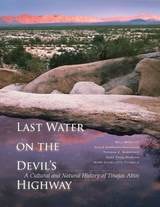
Last Water on the Devil's Highway
A Cultural and Natural History of Tinajas AltasBill Broyles, Gayle Harrison Hartmann, Thomas E. Sheridan, Gary Paul Nabhan, and Mary Charlotte Thurtle
University of Arizona Press, 2013
Now an expert cast of authors describes, narrates, and explains the human and natural history of this special place in a thorough and readable account. Addressing the latest archaeological and historical findings, they reveal why Tinajas Altas was so important and how it related to other waterholes in the arid borderlands. Readers can feel like pioneers, following in the footsteps of early Native Americans, Spanish priests and soldiers, gold seekers and borderland explorers, tourists, and scholars.
Combining authoritative writing with a rich array of more than 180 illustrations and maps as well as detailed appendixes providing up-to-date information on the wildlife and plants that live in the area, Last Water on the Devil’s Highway allows readers to uncover the secrets of this fascinating place, revealing why it still attracts intrepid tourists and campers today.

Letters from Wupatki
Courtney Reeder Jones; Edited by Lisa Rappoport
University of Arizona Press, 1995
The year was 1938, and the newlyweds had come to Wupatki National Monument as full-time National Park Service caretakers for the ruin. Remote in time and place, their story as described in Courtney's letters will take readers into a dramatic landscape of red rocks, purple volcanoes, and endless blue sky. Here, some 60 years ago, two young people came to terms with their new life together and with their nearly total reliance upon each other and their Navajo neighbors.
"They helped us in any way that a neighbor would, and we helped them as we could," wrote Courtney in her memoirs years later. Vivid and engaging, her letters home spill over with descriptions of their friendship with local Navajo families, their sings and celebrations, and her good luck in being able to be a part of it all.
Letters from Wupatki captures a more innocent era in southwestern archaeology and the history of the National Park Service before the post-war years brought paved roads, expanded park facilities, and ever-increasing crowds of visitors. Courtney's letters to her family and friends reflect all the charm of the earlier time as they convey the sense of rapid transition that came after the war.
Tracking those changes in the development of Wupatki National Monument and the National Park Service, the letters also—and perhaps more important—reveal changes in the Joneses themselves. Of particular interest to anthropologists and historians, their story also gives the general reader captivating glimpses of a partnership between two people who only grew stronger for the struggles they shared together.
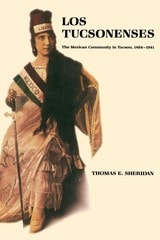
Los Tucsonenses
The Mexican Community in Tucson, 1854–1941Thomas E. Sheridan
University of Arizona Press, 1986
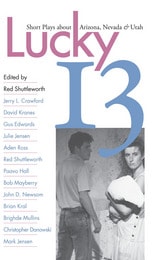
Lucky 13
Short Plays about Arizona, Nevada, and UtahRed Shuttleworth
University of Nevada Press, 1995