Results by title
133 books match the query 'Artists' and 10 start with l
Laszlo Moholy-Nagy
Biographical WritingsLouis Kaplan
Duke University Press, 1995
In Laszlo Moholy-Nagy, Louis Kaplan applies the Derridean deconstructivist model of the "signature effect" to an intellectual biography of a Constructivist artist. Inhabiting the borderline between life and work, the book demonstrates how the signature inscribed by "Moholy" operates in a double space, interweaving signified object and signifying matter, autobiography and auto-graphy. Through interpretative readings of over twenty key artistic and photographic works, Kaplan graphically illustrates Moholy’s signature effect in action. He shows how this effect plays itself out in the complex of relations between artistic originality and plagiarism, between authorial identity and anonymity, as well as in the problematic status of the work of art in the age of technical reproduction. In this way, the book reveals how Moholy’s artistic practice anticipates many of the issues of postmodernist debate and thus has particular relevance today. Consequently, Kaplan clarifies the relationship between avant-garde Constructivism and contemporary deconstruction.
This new and innovative configuration of biography catalyzed by the life writing of Moholy-Nagy will be of critical interest to artists and writers, literary theorists, and art historians.
Latinx Art
Artists, Markets, and PoliticsArlene Dávila
Duke University Press, 2020
LeRoy Neiman
The Life of America’s Most Beloved and Belittled ArtistTravis Vogan
University of Chicago Press, 2024
LeRoy Neiman—the cigar-smoking and mustachioed artist famous for his Playboy illustrations, sports paintings, and brash interviews—stood among the twentieth century’s most famous, wealthy, and polarizing artists. His stylish renderings of musicians, athletes, and sporting events captivated fans but baffled critics, who accused Neiman of debasing art with popular culture. Neiman cashed in on the controversy, and his extraordinary popularity challenged the norms of what art should be, where it belongs, and who should have access to it.
The story of a Depression-era ragamuffin–turned–army chef–turned–celebrity artist, Neiman’s biography is a rollicking ride through twentieth-century American history, punctuated by encounters with the likes of Muhammad Ali, Frank Sinatra, Joe Namath, and Andy Warhol. In the whirlwind of his life, Neiman himself once remarked that even he didn’t know who he really was—but, he said, the fame and money that came his way made it all worth it. In this first biography of the captivating and infamous man, Travis Vogan hunts for the real Neiman amid the America that made him.
.
Leon Bibel
Forgotten Artist of the New DealRichard Haw
Rutgers University Press, 2025
Honorable Mention for the 2025 New Deal Book Award
Leon Bibel (1913–1995) was a prolific modern American artist who painted, printed, stamped, etched, sketched, and carved. He produced pieces that ranged from social realism to dreamy expressionism and was an aesthetic experimentalist, never working for too long in any medium or style. And despite Bibel's obvious talent, his work would have languished in obscurity were it not for the New Deal programs like the Federal Art Project and Public Works of Art Project.
Leon Bibel, the first biography of this eclectic artist, recounts his life from his birth in Szczebrzeszyn, Poland, in 1913, to his death in New Jersey in 1995. After immigrating to the United States in the 1920s, Bibel came of age during the Great Depression, when New Deal agencies recognized his abilities and supported his artistic endeavors. Working-class artists faced challenges after these programs folded, and Bibel would later spend twenty years as a New Jersey chicken farmer before resurrecting his art career in the 1960s.
Historian Richard Haw shows how Bibel's life was defined by the New Deal, his visionary artwork shaped by the era's commitment to social and economic justice. With reproductions of more than 240 of Bibel's works, most in vivid color, this book reveals how he depicted everything from the trauma of unemployment to the dignity of work, from the horrors of lynching to the pleasures of everyday life.
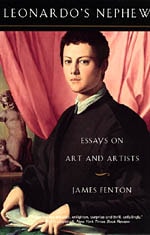
Leonardo's Nephew
Essays on Art and ArtistsJames Fenton
University of Chicago Press, 2000
"Ingenious. . . . Intrigued by emerging and unstable reputations, [Fenton] introduces us to Leonardo da Vinci's half-brother's son Pierino: a precocious sculptor celebrated by Vasari but virtually forgotten since."—Publishers Weekly
"Not surprisingly, Fenton displays throughout the passionate attentiveness of a scholar, the enthusiasm of an amateur, and the urbane cleverness of an English journalist."—Washington Post Book World
"[Fenton] is not, like Baudelaire, a poet moonlighting as art critic; he is something else again—a poetic art historian." —Karen Wright, Observer
"These essays educate, enlighten, surprise and thrill, unfailingly."—Robin Lippincott, New York Times Book Review
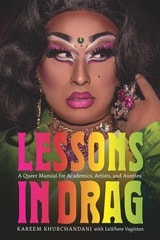
Lessons in Drag
A Queer Manual for Academics, Artists, and AuntiesKareem Khubchandani with LaWhore Vagistan
Brandeis University Press, 2025
Lessons in Drag brings to life a vibrant and thought-provoking dialogue between scholar Kareem Khubchandani and his drag persona LaWhore Vagistan. Beginning with an intimate interview, the book unfolds in alternating chapters where the two exchange insights, stories, and critiques. Khubchandani delves into the lessons LaWhore’s drag practice offers about academia—shaping his approaches to research, teaching, and writing—while Vagistan reveals how Khubchandani’s scholarship influences her performances, inspiring her understanding of fashion, music, divas, and aunties. Together, their reflections and conversations weave a compelling tapestry of drag’s instructive power. Witty, bold, and deeply personal, Lessons in Drag is both an invitation to explore drag as a practice and a celebration of its transformative potential.
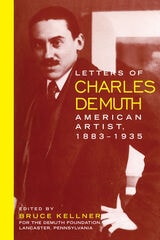
Letters Of Charles Demuth
Bruce Kellner
Temple University Press, 2000
This collection of 155 of his letters offers valuable views of the arts and letters colonies in Provincetown, New York, and Paris. Besides offering information on Demuth's own works, the letters also shed light on the output of his contemporaries, as well as references to their trips, liaisons, and idiosyncrasies. Demuth numbered among his correspondents some of the most famous artists and writers of his time, including Georgia O'Keeffe, Eugene O'Neill, John Reed, Gertrude Stein, Alfred Stieglitz, Carl Van Vechten, and William Carlos Willliams. In his travels in the United States and abroad, he encountered many other talented contemporaries: Peggy Bacon, Muriel Draper, Marcel Duchamp, the Stetthemer sisters, artists and writers, patrons, and gallery owners.
Whether he is offering to pick up a copy of Joyce's Ulysses for Eugene O'Neill or trying to convince Georgia O'Keeffe to decorate his music room ("just allow that red and yellow 'canna' one to spread until it fills the room"), Demuth is always in the thick of art and literary life. Flamboyant in attire but discreet in his homosexuality, Demuth also reveals in his letters the life of a talented homosexual in the teens and twenties. With his best friends Robert Locher and Marsden Hartley, he circulated through the art colonies of Greenwich Village, Provincetown, and Paris, meeting everyone.
The book also contains reprints of some short appraisals of Demuth and his work that were published during his lifetime, long out of print, including pieces by A. E. Gallatin, Angela E. Hagen, Marsden Hartley, Helen Henderson, Henry McBride, Carl Van Vechten, Rita Wells, and Willard Huntington Wright.
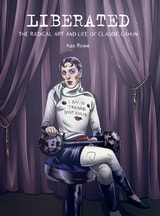
Liberated
The Radical Art and Life of Claude CahunKaz Rowe
J. Paul Getty Trust, The, 2023
At the turn of the twentieth century in Nantes, France, Lucy Schwob met Suzanne Malherbe, and lightning struck. The two became partners both artistically and romantically and transformed themselves into the creative personas Claude Cahun and Marcel Moore. Together, the couple embarked on a radical journey of Surrealist collaboration that would take them from conservative provincial France to the vibrancy of 1920s Paris to the oppression of Nazi-occupied Jersey during World War II, where they used art to undermine the Nazi regime.
Cahun and Moore challenged gender roles and championed freedom at a time when strict societal norms meant that the truth of their relationship had to remain secret. Featuring ten photographs by Cahun and Moore, this graphic biography by cartoonist Kaz Rowe brings Cahun’s inspiring story to life.
Ages thirteen to eighteen
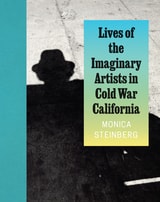
Lives of the Imaginary Artists in Cold War California
Monica Steinberg
University of Chicago Press, 2025
This book explores how a group of real California artists created imaginary artists, engaging with the political climate of the Cold War era and frustrating the discipline of art history. They employed pseudonymity, obfuscation, anonymity, (auto)biografiction, imaginary portraiture, heteronymity, role-playing, doubling, and alter ego. Often laced with humor, these exploits facilitated stylistic experimentation, provoking reactions from art viewers and governing authorities alike, and disrupting reliance on documentation and attribution within art history.
In the 1950s and early 1960s, Ed Kienholz, Walter Hopps, Robert Alexander, Wally Hedrick, George Herms, and Wallace Berman activated imagined and secret identities, provoking reactions within a conservative environment gripped by communist paranoia. As political concerns shifted in the 1960s and 1970s to movements for peace and equality, artists including Billy Al Bengston, Ed Ruscha, Joe Goode, Lynda Benglis, Larry Bell, Judy Chicago, Lowell Darling, and Eleanor Antin redirected these tactics to probe the rise of celebrity culture and the administrative state. These practices also became the precursor for later interventions by Bruce Conner, Asco, Allen Ruppersberg, Senga Nengudi, and others.
Considering a compelling range of visual material, including paintings, sculptures, and performed intrusions as well as publications, postcards, and advertisements, Monica Steinberg examines why these imaginary artists appeared when and where they did—and to what ends.
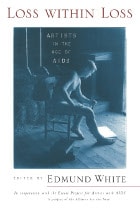
Loss within Loss
Artists in the Age of AIDSEdited by Edmund White; In Cooperation with the Estate Project for Artists with AIDS, a project of the Alliance for the Arts
University of Wisconsin Press, 2002
This landmark book is published in association with the Estate Project for Artists with AIDS, a national organization that preserves art works created by artists living with HIV or lost to AIDS. Loss within Loss stands as a powerful reminder of the devastating impact of the AIDS epidemic on the arts community and as the first real survey of that devastation. Though these accounts are often intensely sad, Loss within Loss is an invigorating, sometimes even exuberant, testimony to the sheer joy of being an artist . . . and being alive.