Results by title
197 books match the query 'Arts' and 6 start with l
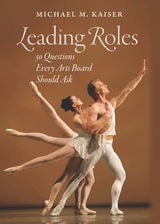
Leading Roles
50 Questions Every Arts Board Should AskMichael M. Kaiser
Brandeis University Press, 2010
Not-for-profit arts organizations struggled to survive the recent economic recession. In this increasingly hardscrabble environment, it is absolutely imperative that the boards of these organizations function as energetically, creatively, and efficiently as possible. Michael M. Kaiser’s personal history with boards of arts organizations began when he served on the board of the Washington Opera (now the Washington National Opera) in 1983. Today, in his capacity as president of the John F. Kennedy Center for the Performing Arts, Kaiser recently completed a 50-state, 69-city Arts in Crisis tour. Board issues came up repeatedly as central to the success or failure of the organization. Drawing on these and many other conversations, nationally and internationally, Kaiser’s book offers members of boards and staffs the information they need to create the healthy atmosphere necessary to thriving arts organizations. Organized in a clear, readable, question-and-answer format, Leading Roles covers every aspect of board participation in the life of the organization, including mission and governance; fundraising and marketing responsibilities; the relationship of the board to the artistic director, executive director, and staff; and its responsibilities for planning and budgeting. Kaiser addresses boards in crisis, international boards, and boards of arts organizations of color. Throughout, he emphasizes the importance of transparency and clarity in the board’s dealings with its own members and those of the arts community of which it is a part, showing how anything less results in contentiousness that can immobilize an arts organization, or even tear it apart.
[more]

Leaving Art
Writings on Performance, Politics, and Publics, 1974-2007Suzanne Lacy
Duke University Press, 2010
Since the 1970s, the performance and conceptual artist Suzanne Lacy has explored women’s lives and experiences, as well as race, ethnicity, aging, economic disparities, and violence, through her pioneering community-based art. Combining aesthetics and politics, and often collaborating with other artists and community organizations, she has staged large-scale public art projects, sometimes involving hundreds of participants. Lacy has consistently written about her work: planning, describing, and analyzing it; advocating socially engaged art practices; theorizing the relationship between art and social intervention; and questioning the boundaries separating high art from popular participation. By bringing together thirty texts that Lacy has written since 1974, Leaving Art offers an intimate look at the development of feminist, conceptual, and performance art since those movements’ formative years. In the introduction, the art historian Moira Roth provides a helpful overview of Lacy’s art and writing, which in the afterword the cultural theorist Kerstin Mey situates in relation to contemporary public art practices.
[more]
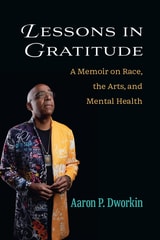
Lessons in Gratitude
A Memoir on Race, the Arts, and Mental HealthAaron P. Dworkin
University of Michigan Press, 2024
Lessons in Gratitude tells the story of Aaron Dworkin, a MacArthur Fellow, social entrepreneur, and spoken word artist who has dedicated his life’s work to changing the face of classical arts in the world. The themes of persistence, passion, and loyalty shine through stories of an unhappy childhood, a lifelong search for identity, and the obstacles of race, culture, and class. Readers will learn how the author greets these challenges and how they drove him to make a difference for people who are shut out of opportunity. Persistence in the face of multiple failures and false starts ultimately led Dworkin to create the Sphinx Organization, whose mission is to address the underrepresentation of Black and Latinx people in the field of the classical arts.
Aaron’s unique journey, which begins with his adoption by a white Jewish couple from Chicago at two weeks of age, leads him to the ultimate reunification with his birth family at the age of 31. Lessons of Gratitude is a coming of age story that examines the difficulties of biracial identity across generations and the challenges that mixed race families still face today. It is also a painful and honest adoption memoir, further complicating the narrator’s experiences of racial identity throughout his life and shaping his experiences with his own children. Through his work in the arts and the impact of this work, Dworkin has been able to “pay forward” the first thing that offered him unconditional love—music.
Aaron’s unique journey, which begins with his adoption by a white Jewish couple from Chicago at two weeks of age, leads him to the ultimate reunification with his birth family at the age of 31. Lessons of Gratitude is a coming of age story that examines the difficulties of biracial identity across generations and the challenges that mixed race families still face today. It is also a painful and honest adoption memoir, further complicating the narrator’s experiences of racial identity throughout his life and shaping his experiences with his own children. Through his work in the arts and the impact of this work, Dworkin has been able to “pay forward” the first thing that offered him unconditional love—music.
[more]
Lessons in Gratitude
A Memoir on Race, the Arts, and Mental HealthAaron P. Dworkin
University of Michigan Press, 2024
Lessons in Gratitude tells the story of Aaron Dworkin, a MacArthur Fellow, social entrepreneur, and spoken word artist who has dedicated his life’s work to changing the face of classical arts in the world. The themes of persistence, passion, and loyalty shine through stories of an unhappy childhood, a lifelong search for identity, and the obstacles of race, culture, and class. Readers will learn how the author greets these challenges and how they drove him to make a difference for people who are shut out of opportunity. Persistence in the face of multiple failures and false starts ultimately led Dworkin to create the Sphinx Organization, whose mission is to address the underrepresentation of Black and Latino people in the field of the classical arts.
Aaron’s unique journey, which begins with his adoption by a white Jewish couple from Chicago at two weeks of age, leads him to the ultimate reunification with his birth family at the age of 31. Lessons in Gratitude is a coming of age story that examines the difficulties of biracial identity across generations and the challenges that mixed race families still face today. It is also a painful and honest adoption memoir, further complicating the narrator’s experiences of racial identity throughout his life and shaping his experiences with his own children. Through his work in the arts and the impact of this work, Dworkin has been able to “pay forward” the first thing that offered him unconditional love—music.
Aaron’s unique journey, which begins with his adoption by a white Jewish couple from Chicago at two weeks of age, leads him to the ultimate reunification with his birth family at the age of 31. Lessons in Gratitude is a coming of age story that examines the difficulties of biracial identity across generations and the challenges that mixed race families still face today. It is also a painful and honest adoption memoir, further complicating the narrator’s experiences of racial identity throughout his life and shaping his experiences with his own children. Through his work in the arts and the impact of this work, Dworkin has been able to “pay forward” the first thing that offered him unconditional love—music.
[more]
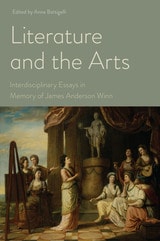
Literature and the Arts
Interdisciplinary Essays in Memory of James Anderson WinnAnna Battigelli
University of Delaware Press, 2024
The ten essays in Literature and the Arts explore the intermedial plenitude of eighteenth-century English culture, honoring the memory of James Anderson Winn, whose work demonstrated how seeing that interplay of the arts and literature was essential to a full understanding of Restoration and eighteenth-century English culture. Scenery, machinery, music, dance, and texts transformed one another, both enriching and complicating generic distinctions. Artists were alive to the power of the arts to reflect and shape reality, and their audience was quick to turn to the arts as performative pleasures and critical lenses through which to understand a changing world. This collection's eminent authors discuss estate design, musicalized theater, the visual spectacle of musical performance, stage machinery and set designs, the social uses of painting and singing, drama’s reflection of a transformed military infrastructure, and the arts of memory and of laughter.
[more]
Lockdown Cultures
The Arts and Humanities in the Year of the Pandemic, 2020–21Edited by Stella Bruzzi and Maurice Biriotti Biriotti
University College London, 2022
How the pandemic has changed and reinvigorated the arts and humanities.
Lockdown Cultures is both a cultural response to our extraordinary times and a manifesto for the arts and humanities and their role in our post-pandemic society. This book offers a unique response to the question of how the humanities have responded to the dominant crisis of our times: the Covid-19 pandemic. While the roles of engineers, epidemiologists, and, of course, medics are assumed, this volume illustrates some of how the humanities understood and analyzed 2020–21, the year of lockdown and plague. Though the impulse behind the book was topical, underpinning the richly varied and individual essays is a lasting concern with the value of the humanities in the twenty-first century. Each contributor approaches this differently but there are two dominant strands: how art and culture can help us understand the Covid crisis; and how the value of the humanities can be demonstrated by engaging with cultural products from the past. The result is a book that serves as a testament to the humanities’ reinvigorated and reforged sense of identity. It bears witness to a globally impactful event while showcasing interdisciplinary thinking and examining how the pandemic has changed how we read, watch, write and educate. More than thirty individual contributions collectively reassert the importance of the arts and humanities for contemporary society.
Lockdown Cultures is both a cultural response to our extraordinary times and a manifesto for the arts and humanities and their role in our post-pandemic society. This book offers a unique response to the question of how the humanities have responded to the dominant crisis of our times: the Covid-19 pandemic. While the roles of engineers, epidemiologists, and, of course, medics are assumed, this volume illustrates some of how the humanities understood and analyzed 2020–21, the year of lockdown and plague. Though the impulse behind the book was topical, underpinning the richly varied and individual essays is a lasting concern with the value of the humanities in the twenty-first century. Each contributor approaches this differently but there are two dominant strands: how art and culture can help us understand the Covid crisis; and how the value of the humanities can be demonstrated by engaging with cultural products from the past. The result is a book that serves as a testament to the humanities’ reinvigorated and reforged sense of identity. It bears witness to a globally impactful event while showcasing interdisciplinary thinking and examining how the pandemic has changed how we read, watch, write and educate. More than thirty individual contributions collectively reassert the importance of the arts and humanities for contemporary society.
[more]