435 books match the query 'Asian American & Pacific Islander Studies' and 10 start with l

cover of Landbridge: Life in Fragments

Landbridge

Life in Fragments

Y-Dang Troeung

Duke University Press, 2024
In 1980, Y-Dang Troeung and her family were among the last of the 60,000 refugees from Cambodia that Canada agreed to admit. Their landing was widely documented in newspapers, with photographs of the prime minister shaking Troeung’s father’s hand and patting baby Y-Dang’s head. Troeung became a literal poster child for the benevolence of the Canadian refugee project. She returns to this moment forty years later in her arresting memoir Landbridge, where she explores the tension between that public narrative of happy “arrival,” and the multiple, often hidden truths of what happened to her family. In precise, beautiful prose, Troeung moves back and forth in time to tell stories about her parents and two brothers who lived through the Cambodian genocide, about the lives of her grandparents and extended family, about her own childhood in the refugee camps and in rural Ontario, and eventually about her young son’s illness and her own diagnosis with a terminal disease. Throughout this brilliant and astonishing book, Troeung looks with bracing clarity at refugee existence and dares to imagine a better future, with love.
[more]
cover of Laotian Daughters: Working toward Community, Belonging, and Environmental Justice

Laotian Daughters

Working toward Community, Belonging, and Environmental Justice

Bindi V. Shah

Temple University Press, 2011

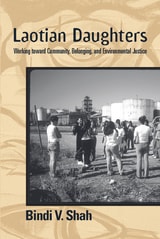
Laotian Daughters focuses on second-generation environmental justice activists in Richmond, California. Bindi Shah's pathbreaking book charts these young women's efforts to improve the degraded conditions in their community and explores the ways their activism and political practices resist the negative stereotypes of race, class, and gender associated with their ethnic group.

Using ethnographic observations, interviews, focus groups, and archival data on their participation in Asian Youth Advocates—a youth leadership development project—Shah analyzes the teenagers' mobilization for social rights, cross-race relations, and negotiations of gender and inter-generational relations. She also addresses issues of ethnic youth, and immigration and citizenship and how these shape national identities.

Shah ultimately finds that citizenship as a social practice is not just an adult experience, and that ethnicity is an ongoing force in the political and social identities of second-generation Laotians.
[more]
cover of Legions of Boom: Filipino American Mobile DJ Crews in the San Francisco Bay Area

Legions of Boom

Filipino American Mobile DJ Crews in the San Francisco Bay Area

Oliver Wang

Duke University Press, 2015
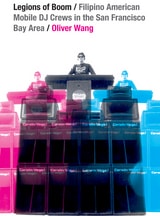
Armed with speakers, turntables, light systems, and records, Filipino American mobile DJ crews, such as Ultimate Creations, Spintronix, and Images, Inc., rocked dance floors throughout the San Francisco Bay Area from the late 1970s through the mid-1990s. In Legions of Boom noted music and pop culture writer and scholar Oliver Wang chronicles this remarkable scene that eventually became the cradle for turntablism. These crews, which were instrumental in helping to create and unify the Bay Area's Filipino American community, gave young men opportunities to assert their masculinity and gain social status. While crews regularly spun records for school dances, weddings, birthdays, or garage parties, the scene's centerpieces were showcases—or multi-crew performances—which drew crowds of hundreds, or even thousands. By the mid-1990s the scene was in decline, as single DJs became popular, recruitment to crews fell off, and aspiring scratch DJs branched off into their own scene. As the training ground for a generation of DJs, including DJ Q-Bert, Shortkut, and Mix Master Mike, the mobile scene left an indelible mark on its community that eventually grew to have a global impact.
[more]
cover of Literary Gestures: The Aesthetic in Asian American Writing

Literary Gestures

The Aesthetic in Asian American Writing

edited by Rocío G. Davis and Sue-Im Lee

Temple University Press, 2005
Literary Gestures:The Aesthetic in Asian American Writing contests the dominance of materialist and cultural critiques in Asian American literary discourse by re-centering critical attention around issues of aesthetics and literary form. Collapsing the perceived divisions between the "ethnic" and the "aesthetic" in Asian American literary criticism, the eleven original essays in this volume provide theoretically sophisticated and formally sensitive readings of works in prose, poetry, and drama. These contributions bring discussions of genre, canonicity, narrative, and literary value to the fore to show how aesthetic and formal concerns play an important part in the production and consumption of these works. By calling for a more balanced mode of criticism, this collection invites students and scholars to reinvest in the literary, not as a negation of the sociopolitical, but as a complementary strategy in reading and understanding Asian American literature.
[more]
cover of Little Manila Is in the Heart: The Making of the Filipina/o American Community in Stockton, California

Little Manila Is in the Heart

The Making of the Filipina/o American Community in Stockton, California

Dawn Bohulano Mabalon

Duke University Press, 2013

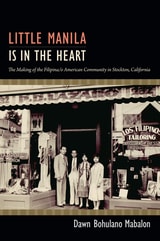
In the early twentieth century—not long after 1898, when the United States claimed the Philippines as an American colony—Filipinas/os became a vital part of the agricultural economy of California's fertile San Joaquin Delta. In downtown Stockton, they created Little Manila, a vibrant community of hotels, pool halls, dance halls, restaurants, grocery stores, churches, union halls, and barbershops. Little Manila was home to the largest community of Filipinas/os outside of the Philippines until the neighborhood was decimated by urban redevelopment in the 1960s. Narrating a history spanning much of the twentieth century, Dawn Bohulano Mabalon traces the growth of Stockton's Filipina/o American community, the birth and eventual destruction of Little Manila, and recent efforts to remember and preserve it.

Mabalon draws on oral histories, newspapers, photographs, personal archives, and her own family's history in Stockton. She reveals how Filipina/o immigrants created a community and ethnic culture shaped by their identities as colonial subjects of the United States, their racialization in Stockton as brown people, and their collective experiences in the fields and in the Little Manila neighborhood. In the process, Mabalon places Filipinas/os at the center of the development of California agriculture and the urban West.

[more]
cover of Little Saigons: Staying Vietnamese in America

Little Saigons

Staying Vietnamese in America

Karin Aguilar–San Juan

University of Minnesota Press, 2009

Karin Aguilar-San Juan examines the contradictions of Vietnamese American community and identity in two emblematic yet different locales: Little Saigon in suburban Orange County, California (widely described as the capital of Vietnamese America) and the urban "Vietnamese town" of Fields Corner in Boston, Massachusetts. Their distinctive qualities challenge assumptions about identity and space, growth amid globalization, and processes of Americanization.

With a comparative and race-cognizant approach, Aguilar-San Juan shows how places like Little Saigon and Fields Corner are sites for the simultaneous preservation and redefinition of Vietnamese identity. Intervening in debates about race, ethnicity, multiculturalism, and suburbanization as a form of assimilation, this work elaborates on the significance of place as an integral element of community building and its role in defining Vietnamese American-ness.

Staying Vietnamese, according to Aguilar-San Juan, is not about replicating life in Viet Nam. Rather, it involves moving toward a state of equilibrium that, though always in flux, allows refugees, immigrants, and their U.S.-born offspring to recalibrate their sense of self in order to become Vietnamese anew in places far from their presumed geographic home.
[more]
cover of Locating Filipino Americans

Locating Filipino Americans

Rick Bonus

Temple University Press, 2000

The Filipino American population in the U.S.  is expected to reach more than two million by the next  century. Yet many Filipino Americans contend that years of formal and covert exclusion from mainstream political, social, and economic institutions on the basis of their race have perpetuated racist stereotypes about them, ignored their colonial and immigration history, and prevented them from becoming fully recognized citizens of the nation. Locating Filipino Americans shows how Filipino Americans counter exclusion by actively engaging in alternative practices of community building.

Locating Filipino Americans, an ethnographic study of Filipino American communities in Los Angeles and San Diego, present a multi-disciplinary cultural analysis of the relationship between ethnic identity and social space. Author Rick Bonus argues that alternative community spaces enable Filipino Americans to respond to and resist the ways in which the larger society has historically and institutionally rendered them invisible, silenced, and racialized. Bonus focuses on the "Oriental" stores, the social halls and community centers, and the community newspapers to demonstrate how ethnic identities are publicly constituted and communities are transformed. Delineating the spaces formed by diasporic consciousness, Bonus shows how community members appropriate elements from their former homeland and from their new settlements in ways defined by their critical stances against racism, homogenization, complete assimilation, and exclusionary citizenship. Locating Filipino Americans is one of the few books that offers a grounded approach to theoretical analyses of ethnicity and contemporary culture in the U.S.

[more]
cover of Lost and Found: Reclaiming the Japanese American Incarceration

Lost and Found

Reclaiming the Japanese American Incarceration

Karen L. Ishizuka

University of Illinois Press, 2006

For decades, a fog of governmental cover-ups, euphemisms, and societal silence kept the victims the mass incarceration of Americans of Japanese descent during World War II from understanding their experiences. The Japanese American National Museum mounted a critically acclaimed exhibition with the twin goals of educating the general public and encouraging former inmates to come to grips with and tell their own history. 

Combining heartfelt stories with first-rate scholarship, Lost and Found reveals the complexities of a people reclaiming the past. Author/curator Karen L. Ishizuka, a third-generation Japanese American, deftly blends official history with community memory to frame the historical moment of recovery within its cultural legacy. Detailing the interactive strategy that invited visitors to become part of the groundbreaking exhibition, Ishizuka narrates the processes of revelation and reclamation that unfolded as former internees and visitors alike confronted the experience of the camps. She also analyzes how the dual act of recovering—and recovering from—history necessitates private and public mediation between remembering and forgetting, speaking out and remaining silent.
[more]
cover of Lost in Translation: Orientalism, Cinema, and the Enigmatic Signifier

Lost in Translation

Orientalism, Cinema, and the Enigmatic Signifier

Homay King

Duke University Press, 2010

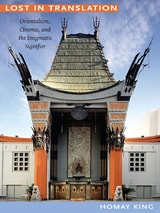
In a nuanced exploration of how Western cinema has represented East Asia as a space of radical indecipherability, Homay King traces the long-standing association of the Orient with the enigmatic. The fantasy of an inscrutable East, she argues, is not merely a side note to film history, but rather a kernel of otherness that has shaped Hollywood cinema at its core. Through close readings of The Lady from Shanghai, Chinatown, Blade Runner, Lost in Translation, and other films, she develops a theory of the “Shanghai gesture,” a trope whereby orientalist curios and décor become saturated with mystery. These objects and signs come to bear the burden of explanation for riddles that escape the Western protagonist or cannot be otherwise resolved by the plot. Turning to visual texts from outside Hollywood which actively grapple with the association of the East and the unintelligible—such as Michelangelo Antonioni’s Chung Kuo: Cina, Wim Wenders’s Notebook on Cities and Clothes, and Sophie Calle’s Exquisite Pain—King suggests alternatives to the paranoid logic of the Shanghai gesture. She argues for the development of a process of cultural “de-translation” aimed at both untangling the psychic enigmas prompting the initial desire to separate the familiar from the foreign, and heightening attentiveness to the internal alterities underlying Western subjectivity.
[more]
cover of Lured by the American Dream: Filipino Servants in the U.S. Navy and Coast Guard, 1952-1970

Lured by the American Dream

Filipino Servants in the U.S. Navy and Coast Guard, 1952-1970

P. James Paligutan

University of Illinois Press, 2022

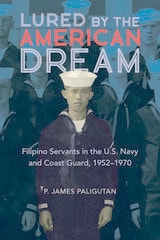
Starting in 1952, the United States Navy and Coast Guard actively recruited Filipino men to serve as stewards--domestic servants for officers. Oral histories and detailed archival research inform P. James Paligutan's story of the critical role played by Filipino sailors in putting an end to race-based military policies. Constrained by systemic exploitation, Filipino stewards responded with direct complaints to flag officers and chaplains, rating transfer requests that flooded the bureaucracy, and refusals to work. Their actions had a decisive impact on seagoing military’s elimination of the antiquated steward position. Paligutan looks at these Filipino sailors as agents of change while examining the military system through the lens of white supremacy, racist perceptions of Asian males, and the motives of Filipinos who joined the armed forces of the power that had colonized their nation.

Insightful and dramatic, Lured by the American Dream is the untold story of how Filipino servicepersons overcame tradition and hierarchy in their quest for dignity.

[more]