70 books match the query 'Authority' and 4 start with l
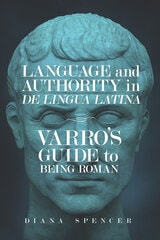
cover of Language and Authority in De Lingua Latina: Varro's Guide to Being Roman

Language and Authority in De Lingua Latina

Varro's Guide to Being Roman

Diana Spencer

University of Wisconsin Press, 2022
Diana Spencer, known for her scholarly focus on how ancient Romans conceptualized themselves as a people and how they responded to and helped shape the world they lived in, brings her expertise to an examination of the Roman scholar Varro and his treatise De Lingua Latina. This commentary on the origin and relationships of Latin words is an intriguing, but often puzzling, fragmentary work for classicists. Since Varro was engaged in defining how Romans saw themselves and how they talked about their world, Spencer reads along with Varro, following his themes and arcs, his poetic sparks, his political and cultural seams. Few scholars have accepted the challenge of tackling Varro and his work, and in this pioneering volume, Spencer provides a roadmap for considering these topics more thoroughly.
[more]
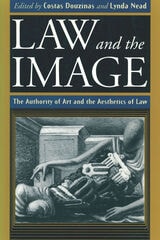
cover of Law and the Image: The Authority of Art and the Aesthetics of Law

Law and the Image

The Authority of Art and the Aesthetics of Law

Edited by Costas Douzinas and Lynda Nead

University of Chicago Press, 1999

This highly original collection brings together some of the most important minds in both contemporary art history and theory, and law and legal history. The result is a fascinating discussion of the diverse relationships between law and the artistic image.

The essays draw on the critical procedures of law, art history, and cultural studies in order to create a new interdisciplinary field of visual culture and law. In exploring the hidden interdependence of law and art, the writings refute the generally held conception that law is fixed and rational while the judgment of art is autonomous and ambiguous. Among the topics addressed are the history of the relationship between art and law, the ways in which the visual is made subject to the force of the law, and the complex relations between law, the image, and identity.

With its groundbreaking ideas from a variety of intellectual traditions and disciplines, this book puts law and art into a new and exciting conversation that will introduce a new field of study and spark international debate.

Contributors are: Georges Didi-Huberman, Costas Douzinas, Hal Foster, Peter Goodrich, Piyel Haldar, Martin Jay, Mandy Merck, Lynda Nead, Jonathan Ribner, Katherine Fischer Taylor.
[more]
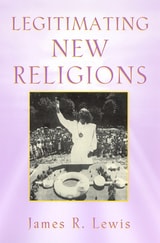
cover of Legitimating New Religions

Legitimating New Religions

Lewis, James R

Rutgers University Press, 2003

James R. Lewis has written the first book to deal explicitly with the issue of how emerging religions legitimate themselves. He contends that a new religion has at least four different, though overlapping, areas where legitimacy is a concern: making converts, maintaining followers, shaping public opinion, and appeasing government authorities. The legitimacy that new religions seek in the public realm is primarily that of social acceptance. Mainstream society's acknowledgement of a religion as legitimate means recognizing its status as a genuine religion and thus recognizing its right to exist. Through a series of wide-ranging case studies Lewis explores the diversification of legitimation strategies of new religions as well the tactics that their critics use to de-legitimate such groups. Cases include the Movement for Spiritual Inner Awareness, Native American prophet religions, spiritualism, the Church of Christ-Scientist, Scientology, Church of Satan, Heaven's Gate, Unitarianism, Hindu reform movements, and Soka Gakkai, a new Buddhist sect.

Since many of the issues raised with respect to newer religions can be extended to the legitimation strategies deployed by established religions, this book sheds an intriguing new light on classic questions about the origin of all religions.
[more]
cover of Loser Sons: Politics and Authority

Loser Sons

Politics and Authority

Avital Ronell

University of Illinois Press, 2013

There are sons who grow up unhappily believing that no matter what they do, they cannot please their fathers. Often unable to shed their sense of lifelong failure, either they give up and suffer in a permanent sulk, or they try with all their might to prove they are worth something after all. These are the "loser sons," a group of historical men as varied as President George W. Bush, Osama bin Laden, and Mohammed Atta. Their names quickly illustrate that not only are their problems serious, but they also make serious problems for others, expanding to whole nations. When God is conceived and inculcated as an angry and impossible-to-please father, the problems can last for generations.
 
In Loser Sons, Avital Ronell draws on current philosophy, literary history, and political events to confront the grim fact that divested boys become terrifying men. This would be old news if the problem didn't recur so often with such disastrous consequences. Looking beyond our current moment, she interrogates the problems of authority, paternal fantasy, and childhood as they have been explored and exemplified by Franz Kafka, Goethe's Faust, Benjamin Franklin, Jean-François Lyotard, Hannah Arendt, Alexandre Kojève, and Immanuel Kant.
 
Brilliantly weaving these threads into a polyvocal discourse, Ronell shows how, with their arrays of powerful symbols, ideologies of all sorts perpetuate the theme that while childhood represents innocence, adulthood entails responsible cruelty. The need for suffering--preferably somebody else's--has become a widespread assumption, not only justifying abuses of authority, but justifying authority itself. 
 
Shockingly honest, Loser Sons recognizes that focusing on the spectacular catastrophes of modernity might make writer and reader feel they're engaged in something important, while in fact what they are engaged in is still only spectacle. To understand the implications of her insights, Ronell addresses them directly to her readers, challenging them to think through their own notions of authority and their responses to it.
[more]