208 books match the query 'Autobiography' and 8 start with l
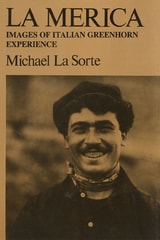
cover of La Merica: Images Of Italian Greenhorn Experience

La Merica

Images Of Italian Greenhorn Experience

Michael A. La Sorte

Temple University Press, 2003
Why would a man tie up a cheap suitcase with grass rope, leave his family and his paesani in Italy to risk his life and meager possessions among the dock thieves of Naples and Genoa to suffer the congestion and stench of steerage accommodations aboard ship, to endure the assembly-line processing of Ellis Island, to wander almost incommunicado through a city of sneering strangers speaking an unknown tongue, to perform ten to twelve hours of heavy manual labor a day for wages of perhaps $1.65—most of which he probably owed to the "company store" before he got it? Why were there not just a few such men but droves of them coming to the United States in the late nineteenth and early twentieth century? How did they survive and—some of them—prosper? How did they surmount the language barrier? Why did some stay, some go home, and some bounce back and forth repeatedly across the Atlantic?Michael La Sorte examines these questions and more in this lively study of Italian immigration prior to World War I. In exploring for answers, he draws upon the commentary of recent scholars, as well as the statistical documents of the day. But most important, he has searched out individual stories in the published and unpublished diaries, letters, and autobiographies of immigrants who lived the "greenhorn" (grignoni) experience.In their own language, the men bring to life the teeming tenements of New York's Mulberry Street, the exploitative labor-recruiting practices of Boston's North Square, and the harsh squalor of work camp life along the country's expanding railroad lines. What emerges is a powerful, moving, alternately funny and appalling picture of their everyday lives.Through detailed narration, La Sorte traces the men's lives from their native villages across the Atlantic through the ports of entry to their first immigrant jobs. He describes their views of Italy, America, and each other, the cultural and linguistic adjustments that they were compelled to make, and their motives for either Americanizing or repatriating themselves. His chapter on "Italglish" (a hybrid language developed by the greenhorns) will echo in the ears of Italian-Americans as the sound of their parents' and grandparents' voices.
[more]
cover of Legacy: A Step-By-Step Guide To Writing Personal History

Legacy

A Step-By-Step Guide To Writing Personal History

Linda Spence

Ohio University Press, 1997

When Linda Spence asked her aging mother to write her life story, her mother stared at a blank sheet of paper and asked—“How? Where do I begin?” In this practical guide to capturing those memories that have been stored away, Linda Spence provides the questions that are the keys to unlocking the memories that make up a life.

Beyond the vital statistics are the personal stories that tell what it was like, what we did, and why we did it, how we feel about our choices, and what our circumstances were. Through encouraging coaching, shared memories, and open-ended questions, the process of producing a personal history becomes intriguing and engaging.

With Legacy the possibilities expand: a personal record is preserved—with its myths, traditions, joys, pains, gains, and losses; a family opens a potential dialogue that will last for generations; the writer has an opportunity for insight and resolution; the culture of a time and place is noted; the tradition of personal story is revitalized, and our present and future find nourishment and knowledge in the past.

Either as a gift that can act as a shared experience as the memories are recounted or as a personal way to take account of one’s experiences, often long since forgotten, Legacy is indeed a way to get one’s story down.
[more]
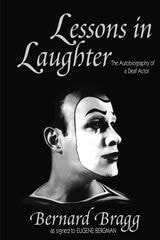
cover of Lessons in Laughter: The Autobiography of a Deaf Actor

Lessons in Laughter

The Autobiography of a Deaf Actor

Bernard Bragg

Gallaudet University Press, 1989

To succeed as an actor is a rare feat. To succeed as a deaf actor is nothing short of amazing. Lessons in Laughter is the story of Bernard Bragg and his astonishing lifelong achievements in the performing arts.

Born deaf of deaf parents, Bernard Bragg has won international renown as an actor, director, playwright, and lecturer. Lessons in Laughter recounts in stories that are humorous, painful, touching, and outrageous, the growth of his dream of using the beauty of sign language to act. He starred in his own television show “The Quiet Man,” helped found The National Theatre of the Deaf, and traveled worldwide to teach his acting methods.
[more]
cover of Life Writing in the Long Run: A Smith and Watson Autobiography Studies Reader

Life Writing in the Long Run

A Smith and Watson Autobiography Studies Reader

Sidonie Smith and Julia Watson

Michigan Publishing Services, 2016

 Life Writing in the Long Run gathers twenty-one essays by Sidonie Smith and Julia Watson written in collaboration or solo and published over the last quarter-century. It includes the introductions to their five edited collections; essays focused on such autobiographical genres as autoethnography, Bildungsroman, diary, digital life writing, genealogy, graphic memoir, human rights witnessing, manifesto; and essays engaging the key concepts of authenticity, performativity, postcoloniality, relationality, and visuality.
 
Available in print, eBook, and open access versions, this collection captures decades of exciting developments in the field, making it indispensable reading for courses on modes and media of self-presentation in cultural, gender, and literary studies and feminist theory.
[more]
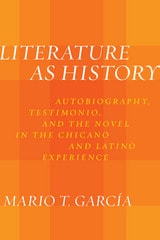
cover of Literature as History: Autobiography, Testimonio, and the Novel in the Chicano and Latino Experience

Literature as History

Autobiography, Testimonio, and the Novel in the Chicano and Latino Experience

Mario T. García

University of Arizona Press, 2016

Historical documents—and, for that matter, historical sources—exist in many forms. The traditional archival sources such as official documents, newspapers, correspondence, and diaries can be supplemented by personal archives, oral histories, and even works of fiction in order for historians to illuminate the past.

Literature as History offers a critical new path for Chicano and Latino history. Historian Mario T. García analyzes prominent works of Chicano fiction, nonfiction, and autobiographical literature to explore how they can sometimes reveal even more about ordinary people’s lives. García argues that this approach can yield personal insights into historical events that more formal documents omit, lending insights into such diverse issues as gender identity, multiculturalism, sexuality, and the concerns of the working class.

In a stimulating and imaginative look at the intersection of history and literature, García discusses the meaning and intent of narratives. Literature as History represents a unique way to rethink history. García, a leader in the field of Chicano history and one of the foremost historians of his generation, explores how Chicano historians can use Chicano and Latino literature as important historical sources. Autobiography, testimonio, and fiction are the genres the author researches to obtain new and insightful perspectives on Chicano history at the personal and grassroots levels. Breaking the boundaries between history and literature, García provides a thought-provoking discussion of what constitutes a historical source.
[more]
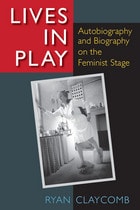
cover of Lives in Play: Autobiography and Biography on the Feminist Stage

Lives in Play

Autobiography and Biography on the Feminist Stage

Ryan Claycomb

University of Michigan Press, 2014

Lives in Play explores the centrality of life narratives to women's drama and performance from the 1970s to the present moment. In the early days of second-wave feminism, the slogan was "The personal is the political." These autobiographical and biographical "true stories" have the political impact of the real and have also helped a range of feminists tease out the more complicated aspects of gender, sex, and sexuality in a Western culture that now imagines itself to be "postfeminist."

The book covers a broad range of texts and performances, from performance artists like Karen Finley, Holly Hughes, and Bobby Baker to playwrights like Suzan-Lori Parks, Maria Irene Fornes, and Sarah Kane. The book examines biography and autobiography together to link their narrative tactics and theatrical approaches and show the persistent and important uses of life writing strategies for theater artists committed to advancing women's rights and remaking women's representations.

Lives in Play argues that these writers and artists have not only responded to the vibrant conversations in feminist theory but also have anticipated and advanced these ideas, theorizing gender onstage for specific ends. Ryan Claycomb demonstrates how these performances work through tensions between performative identity and the essentialized body, between the truth value of life stories and the constructed nature of gender and narrative alike, and between writing and performing as modes of feminist representation.

The book will appeal to scholars in performance studies, women's studies, and literature, including those in the growing field of auto/biography studies.
[more]
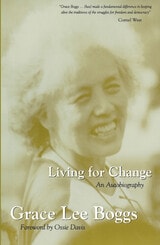
cover of Living For Change: An Autobiography

Living For Change

An Autobiography

Grace Lee Boggs

University of Minnesota Press, 1998
"Grace Lee Boggs has made a fundamental difference in keeping alive the traditions of the struggles for freedom and democracy." Cornel West "More than a deeply moving memoir, this is a book of revelation. Grace Lee Boggs, Chinese American, middle class, highly educated, discovers through her encounters with remarkable rebels, blue collars as well as philosophers, where the body is buried: who is doing what to whom in our society. It is an adventure that is truly liberating." Studs Terkel "It seems to me that the life of Grace Lee Boggs has been an exercise of will. Through sheer will, without waiting for social conditions to come around and without waiting to explore her identity, she turned her back on who she was and barged into new territories. She was a woman who barged into men's territory; she was a Chinese who barged into black territory; she was an intellectual who barged into workers territory." from a letter from Louis Tsen "Throught these pages walk causes, gatherings, confrontations, movements, and the men and women who made them: workers, and students, and committees of the People; Christians, Black Muslims, Black Panthers, Labor Unions; C.L.R. James. Rev. Cleage, Rev. Cleveland, Coleman Young, Malcolm and Martin; artists, musicians, poets, actors, strikers, and seekers of revolution." from the foreword by Ossie Davis Living for Change is a sweeping account of the life of an untraditional radical from the end of the thirties, through the cold war, the civil rights era, and the rise of Black Power, the Nation of Islam, and the Black Panthers to the present efforts to rebuild our crumbling urban communities. This fascinating autobiography traces the story of a woman who transcended class and racial boundaries to pursue her passionate belief in a better society. Grace Lee Boggs was raised in New York City during a time when her father was not allowed to buy land for their home because he was Chinese. Educated at Barnard and Bryn Mawr, Boggs was in her twenties when radical politics beckoned, and she was inspired to become a revolutionary focusing on the black community. During her early years as an activist in New York, Boggs began a twenty-year friendship and collaboration with C. L. R. James, the brilliant and influential West Indian Marxist to whom she devotes a revelatory chapter of this book. In 1953, she moved to Detroit where, she writes, "radical history had been made and could be made again." It was also the home of James Boggs, an African American auto worker (and later author and revolutionary theoretician) who would become one of the movement's freshest and most persuasive voices, as well as Grace's husband. Beginning with their work together on the newsletter Correspondence, Grace and James formed the core of a network that over the years would include Malcolm X, Lyman Paine, Ping Ferry, Ossie Davis and Ruby Dee, Kwame Nkrumah, Stokely Carmichael, and inner-city youth. Rich in the personalities and anecdotes of twentieth-century progressive activism, Living for Change is an involving and inspiring look at a remarkable woman who continues to dedicate her life to social justice. Grace Lee Boggs is a first-generation Chinese American who has been a speaker, writer, and movement activist in the African American community for fifty-five years.
[more]
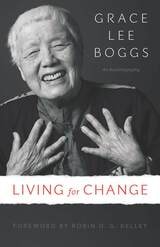
cover of Living for Change: An Autobiography

Living for Change

An Autobiography

Grace Lee Boggs

University of Minnesota Press, 2016

No one can tell in advance what form a movement will take. Grace Lee Boggs’s fascinating autobiography traces the story of a woman who transcended class and racial boundaries to pursue her passionate belief in a better society. Now with a new foreword by Robin D. G. Kelley, Living for Change is a sweeping account of a legendary human rights activist whose network included Malcolm X and C. L. R. James. From the end of the 1930s, through the Cold War, the Civil Rights era, and the rise of the Black Panthers to later efforts to rebuild crumbling urban communities, Living for Change is an exhilarating look at a remarkable woman who dedicated her life to social justice.

[more]