Results by title
484 books match the query 'Biblical Studies' and 17 start with l
L'influence de l'arameen sur les traducteurs de la LXX principalement sur les traducteurs grecs poste
Anne-Françoise Loiseau
SBL Press, 2016
Further your understanding of the methods and peculiarities of the ancient Greek translators and revisers of the Hebrew Bible
Loiseau presents examples of Greek translations of verses from the Hebrew Bible that clearly illustrate the influence of Aramaic or Late Hebrew on the semantics of the Septuagint translators. The author postulates that the Greek translators based their translations on Hebrew-Aramaic equivalents maintained as lists or even on proto-targumim such as those found at Qumran, both predecessors of the later Aramaic targumic translations. Loiseau's examples provide convincing explanations for different coincidences occurring between the Greek translations and the interpretative traditions found in the targumim and help elucidate a number of puzzling translations where two Aramaic words that are very similar graphically or phonetically were erroneously interchanged.
Features
- Unique insight into ancient Jewish exegesis
- English summary
- The first extensive illustration of the influence of the Aramaic or Late Hebrew on the Septuagint
LXX Isaiah 24
1-26:6 as Interpretation and Translation: A Methodological DiscussionWilson de Angelo Cunha
SBL Press, 2014
Explore how interpretation affects translation
In this volume Cunha argues that the differences found between the Septuagint text of Isaiah and the Hebrew of the Masoretic Text must be weighed against the literary context in which they are found. The author demonstrates that LXX Isa 24:1–26:6 can be seen as a coherent ideological composition that differs greatly from the way scholars have interpreted MT Isa 24:1–26:6. This coherence comes across through the use of certain lexemes and conjunctions throughout the passage. The book lays the case that a scribe or translator already had an interpretation before he started the process of translation that shaped his translation of the Hebrew text into Greek.
Features:
- An introduction sketching the history of research on LXX Isa 24:1–26:6
- A focused comparision of the Masoretic Text to the Septuagint
- A thorough discussion of the coherence of LXX Isa 24:1–26:6
La Violencia and the Hebrew Bible
The Politics and Histories of Biblical Hermeneutics on the AmericaSusanne Scholz
SBL Press, 2016
Exegetically noteworthy and culturally-theologically relevant
Violence in its wide range of horrifying expressions is real in people’s lives, and biblical interpreters must take violence in the world seriously to arrive at relevant ideas about the place of the Bible in the world. Each essay addresses people’s experiences of violence in the study of the Bible through the context of la violencia, the Spanish noun referring to the brutal, repressive, and murderous policies of state-sponsored violence practiced in many South and Central American and Caribbean countries during the twentieth century that external powers such as the USA often endorsed and fostered. The volume represents an important contribution to biblical studies and to the field of Latina/o studies. The contributors are Cheryl B. Anderson, Pablo Andiñach, Nancy Bedford, Lee Cuéllar, Steed V. Davidson, Serge Frolov, Renata Furst, Julia M. O’Brien, Todd Penner, José Enrique Ramírez, Ivoni Richter Reimer, and Susanne Scholz.
Features:
- Twelve essays by scholars living and working on the American continent
- Articles reveal the complex historical, political, and cultural conditions on the American continent that have contributed to our understanding of violence in the Bible
- Focus on themes of racial, social, and cultural violence
Latino/a Biblical Hermeneutics
Problematics, Objectives, StrategiesFrancisco Lozada Jr.
SBL Press, 2014
Engage essays that are profoundly theological and resolutely social
In this collection of essays, contributors seek to analyze the vision of the critical task espoused by Latino/a critics. The project explores how such critics approach their vocation as critics in the light of their identity as members of the Latino/a experience and reality. A variety of critics—representing a broad spectrum of the Latino/a American formation, along various axes of identity—address the question in whatever way they deem appropriate: What does it mean to be a Latino/a critic?
Features:
- Essays from sixteen scholars
- Articles bring together the fields of biblical studies and racial-ethnic studies
- Conclusion addresses directions for future research

Law and Liberty
Jesus, Paul, and the Newness of ChristianityRomano Penna
Catholic University of America Press, 2026
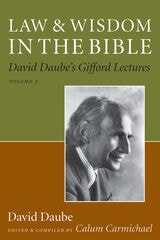
Law and Wisdom in the Bible
David Daube's Gifford Lectures, Volume IIDavid Daube
Templeton Press, 2010
"That over forty years after they were delivered these famous but unavailable Gifford Lectures should be published is occasion for celebration. Once again we hear Daube’s voice, patient and probing, as he turns over, tests, pushes fresh inquiries, and finds new insights. No man has had such a subtle sense of scriptural texts matched by such a supple sense of the practices and peculiarities of human beings engaged in the legal process. Law and Wisdom in the Bible is classic Daube." mdash;John T. Noonan Jr., United States Circuit Judge
David Daube (1909–99) was known for his unique and sophisticated research on Roman law, biblical law, Jewish Law, and medical ethics. In Law and Wisdom in the Bible, the first published collection of his 1964 Gifford Lectures, Daube derives from his complex understanding of biblical texts both ancient and contemporary notions about wisdom, justice, and education.
In addressing these and other profound issues, Daube crosses traditional disciplinary boundaries and bridges the
gap between humanism and religion, especially with regard to Christianity and Judaism. With his sophisticated understanding of Talmudic law and literature, his thinking, which is on full display in these lectures, revolutionized prevailing perceptions about the New Testament.
Legal Writing, Legal Practice
The Biblical Bailment Law and Divine JusticeYael Landman
SBL Press, 2022
Liars, Brutes, and Gluttons
A Relevance-Theory Solution for Titus 1:12Isaiah Allen
SBL Press, 2025
Liberating Our Imaginations
The Bible and Minoritized LiteratureDavid Janzen
SBL Press, 2025
Life in Kings
Reshaping the Royal Story in the Hebrew BibleA. Graeme Auld
SBL Press, 2017
Follow the words with an expert
Building on a lifetime of research and writing, A. Graeme Auld examines passages in Samuel, Kings, Chronicles, and Isaiah that recount the same stories or contain similar vocabulary. He advances his argument that Samuel and Kings were organic developments from a deftly crafted, prophetically interpreted, shared narrative he calls the Book of Two Houses—a work focused on the house of David and the house of Yahweh in Jerusalem. At the end of the study he reconstructs the synoptic material within Kings in Hebrew with an English translation.
Features
- aAcritique of the dominant approach to the narrative books in the Hebrew Bible
- A solid challenge to the widely accepted relationship between Deuteronomy, cultic centralization, and King Josiah’s reform
- Key evidence in the heated contemporary debate over the historical development of Biblical Hebrew
Light for the Nations
The Scriptures on the Universal Mission of Israel and the ChurchLuis Sanchez-Navarro
Catholic University of America Press, 2024
Lincoln's Gettysburg Address
Echoes of the Bible and Book of Common PrayerA. E. Elmore
Southern Illinois University Press, 2009
While it has long been determined that Abraham Lincoln’s writings were influenced by the King James Bible, until now no full-length study has shown the precise ways in which the Gettysburg Address uses its specific language. Refuting the view that the address was crafted with traditional classical references, this revealing investigation provides a new way to think about the speech and the man who wrote it. A. E. Elmore offers chapter and verse evidence from the Bible as well as specific examples from the Episcopal Book of Common Prayer to illustrate how Lincoln borrowed from these sources to imbue his speech with meanings that would resonate with his listeners. He cites every significant word and phrase—conceived, brought forth, struggled, remaining, consecrate, dedicate, hallow, devotion, new birth, to name a few—borrowed by Lincoln from these two religious texts for use in his dedication of the Gettysburg National Cemetery.
Lincoln’s Gettysburg Address focuses on a number of overlooked themes and ideas, such as the importance of literary allusion and the general public’s knowledge of the Bible in the age of Lincoln. It provides fresh answers to old questions and poses new questions: Was Lincoln a common thief who made use of words from previously published materials as well as from works by his contemporaries? Was he a genius whose literary and political skills were unmatched? No one who reads this highly engaging study will ever think about Lincoln or the Gettysburg Address the same way again.
Liturgical Hermeneutics of Sacred Scripture
Marco Benini
Catholic University of America Press, 2023
Lot’s Wife in Jewish, Christian, and Islamic Traditions
Josey Bridges Snyder Snyder
SBL Press, 2025
Loving Yusuf
Conceptual Travels from Present to PastMieke Bal
University of Chicago Press, 2008
Through this inquiry she develops concepts for the analysis of texts that are both strange and overly familiar—culturally remote yet constantly retold. As she puts personal memories in dialogue with scholarly exegesis, Bal asks how all of these different versions complicate her own and others’ experience of the story, and how the different truths of these texts in their respective traditions illuminate the process of canonization.
Lucifer of Cagliari and the Text of 1-2 Kings
Tuukka Kauhanen
SBL Press, 2018
The most up-to-date study of the text history of 1 and 2 Kings
In this book, Tuukka Kauhanen approaches the challenging case of the textual history of 1 and 2 Kings through citations of the text found within the writings of the fourth-century bishop of Sadinia, Lucifer of Cagliari. Kauhanen presents evidence that Lucifer's Latin text sheds important light on lost Hebrew and Greek pieces of the textual puzzle in Kings. In doing so, he compares all of Lucifer's extensive quotations of Kings to extant Greek witnesses as well as Old Latin witnesses where available and subsequently analyzes the probable reasons for textual variations. In each instance he attempts to choose the best possible candidate for the Old Greek reading and where that reading might reflect a now-lost Hebrew text.
Features
- Use of the most current research into the text of the Hebrew Bible and the Septuagint, including the Hebrew Bible: A Critical Edition series and the forthcoming Göttingen Septuagint edition of King
- An appendix listing readings from the analysis sections arranged according to agreement patterns and other meaningful criteria
- Charts comparing readings
Lydia as a Rhetorical Construct in Acts
Alexandra Gruca-Macaulay
SBL Press, 2016
A new sociorhetorical study of Acts
In Lydia as a Rhetorical Construct in Acts, Gruca-Macaulay explores the sociorhetorical function of the story of Lydia, a named Lydian woman ancient interpreters would have associated with cultural stereotypes of Lydians. As a rhetorical figure, Lydia both influenced and was influenced by the ideology of the surrounding text in Acts 16, as well as the approach Luke–Acts as a whole takes to people who are somehow like Lydia.
Features:
- Displays the rhetorical-cultural portrayal of women in Luke-Acts from the perspective of a first-century Mediterranean audience as compared with the history of scholarship, specifically through a sociorhetorical interpretation of the role of Lydia in Acts
- Investigates the rhetorical function of Mediterranean social-cultural topoi in qualitative argumentation, with a focus on Greco-Roman physiognomy generally, and Lydian ethnography especially
- Introduces the rhetorical use of conceptual blending, particularly its application for gaining insight into the function of military discourse in developing the rhetorical force of the Lydia episode in Acts