Results by title
128 books match the query 'Buildings, structures, etc' and 6 start with l
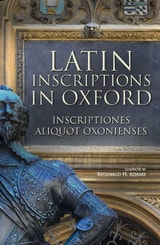
Latin Inscriptions in Oxford
Compiled with Translations by Reginald H. Adams
Bodleian Library Publishing, 2015
For Latin Inscriptions in Oxford, Reginald H. Adams, a former scholar at St. John’s College, University of Oxford, has translated a selection of Latin inscriptions. Among them, he finds a great many tributes and memorials—to Queen Anne, Cardinal Wolsey, and T. E. Lawrence, but also to Irene Frude, a “most kindly landlady” on Little Clarendon who “provided each day for almost thirty-five years enormous breakfasts.” Some of the inscriptions offer concise commentary—“Without experiment, it is not possible to know anything adequately.” While others are instructive like the Rhodes House’s warning, “Let no one who is smoke-bearing enter here.”
Evocative mementoes of the past, the inscriptions collected by Adams bring insight to the vivid history of Oxford, the city and the university.

Le Corbusier
The City of Refuge, Paris 1929/33Brian Brace Taylor
University of Chicago Press, 1988
Brian Brace Taylor draws on extensive archival research to reconstruct each step of the architect's attraction to the commission, his design process and technological innovations, the social and philosophical compatibility of the Salvation Army with Le Corbusier's own ideas for urban planning, and finally, the many modifications required, first to eliminate defects and later to accommodate changes in the services the building provided. Throughout, Taylor focuses on Le Corbusier's environmental, technological, and social intentions as opposed to his strictly formal intentions. He shows that the City of Refuge became primarily a laboratory for the architect's own research and not simply a conventional solution to residents' requirements or the Salvation Army's program.
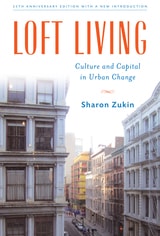
Loft Living
Culture and Capital in Urban ChangeZukin, Sharon
Rutgers University Press, 2014
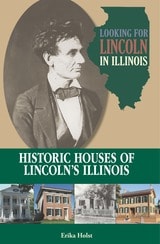
Looking for Lincoln in Illinois
Historic Houses of Lincoln’s IllinoisErika Holst
Southern Illinois University Press, 2018
This richly illustrated compendium of twenty-two historic buildings in the Abraham Lincoln National Heritage Area includes houses, a hotel, and an art center, all of which are open to the public. Each site links today’s visitors with a place Lincoln lived, a home of a Lincoln friend or colleague, or a spot that illuminates Lincoln’s era and legacy in central Illinois. Along with dozens of modern and historical photographs, entries contain explorations of historical connections to Lincoln and detailed information about exceptional features and artifacts. Complete with maps, this showcase of Illinois heritage is a handy guide for day trips, extended tours, or armchair adventures.
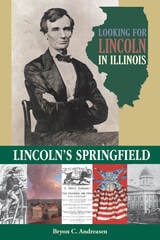
Looking for Lincoln in Illinois
Lincoln's SpringfieldBryon C. Andreasen
Southern Illinois University Press, 2015
Winner, ISHS Certificate of Excellence Award, 2016
Presenting fifty Abraham Lincoln stories—some familiar and beloved, some fresh and unexpected—Looking for Lincoln in Illinois: Lincoln’s Springfield is a carefully researched, richly illustrated guide to the Springfield, Illinois, locations on the Looking for Lincoln Story Trail. Created by the Looking for Lincoln Heritage Coalition, this trail consists of more than two hundred illustrated storyboards posted at sites of significance to Lincoln’s life and career across fifty-two communities in Illinois. The storyboards connect Lincoln-related tales to the geographical locations where they occurred, giving visitors, and now readers, a tour of the social and cultural landscape of Lincoln’s nineteenth-century world while revealing the very human Lincoln known by friends and associates.
This book celebrates the trail as a rich historical resource, featuring the original storyboards produced for Springfield and including twelve additional stories and more than 150 illustrations. Engaging stories in the book bring Lincoln’s Springfield to life: Lincoln created controversy with his Temperance Address, which he delivered in a church on Fourth Street in February 1842. He unexpectedly married Mary Todd in her sister’s home on the edge of Springfield later that year. The Lincolns’ sons used to harness dogs and cats to small wagons and drive them around the dirt streets of town. When Lincoln visited his dentist, he applied his own chloroform, because the practice of analgesia was not yet common. He reportedly played the ball game Fives in a downtown alley while waiting for news of his presidential nomination. And boxing heavyweight champion John C. Heenan visited the presidential candidate in October 1860. Through texts, historic photographs and images, and maps, including one keyed to the story locations in downtown Springfield, readers of this fascinating volume are invited to imagine social and cultural landscapes that have been lost in time.
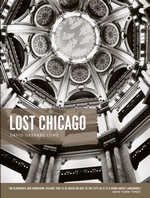
Lost Chicago
David Garrard Lowe
University of Chicago Press, 2010
The City of Big Shoulders has always been our most quintessentially American—and world-class—architectural metropolis. In the wake of the Great Fire of 1871, a great building boom—still the largest in the history of the nation—introduced the first modern skyscrapers to the Chicago skyline and began what would become a legacy of diverse, influential, and iconoclastic contributions to the city’s built environment. Though this trend continued well into the twentieth century, sour city finances and unnecessary acts of demolishment left many previous cultural attractions abandoned and then destroyed.
Lost Chicago explores the architectural and cultural history of this great American city, a city whose architectural heritage was recklessly squandered during the second half of the twentieth century. David Garrard Lowe’s crisp, lively prose and over 270 rare photographs and prints, illuminate the decades when Gustavus Swift and Philip D. Armour ruled the greatest stockyards in the world; when industrialists and entrepreneurs such as Cyrus McCormick, Potter Palmer, George Pullman, and Marshall Field made Prairie Avenue and State Street the rivals of New York City’s Fifth Avenue; and when Louis Sullivan, Daniel Burnham, and Frank Lloyd Wright were designing buildings of incomparable excellence. Here are the mansions and grand hotels, the office buildings that met technical perfection (including the first skyscraper), and the stores, trains, movie palaces, parks, and racetracks that thrilled residents and tourists alike before falling victim to the wrecking ball of progress.
“Lost Chicago is more than just another coffee table gift, more than merely a history of the city’s architecture; it is a history of the whole city as a cultural creation.”—New York Times Book Review