Results by title
335 books match the query 'Caribbean & Latin American Studies' and 7 start with l
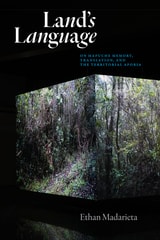
Land's Language
On Mapuche Memory, Translation, and the Territorial AporiaEthan Madarieta
Northwestern University Press, 2026
Presenting a new framework for understanding indigeneity and Indigenous peoples’ demands for territorial restitution
Asserting that the work of critical theory today must attend to an epistemic locality rather than the universalizing impulse of its European intellectual genealogy, Ethan Madarieta makes central to his study the literatures and philosophy of the Mapuche peoples of Wallmapu (comprising south-central regions of what are currently known as Chile and Argentina). In doing so, he argues that the primary site of settler and Indigenous antagonisms is not “land,” as is ubiquitously asserted, but the overlapping and incommensurate conceptual orders within which land and body are constituted and accrue meaning.
Land’s Language works to unsettle the stability and universality of how land and body are understood by calling into question what can or will be restored or returned and to whom. Drawing on Latin American and Mapuche historical, philosophical, and literary studies in dialogue with global critical theory and Anglophone critical Indigenous studies, this book demonstrates how Mapuche knowledge and thought, and that of each Indigenous nation across the planet, offer ways to live in ethical relation beyond that of the state and under the wider systemic hegemony of colonial racial capitalism.
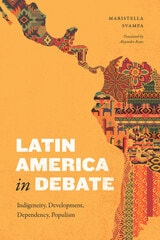
Latin America in Debate
Indigeneity, Development, Dependency, PopulismMaristella Svampa
Duke University Press, 2025
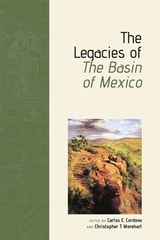
Legacies of The Basin of Mexico
Carlos E. Cordova
University Press of Colorado, 2023
More than four decades after that book’s publication, the fourteen contributions in this volume review and analyze its theoretical and methodological influence in light of recent research across disciplines. Among a spectrum of authors representing several generations are those who participated directly in the Basin of Mexico surveys—including the late Jeffrey R. Parsons—as well as those who have been actively working on recent projects in the basin and neighboring regions.
Providing a broad and multidisciplinary perspective of the present and future state of research in the area, The Legacies of The Basin of Mexico will be of interest to Mesoamerican and Latin American archaeologists as well as geographers, geologists, historians, and specialists in the study of past environments.
Contributors: Guillermo Acosta Ochoa, Aleksander Borejsza, Destiny Crider, Charles Frederick, Raúl García-Chávez, Larry Gorenflo, Angela Huster, Georgina Ibarra Arzave, Charles Kolb, Frank Lehmkuhl, Abigail Meza Peñaloza, Emily McClung de Tapia, John K. Millhauser, Deborah Nichols, Jeffrey R. Parsons, Serafin Sánchez Pérez, Philipp Schulte, Sergey Sedov, Elizabeth Solleiro Rebolledo, Daisy Valera Fenández, Federico Zertuche
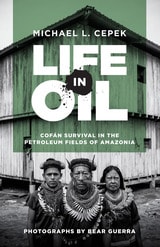
Life in Oil
Cofán Survival in the Petroleum Fields of AmazoniaBy Michael L. Cepek, Photographs by Bear Guerra
University of Texas Press, 2018
Oil is one of the world’s most important commodities, but few people know how its extraction affects the residents of petroleum-producing regions. In the 1960s, the Texaco corporation discovered crude in the territory of Ecuador’s indigenous Cofán nation. Within a decade, Ecuador had become a member of OPEC, and the Cofán watched as their forests fell, their rivers ran black, and their bodies succumbed to new illnesses. In 1993, they became plaintiffs in a multibillion-dollar lawsuit that aims to compensate them for the losses they have suffered. Yet even in the midst of a tragic toxic disaster, the Cofán have refused to be destroyed. While seeking reparations for oil’s assault on their lives, they remain committed to the survival of their language, culture, and rainforest homeland.
Life in Oil presents the compelling, nuanced story of how the Cofán manage to endure at the center of Ecuadorian petroleum extraction. Michael L. Cepek has lived and worked with Cofán people for more than twenty years. In this highly accessible book, he goes well beyond popular and academic accounts of their suffering to share the largely unknown stories that Cofán people themselves create—the ones they tell in their own language, in their own communities, and to one another and the few outsiders they know and trust. Their words reveal that life in oil is a form of slow, confusing violence for some of the earth’s most marginalized, yet resilient, inhabitants.
Listening in Detail
Performances of Cuban MusicAlexandra T. Vazquez
Duke University Press, 2013
Living Ruins
Native Engagements with Past Materialities in Contemporary Mesoamerica, Amazonia, and the AndesPhilippe Erikson
University Press of Colorado, 2022
Ten case studies from the Maya region, Amazonia, and the Andes detail and contextualize narratives, rituals, and a range of practices and attitudes toward different kinds of vestiges. The chapters engage with recently debated issues such as regimes of historicity and knowledge, cultural landscapes, conceptions of personhood and ancestrality, artifacts, and materiality. They focus on Indigenous perspectives rather than mainstream narratives such as those mediated by UNESCO, Hollywood, travel agents, and sometimes even academics. The contributions provide critical analyses alongside a multifaceted account of how people relate to the place/time nexus, expanding our understanding of different ontological conceptualizations of the past and their significance in the present.
Living Ruins adds to the lively body of work on the invention of tradition, Indigenous claims on their lands and history, “retrospective ethnogenesis,” and neo-Indianism in a world where tourism, NGOs, and Western essentialism are changing Indigenous attitudes and representations. This book is significant to anyone interested in cultural heritage studies, Amerindian spirituality, and Indigenous engagement with archaeological sites in Latin America.
Contributors: Cedric Becquey, Laurence Charlier Zeineddine, Marie Chosson, Pablo Cruz, Philippe Erikson, Antoinette Molinié, Fernando Santos-Granero, Emilie Stoll, Valentina Vapnarsky, Pirjo Kristiina Virtanen
Living and Dying in São Paulo
Immigrants, Health, and the Built Environment in BrazilJeffrey Lesser
Duke University Press, 2025