50 books match the query 'Catholics' and 3 start with l
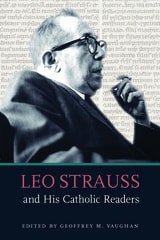
cover of Leo Strauss and His Catholic Readers

Leo Strauss and His Catholic Readers

Geoffrey M. Vaughan

Catholic University of America Press, 2018
This book looks at the work and influence of Leo Strauss in a variety of ways that will be of interest to readers of political philosophy. It will be of particular interest to Catholics and scholars of other religious traditions. Strauss had a great deal of interaction with his contemporary Catholic scholars, and many of his students or their students teach or have taught at Catholic colleges and universities in America. Leo Strauss and His Catholic Readers brings together work by scholars from two continents, some of whom knew Strauss, one of whom was his student at the University of Chicago. The first section of essays considers Catholic responses to Strauss’s project of recovering Classical natural right as against modern individual rights. Some of the authors suggest that his approach can be a fruitful corrective to an uncritical reception of modern ideas. Nevertheless, most point out that the Catholic cannot accept all of Strauss’s project. The second section deals with areas of overlap between Strauss and Catholics. Some of the chapters explore encounters with his contemporary scholars while others turn to more current concerns. The final section approaches the theological-political question itself, a question central to both Strauss’s work and that of the Catholic intellectual tradition. This section of the book considers the relationship of Strauss’s work to Christianity and Christian commitments at a broader level. Because Christianity does not have an explicit political doctrine, Christians have found themselves as rulers, subjects, and citizens in a variety of political regimes. Leo Strauss’s return to Platonic political philosophy can provide a useful lens through which his Catholic readers can assess what it means for there to be a best regime.
[more]
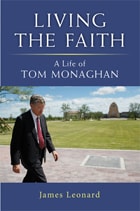
cover of Living the Faith: A Life of Tom Monaghan

Living the Faith

A Life of Tom Monaghan

James Leonard

University of Michigan Press, 2012

Who is Tom Monaghan?

Is he the four-year-old kid whose father died on Christmas Eve and whose mother sent him to an orphanage and then a juvenile detention home?

Is he the entrepreneurial genius who built Domino's Pizza from a hole-in-the-wall pizzeria in Michigan into an American brand as world-conquering as Ford or Coke?

Is he the religious visionary who sold Domino's for $1 billion to create an orthodox Catholic university, law school, and special interest law firm with the goal of transforming America to reflect his conservative values?

He's all that and more. With extensive interviews with friends and enemies plus unprecedented access to the man himself, but wholly without his authorization, Living the Faith illuminates Tom Monaghan, the man and the myth.

Living the Faithis the much-needed, definitive biography of one of the most fascinating and controversial figures in the realms of American business and religion. Through eighteen hard-boiled chapters, journalist James Leonard follows Monaghan on his path from a heartbroken kid who climbed into his father's coffin to the business tycoon who purchased the world-champion Detroit Tigers and spent a fortune on his own air force, navy, and island to the religious visionary who founded a university to make saints and a public interest law firm to overturn evolution.

A sympathetic but critical perspective of the man and his works, this book is for believers, nonbelievers, and agnostics; for conservatives, liberals, and independents; for the rich, the poor, and the shrinking middle class. Mainly, however, this book is for those who want the facts about Tom Monaghan—and the truth about the effect religion had on one man and the effect that man had on the world.
[more]
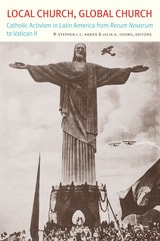
cover of Local Church, Global Church

Local Church, Global Church

Stephen J.C. Andes

Catholic University of America Press, 2016

This important volume investigates the many forms of Catholic activism in Latin America between the 1890s and 1962 (from the publication of the papal encyclical Rerum Novarum to the years just prior to the Second Vatican Council). It argues that this period saw a variety of lay and clerical responses to the social changes wrought by industrialization, political upheavals and mass movements, and increasing secularization. Spurred by these local developments as well as by initiatives from the Vatican, and galvanized by national projects of secular state-building, Catholic activists across Latin America developed new ways of organizing in order to effect social and political change within their communities.
[more]