Results by title
77 books match the query 'Characters' and 3 start with l
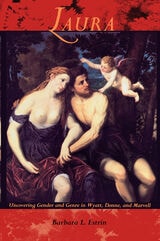
Laura
Uncovering Gender and Genre in Wyatt, Donne and MarvellBarbara L. Estrin
Duke University Press, 1994
How do men imagine women? In the poetry of Petrarch and his English successors—Wyatt, Donne, and Marvell—the male poet persistently imagines pursuing a woman, Laura, whom he pursues even as she continues to deny his affections. Critics have long held that, in objectifying Laura, these male-authored texts deny the imaginative, intellectual, and physical life of the woman they idealize. In Laura, Barbara L. Estrin counters this traditional view by focusing not on the generative powers of the male poet, but on the subjectivity of the imagined woman and the imaginative space of the poems she occupies.
Through close readings of the Rime sparse and the works of Wyatt, Donne, and Marvell, Estrin uncovers three Lauras: Laura-Daphne, who denies sexuality; Laura-Eve, who returns the poet’s love; and Laura-Mercury, who reinvents her own life. Estrin claims that in these three guises Laura subverts both genre and gender, thereby introducing multiple desires into the many layers of the poems. Drawing upon genre and gender theories advanced by Jean-François Lyotard and Judith Butler to situate female desire in the poem’s framework, Estrin shows how genre and gender in the Petrarchan tradition work together to undermine the stability of these very concepts.
Estrin’s Laura constitutes a fundamental reconceptualization of the Petrarchan tradition and contributes greatly to the postmodern reassessment of the Renaissance period. In its descriptions of how early modern poets formulate questions about sexuality, society and poetry, Laura will appeal to scholars of the English and Italian Renaissance, of gender studies, and of literary criticism and theory generally.
[more]
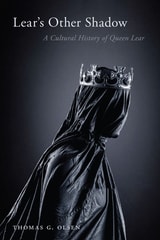
Lear’s Other Shadow
A Cultural History of Queen LearThomas G. Olsen
University of Delaware Press, 2025
Lear’s Other Shadow: A Cultural History of Queen Lear offers a deep cultural analysis of the figure of Queen Lear, who shadows and eventually sometimes overshadows her royal husband across the nearly one-thousand-year life of this archetypal tale. What appears to be a deliberate strategy of suppression, even erasure in Shakespeare’s King Lear later inspired dozens of stage, page, and cinematic remakes and adaptations in which this figure is revived or remembered, often pointedly so. From Jacob Gordin’s Yiddish-language Miriele Efros (1898), through edgy stage remakes such as Gordon Bottomley’s King Lear’s Wife (1915) and the Women’s Theatre Group’s Lear’s Daughters (1987), to novelized retellings from Jane Smiley’s A Thousand Acres (1991) to Preti Taneja’s We That Are Young (2018) and J. R. Thorp’s Learwife (2021), and even the television series Empire (2015–2020) and Succession (2018–2023), Queen Lear regularly emerges from her shadowy origins to challenge how we understand the ancient King Leir/King Lear story. These and many other examples reveal fascinating patterns of adaptation and reinterpretation that Lear's Other Shadow identifies and analyzes for the first time, showing how and why Queen Lear is at the center of this ancient story, whether she is heard from or not.
[more]
Lermontov's Narratives of Heroism
Vladimir Golstein
Northwestern University Press, 2012
This is the first study of Russian writer Mikhail Lermontov (1814-41) that attempts to integrate the in-depth interpretations of all his major texts--including his famous A Hero of Our Time, the novel that laid the foundation for the Russian psychological novel.
Lermontov's explorations of the virtues and limitations of heroic, self-reliant conduct have subsequently become obscured or misread. This new book focuses upon the peculiar, disturbing, and arguably most central feature of Russian culture: its suspicion of and hostility toward individual achievement and self-assertion. The analysis and interpretation of Lermontov's texts enables Golstein to address broader cultural issues by exploring the reasons behind the persistent misreading of Lermontov's major works and by investigating the cultural attitudes that shaped Russia's reaction to the challenges of modernity.
Lermontov's explorations of the virtues and limitations of heroic, self-reliant conduct have subsequently become obscured or misread. This new book focuses upon the peculiar, disturbing, and arguably most central feature of Russian culture: its suspicion of and hostility toward individual achievement and self-assertion. The analysis and interpretation of Lermontov's texts enables Golstein to address broader cultural issues by exploring the reasons behind the persistent misreading of Lermontov's major works and by investigating the cultural attitudes that shaped Russia's reaction to the challenges of modernity.
[more]