Results by title
662 books match the query 'China' and 11 start with l
Labor and the Chinese Revolution
Class Strategies and Contradictions of Chinese Communism, 1928–1948S. Bernard Thomas
University of Michigan Press, 1983
Lawyering an Uncertain Cause
Immigration Advocacy and Chinese Youth in the USMichele Statz
Vanderbilt University Press, 2018
In and beyond the legal realm, the figure of the "vulnerable Chinese child" powerfully legitimates legal claims and attorneys' efforts. At the same time, the transnational ambitions and obligations of Chinese youth implicitly unsettle this figure. The maneuvers of these youth not only belie attorneys' reliance on racialized discourses of childhood and the Chinese family, but they also reveal more broad uncertainties around legal frameworks, institutional practices, health and labor rights—and cause lawyering itself.
Based on three years of fieldwork across the United States, Lawyering an Uncertain Cause is a novel study of the complex and often contradictory rights, responsibilities, and expectations that motivate global youth and the American attorneys who work on their behalf.
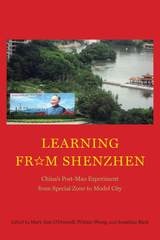
Learning from Shenzhen
China’s Post-Mao Experiment from Special Zone to Model CityEdited by Mary Ann O'Donnell, Winnie Wong, and Jonathan Bach
University of Chicago Press, 2017
Bringing China studies into dialogue with urban studies, the contributors explore how the post-Mao Chinese appropriation of capitalist logic led to a dramatic remodeling of the Chinese city and collective life in China today. These essays show how urban villages and informal institutions enabled social transformation through cases of public health, labor, architecture, gender, politics, education, and more. Offering scholars and general readers alike an unprecedented look at one of the world’s most dynamic metropolises, this collective history uses the urban case study to explore critical problems and possibilities relevant for modern-day China and beyond.
Learning to Love
Intimacy and the Discourse of Development in ChinaSonya E. Pritzker
University of Michigan Press, 2024
Learning to Love offers a range of perspectives on the embodied, relational, affective, and sociopolitical project of “learning to love” at the New Life Center for Holistic Growth, a popular “mind-body-spirit” bookstore and practice space in northeast China, in the early part of the 21st century. This intimate form of self-care exists alongside the fast-moving, growing capitalist society of contemporary China and has emerged as an understandable response to the pressures of Chinese industrialized life in the early 21st century. Opening with an investigation of the complex ways newcomers to the center suffered a sense of being “off,” both in and with the world at multiple scales, Learning to Love then examines how new horizons of possibility are opened as people interact with one another as well as with a range of aesthetic objects at New Life.
Author Sonya Pritzker draws upon the core concepts of scalar intimacy—a participatory, discursive process in which people position themselves in relation to others as well as dominant ideologies, concepts, and ideals—and scalar inquiry—the process through which speakers interrogate these forms, their relationship with them, and their participation in reproducing them. In demonstrating the collaborative interrogation of culture, history, and memory, she examines how these exercises in physical, mental, and spiritual self-care allow participants to grapple with past social harms and forms of injustice, how historical systems of power—including both patriarchal and governance structures—continue in the present, and how they might be transformed in the future. By examining the interactions and relational experiences from New Life, Learning to Love offers a range of novel theoretical interventions into political subjectivity, temporality, and intergenerational trauma/healing.

Leaving the Tomboy Behind
Sinophone Lesbian Subjectivities and Transnational Queer MediaCarman K. M. Fung
University of Michigan Press, 2027
For decades queer women in the Sinophone world have followed a strict dating custom: a lesbian relationship usually consists of a masculine partner, known as a tomboy, and a feminine counterpart. In the 2010s, however, many queer women have come to reject this custom and abandon their own former identities as tomboys. Leaving The Tomboy Behind follows their journey moving beyond lesbian masculinity and turning towards global LGBTQ+ media from Japan, Thailand, and the United States to explore new forms of gender expressions. Carman K. M. Fung offers a rich ethnography of the impacts media has had on queer Sinophone women’s lives, focusing on transnational interpretations and misinterpretations, and how media globalization shapes viewers’ perceptions of unfamiliar places. Through a combination of personal interviews and analysis of the global media these communities consume, Fung traces the genealogy of the tomboy identity in China, Hong Kong, and Taiwan in relation to global queer and trans cultures.
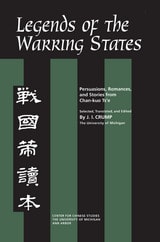
Legends of the Warring States
Persuasions, Romances, and Stories from <em>Chan-kuo Ts'e</em>J. I. Crump
University of Michigan Press, 1998

Like Cattle and Horses
Nationalism and Labor in Shanghai, 1895-1927S. A. Smith
Duke University Press, 2002
While the massive wave of labor protest in the 1920s was principally an expression of militant nationalism rather than of class consciousness, Smith argues, elements of a precarious class identity were in turn forged by the very discourse of nationalism. By linking work-related demands to the defense of the nation, anti-imperialist nationalism legitimized participation in strikes and sensitized workers to the fact that they were worthy of better treatment as Chinese citizens. Smith shows how the workers’ refusal to be treated “like cattle and horses” (a phrase frequently used by workers to describe their condition) came from a new but powerfully felt sense of dignity. In short, nationalism enabled workers to interpret the anger they felt at their unjust treatment in the workplace in political terms and to create a link between their position as workers and their position as members of an oppressed nation. By focusing on the role of the working class, Like Cattle and Horses is one of very few studies that examines nationalism “from below,” acknowledging the powerful agency of nonelite forces in promoting national identity.
Like Cattle and Horses will interest historians of labor, modern China, and nationalism, as well as those engaged in the study of revolutions and revolt.
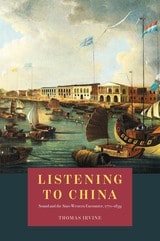
Listening to China
Sound and the Sino-Western Encounter, 1770-1839Thomas Irvine
University of Chicago Press, 2020
Through these stories, Irvine not only investigates how the Sino-Western encounter sounded, but also traces the West’s shifting response to China. As the trading relationships between China and the West broke down, travelers and music theorists abandoned the vision of shared musical approaches, focusing instead on China’s noisiness and sonic disorder and finding less to like in its music. At the same time, Irvine reconsiders the idea of a specifically Western music history, revealing that it was comparison with China, the great “other,” that helped this idea emerge. Ultimately, Irvine draws attention to the ways Western ears were implicated in the colonial and imperial project in China, as well as to China’s importance to the construction of musical knowledge during and after the European Enlightenment. Timely and original, Listening to China is a must-read for music scholars and historians of China alike.
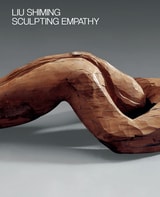
Liu Shiming
Sculpting EmpathyRichard Vine
Rutgers University Press, 2026
Liu Shiming (1926–2010) is a revered Chinese artist whose works have had a distinct impact on the course of modern Chinese sculpture. Born in Tianjin in 1926, Shiming attended the prestigious Central Academy of Fine Arts (CAFA) in Beijing, where he was part of the first generation of sculptors trained by the People’s Republic of China to study both traditional Chinese art and French modernist principles. Shiming received early recognition for his work, and his student project Measuring Land (1950) was one of the first works exhibited abroad following the establishment of the People’s Republic of China.
Though well respected in China, the sculptor, who died in 2010 at the age of eighty-four, is only now beginning to win the wider recognition he deserves. Meanwhile, contemporary competitors are numberless, most of them Instagram-friendly, while art history tends to focus on towering names and indisputably major movements and events: Braque and Picasso inventing Cubism, Duchamp’s readymades redefining art itself, Warhol’s mind-bending Brillo Boxes, and so on. So why examine an artist in the middle ground? Perhaps, first, because that is where the vast majority of us live, trying to make sense of our lives and grateful for the occasional insight, release, or enrichment that visual art can bring us. Second, because the story of Liu Shiming reveals a great deal about the forces that have shaped postwar art worldwide. He was a man who sought to lead a simple life, dedicated entirely to art, in the midst of China’s epochal, dangerously complex twentieth-century social and political changes.
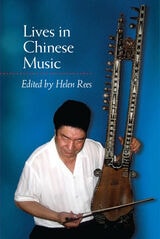
Lives in Chinese Music
Edited by Helen Rees
University of Illinois Press, 2008
Using biography to deepen understanding of Chinese music, contributors present richly contextualized portraits of rural folk singers, urban opera singers, literati, and musicians on both geographic and cultural frontiers. The topics investigated by these authors provide fresh insights into issues such as the urban-rural divide, the position of ethnic minorities within the People's Republic of China, the adaptation of performing arts to modernizing trends of the twentieth century, and the use of the arts for propaganda and commercial purposes.
The social and political history of China serves as a backdrop to these discussions of music and culture, as the lives chronicled here illuminate experiences from the pre-Communist period through the Cultural Revolution to the present. Showcasing multiple facets of Chinese musical life, this collection is especially effective in taking advantage of the liberalization of mainland China that has permitted researchers to work closely with artists and to discuss the interactions of life and local and national histories in musicians' experiences.
Contributors are Nimrod Baranovitch, Rachel Harris, Frank Kouwenhoven, Tong Soon Lee, Peter Micic, Helen Rees, Antoinet Schimmelpenninck, Shao Binsun, Jonathan P. J. Stock, and Bell Yung.
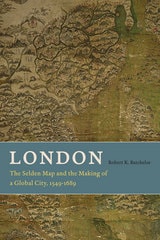
London
The Selden Map and the Making of a Global City, 1549-1689Robert K. Batchelor
University of Chicago Press, 2013