Results by title
95 books match the query 'Christian Living' and 6 start with l
Letters, 1-30
Peter Damian
Catholic University of America Press, 1989
Peter Damian (1007-1072), an eleventh-century monk and man of letters, left a large and significant body of correspondence. Over one hundred and eighty letters have been preserved, principally from Damian's own monastery of Fonte Avellana. Ranging in length from short memoranda to longer monographs, the letters provide a contemporary account of many of the controversies of the eleventh century: purgatory, the Eucharist, clerical marriage and celibacy, immorality, and others. Peter Damian, or "Peter the Sinner" as he often referred to himself, was one of the most learned men of his day, and his letters are filled with both erudition and zeal for reform.
[more]
Letters, 31-60
Peter Damian
Catholic University of America Press, 1990
Peter Damian (1007-1072), an eleventh-century monk and man of letters, left a large and significant body of correspondence. Over one hundred and eighty letters have been preserved, principally from Damian's own monastery of Fonte Avellana. Ranging in length from short memoranda to longer monographs, the letters provide a contemporary account of many of the controversies of the eleventh century: purgatory, the Eucharist, clerical marriage and celibacy, immorality, and others. Peter Damian, or "Peter the Sinner" as he often referred to himself, was one of the most learned men of his day, and his letters are filled with both erudition and zeal for reform.
[more]
Letters, 61-90
Peter Damian
Catholic University of America Press, 1992
Peter Damian (1007-1072), an eleventh-century monk and man of letters, left a large and significant body of correspondence. Over one hundred and eighty letters have been preserved, principally from Damian's own monastery of Fonte Avellana. Ranging in length from short memoranda to longer monographs, the letters provide a contemporary account of many of the controversies of the eleventh century: purgatory, the Eucharist, clerical marriage and celibacy, immorality, and others. Peter Damian, or "Peter the Sinner" as he often referred to himself, was one of the most learned men of his day, and his letters are filled with both erudition and zeal for reform.
[more]
Liberal Christianity and Women's Global Activism
The YWCA of the USA and the Maryknoll SistersAmanda L. Izzo
Rutgers University Press, 2018
Religiously influenced social movements tend to be characterized as products of the conservative turn in Protestant and Catholic life in the latter part of the twentieth century, with women's mobilizations centering on defense of the “traditional” family. In Liberal Christianity and Women’s Global Activism, Amanda L. Izzo argues that, contrary to this view, liberal wings of Christian churches have remained an instrumental presence in U.S. and transnational politics. Women have been at the forefront of such efforts.
Focusing on the histories of two highly influential groups, the Young Women’s Christian Association of the USA, an interdenominational Protestant organization, and the Maryknoll Sisters, a Roman Catholic religious order, Izzo offers new perspectives on the contributions of these women to transnational social movements, women’s history, and religious studies, as she traces the connections between turn-of-the-century Christian women’s reform culture and liberal and left-wing religious social movements of the 1960s and 1970s. Izzo suggests that shared ethical, theological, and institutional underpinnings can transcend denominational divides, and that strategies for social change often associated with secular feminism have ties to spiritually inspired social movements.
Focusing on the histories of two highly influential groups, the Young Women’s Christian Association of the USA, an interdenominational Protestant organization, and the Maryknoll Sisters, a Roman Catholic religious order, Izzo offers new perspectives on the contributions of these women to transnational social movements, women’s history, and religious studies, as she traces the connections between turn-of-the-century Christian women’s reform culture and liberal and left-wing religious social movements of the 1960s and 1970s. Izzo suggests that shared ethical, theological, and institutional underpinnings can transcend denominational divides, and that strategies for social change often associated with secular feminism have ties to spiritually inspired social movements.
[more]
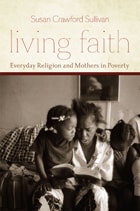
Living Faith
Everyday Religion and Mothers in PovertySusan Crawford Sullivan
University of Chicago Press, 2012
Scholars have made urban mothers living in poverty a focus of their research for decades. These women’s lives can be difficult as they go about searching for housing and decent jobs and struggling to care for their children while surviving on welfare or working at low-wage service jobs and sometimes facing physical or mental health problems. But until now little attention has been paid to an important force in these women’s lives: religion.
Based on in-depth interviews with women and pastors, Susan Crawford Sullivan presents poor mothers’ often overlooked views. Recruited from a variety of social service programs, most of the women do not attend religious services, due to logistical challenges or because they feel stigmatized and unwanted at church. Yet, she discovers, religious faith often plays a strong role in their lives as they contend with and try to make sense of the challenges they face. Supportive religious congregations prove important for women who are involved, she finds, but understanding everyday religion entails exploring beyond formal religious organizations.
Offering a sophisticated analysis of how faith both motivates and at times constrains poor mothers’ actions, Living Faith reveals the ways it serves as a lens through which many view and interpret their worlds.
[more]
Losing the Good Portion
Why Men Are Alienated from ChristianityLeon J. Podles
St. Augustine's Press, 2017
Few books have explored in depth the lack of men in the churches. Podles’ book The Church Impotent: The Feminization of Christianity was the first book-length attempt to examine this phenomenon. David Murrow’s Why Men Hate Going to Church was a popular presentation of Podles’ material. Marta Trzebiatowska’s and Steve Bruce’s short Why Are Women More Religious than Men? confines itself almost entirely to modern British and American examples.
Losing the Good Portion: Why Men Are Alienated from Christianity explores the causes and consequences of the almost millennium-old disparity between the participation of lay men and lay women in the churches of Western Christianity. Podles considers both the anecdotal and statistical evidence for the lack of men: sermons, church rolls, censuses, and sociological analyses.
Podles sees the intellectual roots of lack of men in the Aristotelian understanding of male and female as active and passive, an understanding which has formed all discussion of masculinity and femininity, from Aquinas through Schleiermacher, Barth, and Hans Urs von Balthasar, all of whom saw femininity as more compatible with Christianity than masculinity. Men, according to anthropologists and psychologists, go through a difficult process to attain masculinity and therefore distance themselves from threats to that masculine identity, including Christianity.
Men suspected the clergy was effeminate and sexually irregular. Historians of violence have examined the decline in violence in Europe and the civilizing role of the clergy, a role which further alienated men and led to violent anticlericalism
Podles examines the presentation of Jesus’ masculinity in Scripture and images of Jesus’ masculinity in art, the role of thumos in spirituality, and the various movements that have helped keep men connected to the churches. He makes suggestions for possible outreach to men.
[more]