Results by title
496 books match the query 'Christian Theology' and 27 start with l
Lands of Likeness
For a Poetics of ContemplationKevin Hart
University of Chicago Press, 2023
In Lands of Likeness, Kevin Hart develops a new hermeneutics of contemplation through a meditation on Christian thought and secular philosophy. Drawing on Kant, Schopenhauer, Coleridge, and Husserl, Hart first charts the emergence of contemplation in and beyond the Romantic era. Next, Hart shows this hermeneutic at work in poetry by Gerard Manley Hopkins, Marianne Moore, Wallace Stevens, and others. Delivered in its original form as the prestigious Gifford Lectures, Lands of Likeness is a revelatory meditation on contemplation for the modern world.
Latter-day Saint Perspectives on Atonement
Edited by Deidre Nicole Green and Eric D. Huntsman
University of Illinois Press, 2024
The Church of Jesus Christ of Latter-day Saints and other Christians have always shared a fundamental belief in the connection between personal salvation and the suffering, death, and resurrection of Jesus Christ. While having faith in and experiencing the atonement of Christ remains a core tenet for Latter-day Saints, some thinkers have in recent decades reconsidered traditional understandings of atonement.
Deidre Nicole Green and Eric D. Huntsman edit a collection that brings together multiple and diverse approaches to thinking about Latter-day Saint views on this foundational area of theology. The essayists draw on and go beyond a wide range of perspectives, classical atonement theories, and contemporary reformulations of atonement theory. The first section focuses on scriptural and historical foundations while the second concentrates on theological explorations. Together, the contributors evaluate what is efficacious and ethical in the Latter-day Saint outlook and offer ways to reconceive those views to provide a robust theological response to contemporary criticisms about atonement.
Contributors: Nicholas J. Frederick, Fiona Givens, Deidre Nicole Green, Sharon J. Harris, J.B. Haws, Eric D. Huntsman, Benjamin Keogh, Ariel Bybee Laughton, Adam S. Miller, Jenny Reeder, T. Benjamin Spackman, and Joseph M. Spencer
Letters
Saint Leo the Great
Catholic University of America Press, 1957
Letters (1–81)
Saint Cyprian
Catholic University of America Press, 1964
Letters 1–50
Saint Cyril of Alexandria
Catholic University of America Press, 1987
Letters 51–110
Saint Cyril of Alexandria
Catholic University of America Press, 1987
Letters 91-120
Catholic University of America Press, 1998
Letters, 1-30
Peter Damian
Catholic University of America Press, 1989
Letters, 121-150
Owen J. Peter Damian
Catholic University of America Press, 2004
Letters, 151-180
Owen J. Peter Damian
Catholic University of America Press, 2005
Letters, 31-60
Peter Damian
Catholic University of America Press, 1990
Letters, 61-90
Peter Damian
Catholic University of America Press, 1992
Letters, Volume 1
John Barsanuphius and John
Catholic University of America Press, 2006
Letters, Volume 1 (1–185)
Saint Basil
Catholic University of America Press, 1951
Letters, Volume 1 (1–82)
Saint Augustine
Catholic University of America Press, 1951
Letters, Volume 2
John Barsanuphius and John
Catholic University of America Press, 2006
Letters, Volume 2 (186–368)
Saint Basil
Catholic University of America Press, 1955
Letters, Volume 2 (83–130)
Saint Augustine
Catholic University of America Press, 1953
Letters, Volume 3 (131-164)
Saint Augustine
Catholic University of America Press, 1953
Letters, Volume 4 (165–203)
Saint Augustine
Catholic University of America Press, 1955
Letters, Volume 5 (204–270)
Saint Augustine
Catholic University of America Press, 1956
Letters, Volume 6 (1*–29*)
Saint Augustine
Catholic University of America Press, 1989

Liberation Theology and Praxis in Contemporary Latin America
As It Was in the Beginning?Edited by Pablo Bradbury and Niall H.D. Geraghty
University of London Press, 2025
This highly interdisciplinary collection brings together diverse and complementary approaches from history, theology, cultural studies, architecture, sociology, and anthropology to reevaluate the legacy of liberation theology in Latin America.
Liberation theology was born in the 1960s at a time of Church renewal and socio-economic ferment, as many sought more radical solutions in the context of the exhaustion of developmentalist projects and the institutionalized violence of capitalism. The book’s central focus on the lived experiences and embodied practices of those engaged in social action in the region challenges the narrative that suggests that liberation theology had reached its decline by the end of the 1970s. It demonstrates that liberationist Christianity was at once more diverse and internally conflicted, more widely resonant outside ecclesial confines, and more interconnected over time than often allowed.
The chapters investigate a range of topics: the ecclesiology of a revolutionary movement of Argentine priests in the 1960s and ́1970s, the engagement of liberation theology with Participatory Action Research and its influence on architectural approaches and urbanism, 1980s feminist liberation theology, encounters with Western human rights at a time of Cold War repression and exile, and ecofeminist political theology in contemporary Latin America. Pulling these threads together, Liberation Theology and Praxis in Contemporary Latin America invites us to reconsider how we understand liberation theology’s history as well as its reach into the present day.
Life and Works
Saint Gregory Thaumaturgus
Catholic University of America Press, 1998
Light for the Nations
The Scriptures on the Universal Mission of Israel and the ChurchLuis Sanchez-Navarro
Catholic University of America Press, 2024
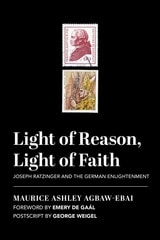
Light of Reason, Light of Faith
Joseph Ratzinger and the German EnlightenmentMaurice Ashley Agbaw-Ebai
St. Augustine's Press, 2021
Ratzinger’s extraordinary and sympathetic understanding of the sources of contemporary secularism equipped him to appreciate the gains of the Enlightenment, while still being a fierce critic of the losses humanity has suffered when reason falsely excludes faith. Fr. Agbaw-Ebai’s account reveals Ratzinger, in relation to his various interlocutors, to be the truly “enlightened” one because he demonstrates a truly balanced understanding of the human mind. To be truly rational one must be able to hold to faith and reason both, reason informed by faith in Jesus Christ.
A particular merit of this book is Agbaw-Ebai’s presentation of Ratzinger’s treatment of the German Enlightenment’s greatest contributors: Kant, Nietzche, Hegel and Habermas, among others. In the postscript George Weigel characterizes what this study accomplishes in the larger framework of scholarship. “[Ratzinger’s] position remains too often misunderstood, and sometimes deliberately misinterpreted, throughout the whole Church. And to misunderstand, or misinterpret, Ratzinger is to misunderstand or misinterpret both the modern history of theology and the Second Vatican Council.” Agbaw-Ebai masterfully positions Ratzinger correctly in the history of ideas, and exhibits why Ratzinger will be remembered as one of its main players. Pure rationalists and true believers are equally indebted to him.
Love and Good Reasons
Postliberal Approaches to Christian Ethics and LiteratureFritz Oehlschlaeger
Duke University Press, 2003
Love and Good Reasons combines postliberal narrative theology—especially Stanley Hauerwas’s Christian ethics and Alasdair MacIntyre’s idea of traditional inquiry—with recent scholarship in literature and ethics including the work of Martha Nussbaum, J. Hillis Miller, Wayne Booth, Jeffrey Stout, and Richard Rorty. Oehlschlaeger offers detailed readings of literature by five major authors—Herman Melville, Jane Austen, Anthony Trollope, Henry James, and Stephen Crane. He examines their works in light of biblical scripture and the grand narratives of Israel, Jesus, and the Church. Discussing the role of religion in contemporary higher education, Oehlschlaeger shares his own experiences of teaching literature from a religious perspective at a state university.