Results by title
188 books match the query 'City planning' and 11 start with l
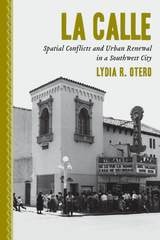
La Calle
Spatial Conflicts and Urban Renewal in a Southwest CityLydia R. Otero
University of Arizona Press, 2010
Otero examines conflicting claims to urban space, place, and history as advanced by two opposing historic preservationist groups: the La Placita Committee and the Tucson Heritage Foundation. Otero gives voice to those who lived in, experienced, or remembered this contested area, and analyzes the historical narratives promoted by Anglo American elites in the service of tourism and cultural dominance.
La Calle explores the forces behind the mass displacement: an unrelenting desire for order, a local economy increasingly dependent on tourism, and the pivotal power of federal housing policies. To understand how urban renewal resulted in the spatial reconfiguration of downtown Tucson, Otero draws on scholarship from a wide range of disciplines: Chicana/o, ethnic, and cultural studies; urban history, sociology, and anthropology; city planning; and cultural and feminist geography.
Landed Internationals
Planning Cultures, the Academy, and the Making of the Modern Middle EastBy Burak Erdim
University of Texas Press, 2020
2022 On the Brinck Book Award, University of New Mexico School of Architecture + Planning
Special Mention, First Book Prize, International Planning History Society
Landed Internationals examines the international culture of postwar urban planning through the case of the Middle East Technical University (METU) in Ankara, Turkey. Today the center of Turkey's tech, energy, and defense elites, METU was founded in the 1950s through an effort jointly sponsored by the UN, the University of Pennsylvania, and various governmental agencies of the United States and Turkey. Drawing on the language of the UN and its Technical Assistance Board, Erdim uses the phrase "technical assistance machinery" to encompass the sprawling set of relationships activated by this endeavor.
Erdim studies a series of legitimacy battles among bureaucrats, academics, and other professionals in multiple theaters across the political geography of the Cold War. These different factions shared a common goal: the production of nationhood—albeit nationhood understood and defined in multiple, competing ways. He also examines the role of the American architecture firm Skidmore, Owings, and Merrill; the New York housing policy guru Charles Abrams; the UN and the University of Pennsylvania; and the Turkish architects Altuğ and Behruz Çinici. In the end, METU itself looked like a model postwar nation within the world order, and Erdim concludes by discussing how it became an important force in transnational housing, planning, and preservation in its own right.
Landscape of Modernity
Essays on New York City, 1900-1940David Ward
Russell Sage Foundation, 1992
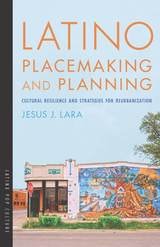
Latino Placemaking and Planning
Cultural Resilience and Strategies for ReurbanizationJesus J. Lara
University of Arizona Press, 2018
Latino Placemaking and Planning offers a pathway to define, analyze, and evaluate the role that placemaking can have with respect to Latino communities in the context of contemporary urban planning, policy, and design practices. Using strategically selected case studies, Jesus J. Lara examines how Latinos contribute to the phenomenon of urban revitalization through the (re)appropriation of physical space for their own use and the consequent transformation of what were previously economically downtrodden areas into vibrant commercial and residential centers.
The book examines the formation of urban cultures and reurbanization strategies from the perspective of Latino urbanism and is divided into four key sections, which address (1) emerging new urban geographies; (2) the power of place and neighborhood selection; (3) Latino urbanism case studies; and (4) lessons and recommendations for “reurbanizing” the city. Latino Placemaking and Planning illustrates the importance of placemaking for Latino communities and provides accessible strategies for planners, students, and activists to sustainable urban revitalization.
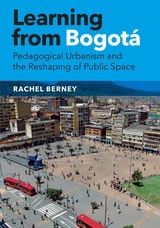
Learning from Bogotá
Pedagogical Urbanism and the Reshaping of Public SpaceBy Rachel Berney
University of Texas Press, 2017
Once known as a “drug capital” and associated with kidnappings, violence, and excess, Bogotá, Colombia, has undergone a transformation that some have termed “the miracle of Bogotá.” Beginning in the late 1980s, the city emerged from a long period of political and social instability to become an unexpected model of urban development through the redesign and revitalization of the public realm—parks, transportation, and derelict spaces—under the leadership of two “public space mayors,” Antanas Mockus and Enrique Peñalosa (the latter reelected in 2015). In Learning from Bogotá, Rachel Berney analyzes how these mayors worked to reconfigure the troubled city into a pedagogical one whose public spaces and urban policy have helped shape a more tolerant and aware citizenry.
Berney examines the contributions of Mockus and Peñalosa through the lenses of both spatial/urban design and the city’s history. She shows how, through the careful intertwining of new public space and transportation projects, the reclamation of privatized public space, and the refurbishment of dilapidated open spaces, the mayors enacted an ambitious urban vision for Bogotá without resorting to the failed method of the top-down city master plan. Illuminating the complex interplay between formal politics, urban planning, and improvised social strategies, as well as the negative consequences that accompanied Bogotá’s metamorphosis, Learning from Bogotá offers significant lessons about the possibility for positive and lasting change in cities around the world.
Learning from Bryant Park
Revitalizing Cities, Towns, and Public SpacesAndrew M. Manshel
Rutgers University Press, 2020
In this new book, Andrew M. Manshel draws from both urbanist theory and his first-hand experiences as a urban public space developer and manager who worked on Bryant Park and later applied its strategies to an equally successful redevelopment project in a very different New York neighborhood: Jamaica, Queens. He candidly describes what does (and doesn’t) work when coordinating urban redevelopment projects, giving special attention to each of the many details that must be carefully observed and balanced, from encouraging economic development to fostering creative communities to delivering appropriate services to the homeless. Learning from Bryant Park is thus essential reading for anyone who cares about giving new energy to downtowns and public spaces.
Limits to Culture
Urban Regeneration vs. Dissident ArtMalcolm Miles
Pluto Press, 2015
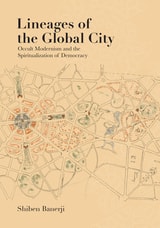
Lineages of the Global City
Occult Modernism and the Spiritualization of DemocracyShiben Banerji
University of Texas Press, 2025
2026 PROSE Award in Architecture & Urban Planning, Association of American Publishers (AAP)
2026 Book Prize Shortlist, Modernist Studies Association (MSA)
The forgotten history of the occult foundations of the early twentieth-century global city.
War, revolution, genocide, rebellion, slump. The economic and political turmoil of the early twentieth century seemed destined to rip asunder the ties that bound colonizers and the colonized to one another. The upheaval represented an opportunity, and not just to nationalists who imagined new homelands or to socialists who dreamed of international brotherhood. For modernists in the orbit of various occultisms, the crisis of empire also represented an opportunity to reveal humanity’s fundamental unity and common fate.
Lineages of the Global City recounts a continuous, if also contentious, transnational exchange among modernists and occultists across the Americas, Europe, South Asia, and Australia between 1905 and 1949. At stake were the feelings and affect of a new global subject who would perceive themselves as belonging to humanity as a unified whole, and the urban environment that would foster their subjectivity. The interventions in this debate, which drew in the period’s most renowned modernists, took the form of a succession of plans for cities, suburbs, and communes, as well as experiments in building, drawing, printmaking, filmmaking, and writing. Weaving together postcolonial, feminist, and Marxist insight on subject formation, Shiben Banerji advances a new way of understanding modernist urban space as the design of subjective effects.
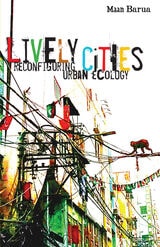
Lively Cities
Reconfiguring Urban EcologyMaan Barua
University of Minnesota Press, 2023
A journey through unexplored spaces that foreground new ways of inhabiting the urban
One of the fundamental dimensions of urbanization is its radical transformation of nature. Today domestic animals make up more than twice the biomass of people on the planet, and cities are replete with nonhuman life. Yet current accounts of the urban remain resolutely anthropocentric. Lively Cities departs from conventions of urban studies to argue that cities are lived achievements forged by a multitude of entities, drawing attention to a suite of beings—human and nonhuman—that make up the material politics of city making.
From macaques and cattle in Delhi to the invasive parakeet colonies in London, Maan Barua examines the rhythms, paths, and agency of nonhumans across the city. He reconceptualizes several key themes in urban thought, including infrastructure, the built environment, design, habitation, and everyday practices of dwelling and provides a critical intervention in animal and urban studies. Generating fresh conversations between posthumanism, postcolonialism, and political economy, Barua reveals how human and nonhuman actors shape, integrate, subsume, and relate to urban space in fascinating ways.
Through novel combinations of ethnography and ethology, and focusing on interlocutors that are not the usual suspects animating urban theory, Barua’s work considers nonhuman lifeworlds and the differences they make in understanding urbanicity. Lively Cities is an agenda-setting intervention, ultimately proposing a new grammar of urban life.
Local Officials and the Struggle to Transform Cities
A View from Post-Apartheid South AfricaEdited by Claire Bénit-Gbaffou
University College London, 2024
Why are even progressive local authorities with the will to improve seldom able to change cities? Why does it seem almost impossible to redress spatial inequalities, deliver and maintain basic services, elevate impoverished areas, and protect marginalized communities? Why do municipalities in the Global South refuse to work with prevailing social informalities, and resort instead to interventions that are known to displace and aggravate the very issues they aim to address?
Local Officials and the Struggle to Transform Cities analyzes these challenges in South African cities, where the brief post-apartheid moment opened a window for progressive city government and made research into state practices both possible and necessary. The book interrogates city officials’ practices through a comparative gaze into other ‘progressive moments’ in large cities in Brazil, the United States, and India. It considers the instruments that these officials invent to implement urban policies, the agency these officials develop, and the constraints they navigate in governing unequal cities. Claire Bénit-Gbaffou captures in this book actual officials’ practices through first-hand experience, state ethnographies, and engaged research. This reveals day-to-day practices that question generalized explanations of state failure in complex urban societies as essential malevolence, contextual weakness, corruption, and inefficiency.
This book opens the black box of the workings of the state, with the hope of opening paths for the construction of progressive policies in contemporary cities.
Local Protests, Global Movements
Capital, Community, and State in San FranciscoKarl Beitel
Temple University Press, 2013
Using San Francisco as an illuminating case study, Beitel analyzes the innovative ways urban social movements have organized around issues regarding land use, housing, urban ecology, and health care on the local level to understand the changing nature of protest formation around the world.
Reconciling the passing of New Left Ideals and the emergence of mobilization on a global scale, he assesses the limits of contemporary urban movements as conduits for advancing a radical political program. Beitel argues these limits reflect recurrent problems of internal fragmentation, and the manner in which liberal democratic institutions structure processes of political participation and interest representation.