Results by title
155 books match the query 'Civil rights movements' and 5 start with l
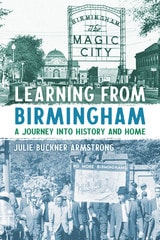
Learning from Birmingham
A Journey into History and HomeJulie Buckner Armstrong
University of Alabama Press, 2023
A steel town daughter’s search for truth and beauty in Birmingham, Alabama
“As Birmingham goes, so goes the nation,” Fred Shuttlesworth observed when he invited Martin Luther King Jr. to the city for the transformative protests of 1963. From the height of the Civil Rights Movement through its long aftermath, images of police dogs, fire hoses and four girls murdered when Ku Klux Klan members bombed the Sixteenth Street Baptist Church have served as an uncomfortable racial mirror for the nation. Like many white people who came of age in the Civil Rights Movement’s wake, Julie Buckner Armstrong knew little about this history. Only after moving away and discovering writers like Toni Morrison and Alice Walker did she realize how her hometown and family were part of a larger, ongoing story of struggle and injustice.
When Armstrong returned to Birmingham decades later to care for her aging mother, Shuttlesworth’s admonition rang in her mind. By then an accomplished scholar and civil rights educator, Armstrong found herself pondering the lessons Birmingham holds for a twenty-first century America. Those lessons extended far beyond what a 2014 Teaching Tolerance report describes as the common distillation of the Civil Rights Movement into “two names and four words: Martin Luther King Jr, Rosa Parks, and ‘I have a dream.’” Seeking to better understand a more complex local history, its connection to broader stories of oppression and resistance, and her own place in relation to it, Armstrong embarked on a journey to unravel the standard Birmingham narrative to see what she would find.
Beginning at the center, with her family’s 1947 arrival to a housing project near the color line, within earshot of what would become known as Dynamite Hill, Armstrong works her way over time and across the map. Weaving in stories of her white working-class family, classmates, and others not traditionally associated with Birmingham’s civil rights history, including members of the city’s LGBTQ community, she forges connections between the familiar and lesser-known. The result is a nuanced portrait of Birmingham--as seen in public housing, at old plantations, in segregated neighborhoods, across contested boundary lines, over mountains, along increasingly polluted waterways, beneath airport runways, on highways cutting through town, and under the gaze of the iconic statue of Vulcan.
In her search for truth and beauty in Birmingham, Armstrong draws on the powers of place and storytelling to dig into the cracks, complicating easy narratives of civil rights progress. Among the discoveries she finds in America’s racial mirror is a nation that has failed to recognize itself in the horrific images from Birmingham’s past and to acknowledge the continuing inequalities that make up the Civil Right’s Movement’s unfinished business. Learning from Birmingham reminds us that stories of civil rights, structural oppression, privilege, abuse, race and gender bias, and inequity are difficult and complicated, but their telling, especially from multiple stakeholder perspectives, is absolutely necessary.
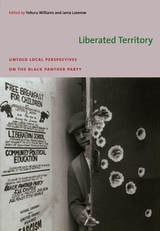
Liberated Territory
Untold Local Perspectives on the Black Panther PartyYohuru Williams and Jama Lazerow, eds.
Duke University Press, 2008
The histories and character of the party branches vary as widely as their locations. The Cape Verdeans of New Bedford, Massachusetts, were initially viewed as a particular challenge for the local Panthers but later became the mainstay of the Boston-area party. In the early 1970s, the Winston-Salem, North Carolina, chapter excelled at implementing the national Black Panther Party’s strategic shift from revolutionary confrontation to mainstream electoral politics. In Detroit, the Panthers were defined by a complex relationship between their above-ground activities and an underground wing dedicated to armed struggle. While the Milwaukee chapter was born out of a rising tide of black militancy, it ultimately proved more committed to promoting literacy and health care and redressing hunger than to violence. The Alabama Black Liberation Front did not have the official imprimatur of the national party, but it drew heavily on the Panthers’ ideas and organizing strategies, and its activism demonstrates the broad resonance of many of the concerns articulated by the national party: the need for jobs, for decent food and housing, for black self-determination, and for sustained opposition to police brutality against black people. Liberated Territory reveals how the Black Panther Party’s ideologies, goals, and strategies were taken up and adapted throughout the United States.
Contributors: Devin Fergus, Jama Lazerow, Ahmad A. Rahman, Robert W. Widell Jr., Yohuru Williams
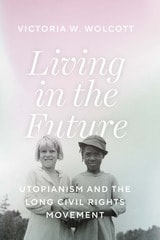
Living in the Future
Utopianism and the Long Civil Rights MovementVictoria W. Wolcott
University of Chicago Press, 2022
Utopian thinking is often dismissed as unrealistic, overly idealized, and flat-out impractical—in short, wholly divorced from the urgent conditions of daily life. This is perhaps especially true when the utopian ideal in question is reforming and repairing the United States’ bitter history of racial injustice. But as Victoria W. Wolcott provocatively argues, utopianism is actually the foundation of a rich and visionary worldview, one that specifically inspired the major figures of the Civil Rights Movement in ways that haven’t yet been fully understood or appreciated.
Wolcott makes clear that the idealism and pragmatism of the Civil Rights Movement were grounded in nothing less than an intensely utopian yearning. Key figures of the time, from Martin Luther King Jr. and Pauli Murray to Father Divine and Howard Thurman, all shared a belief in a radical pacificism that was both specifically utopian and deeply engaged in changing the current conditions of the existing world. Living in the Future recasts the various strains of mid-twentieth-century civil rights activism in a utopian light, revealing the power of dreaming in a profound and concrete fashion, one that can be emulated in other times that are desperate for change, like today.
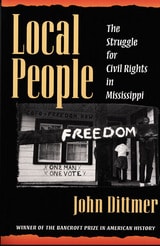
Local People
The Struggle for Civil Rights in MississippiJohn Dittmer
University of Illinois Press, 1994
Publication of this book was supported by a grant from DePauw University, Greencastle, Indiana.
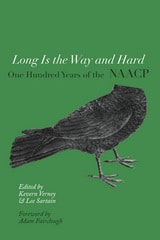
Long Is the Way and Hard
One Hundred Years of the NAACPKevern Verney
University of Arkansas Press, 2009