Results by title
173 books match the query 'Collective Memory' and 6 start with l
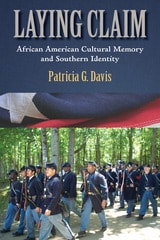
Laying Claim
African American Cultural Memory and Southern IdentityPatricia G. Davis
University of Alabama Press, 2016
Reclaiming Southern history through the voices, memories, and experiences of African Americans.
In Laying Claim: African American Cultural Memory and Southern Identity, Patricia Davis identifies the Civil War as the central narrative around which official depictions of southern culture have been defined. Because that narrative largely excluded African American points of view, the resulting southern identity was monolithically white. Davis traces how the increasing participation of black public voices in the realms of Civil War memory—battlefields, museums, online communities—has dispelled the mirage of “southernness” as a stolid cairn of white culture and has begun to create a more fluid sense of southernness that welcomes contributions by all of the region’s peoples.
Laying Claim offers insightful and penetrating examinations of African American participation in Civil War reenactments; the role of black history museums in enriching representations of the Civil War era with more varied interpretations; and the internet as a forum within which participants exchange and create historical narratives that offer alternatives to unquestioned and dominant public memories. From this evolving cultural landscape, Davis demonstrates how simplistic caricatures of African American experiences are giving way to more authentic, expansive, and inclusive interpretations of southernness.
As a case-study and example of change, Davis cites the evolution of depictions of life at Thomas Jefferson’s Monticello. Where visitors to the site once encountered narratives that repeated the stylized myth of Monticello as a genteel idyll, modern accounts of Jefferson’s day offer a holistic, inclusive, and increasingly honest view of Monticello as the residents on every rung of the social ladder experienced it.
Contemporary violence and attacks about or inspired by the causes, outcomes, and symbols of the Civil War, even one hundred and fifty years after its end, add urgency to Davis’s argument that the control and creation of public memories of that war is an issue of concern not only to scholars but all Americans. Her hopeful examination of African American participation in public memory illuminates paths by which this enduring ideological impasse may find resolutions.
Lessons and Legacies, Volume XV
The Holocaust: Global Perspectives, National Narratives, Local ContextsErin McGlothlin; Avinoam Patt
Northwestern University Press, 2024
The contributions to this volume not only indicate the intellectual vibrancy and diversity of cutting-edge research in Holocaust studies but also reflect multiple approaches to the necessary work of expanding the canon of research in the field and of adopting varied disciplinary perspectives, engaging with global perspectives as well as local studies.
This collection’s chapters manifest three broad categories: history, literature, and memory; at the same time, however, as the interdisciplinary nature of these chapters indicate, these categories should not be regarded as mutually exclusive or discrete. On the contrary, they overlap and intersect in compelling ways, demonstrating the dynamic character of contemporary Holocaust studies, which views history, narrative representation, and commemoration as mutually informative. Further, the contributors continue the recent trend in Holocaust studies whereby specific regional and national narratives are integrated into a more global approach to the event: Newer studies have continued to incorporate what was once termed the periphery into a more global examination of the experiences of Jewish refugees in flight to Latin America, Africa, and the Soviet Union. At the same time, very specific local studies deepen our knowledge of the mechanics of genocide, along with the experiences of refugees in flight, and the subsequent dimensions of Holocaust memory and representation.
Lifting the Shadow
Reshaping Memory, Race, and Slavery in U.S. MuseumsAmy Sodaro
Rutgers University Press, 2025
Listening to Survivors
Four Decades of Holocaust Memorial Week at Oregon State UniversityKatherine E. Hubler
Oregon State University Press, 2024
Historian Katherine Hubler has arranged these recollections thematically in chapters centered on discrimination, refuge, resistance, rescue, and transitional justice. These themes align with Oregon’s Holocaust and Genocide Education learning concepts, discussion questions accompany each chapter to facilitate use in classrooms, and the introduction situates the speakers’ diverse experiences within the broader context of World War Two and the Nazis’ genocidal project.
Intended to bring the history of the Holocaust to all Oregonians, Listening to Survivors honors the legacy of outreach work of local survivors and serves as a reminder of the state’s connection to the Holocaust and commitment to genocide education and prevention.
Losing Culture
Nostalgia, Heritage, and Our Accelerated TimesDavid Berliner
Rutgers University Press, 2020
Such sentiments get echoed around the world, from aging Trump supporters in West Virginia to young villagers in West Africa. But what is triggering this sense of cultural loss, and to what ends does this rhetoric get deployed?
To answer these questions, anthropologist David Berliner travels around the world, from Guinea-Conakry, where globalization affects the traditional patriarchal structure of cultural transmission, to Laos, where foreign UNESCO experts have become self-appointed saviors of the nation’s cultural heritage. He also embarks on a voyage of critical self-exploration, reflecting on how anthropologists handle their own sense of cultural alienation while becoming deeply embedded in other cultures. This leads into a larger examination of how and why we experience exonostalgia, a longing for vanished cultural heydays we never directly experienced.
Losing Culture provides a nuanced analysis of these phenomena, addressing why intergenerational cultural transmission is vital to humans, yet also considering how efforts to preserve disappearing cultures are sometimes misguided or even reactionary. Blending anthropological theory with vivid case studies, this book teaches us how to appreciate the multitudes of different ways we might understand loss, memory, transmission, and heritage.
Lost on the Freedom Trail
The National Park Service and Urban Renewal in Postwar BostonSeth C. Bruggeman
University of Massachusetts Press, 2022
Boston National Historical Park is one of America's most popular heritage destinations, drawing in millions of visitors annually. Tourists flock there to see the site of the Boston Massacre, to relive Paul Revere's midnight ride, and to board Old Ironsides—all of these bound together by the iconic Freedom Trail, which traces the city's revolutionary saga.
Making sense of the Revolution, however, was never the primary aim for the planners who reimagined Boston's heritage landscape after the Second World War. Seth C. Bruggeman demonstrates that the Freedom Trail was always largely a tourist gimmick, devised to lure affluent white Americans into downtown revival schemes, its success hinging on a narrow vision of the city's history run through with old stories about heroic white men. When Congress pressured the National Park Service to create this historical park for the nation's bicentennial celebration in 1976, these ideas seeped into its organizational logic, precluding the possibility that history might prevail over gentrification and profit.