Results by title
319 books match the query 'Communication Studies' and 10 start with l
Lacan in Public
Psychoanalysis and the Science of RhetoricChristian Lundberg
University of Alabama Press, 2012
Lacan in Public argues that Lacan’s contributions to the theory of rhetoric are substantial and revolutionary and that rhetoric is, in fact, the central concern of Lacan’s entire body of work.
Lacan’s conception of rhetoric, Christian Lundberg argues in Lacan in Public, upsets and extends the received wisdom of American rhetorical studies—that rhetoric is a science, rather than an art; that rhetoric is predicated not on the reciprocal exchange of meanings, but rather on the impossibility of such an exchange; and that rhetoric never achieves a correspondence with the real-world circumstances it attempts to describe.
As Lundberg shows, Lacan’s work speaks directly to conversations at the center of current rhetorical scholarship, including debates regarding the nature of the public and public discourses, the materiality of rhetoric and agency, and the contours of a theory of persuasion.

Language of Tomorrow
Towards a Transcultural Visual Communication System in a Posthuman ConditionHaytham Nawar
Intellect Books, 2020
Language of Tomorrow is a comprehensive guide to the history, evolution, and current forms of pictographic communication, charting its course from ancient Egyptian writing systems to modern-day emojis. The book is a culmination of research combining visual communication, semiotic theory, cultural studies, linguistics, artificial intelligence, and new media.
Haytham Nawar presents a cohesive and comprehensive historical framework—covering pictographic, logographic, and ideographic writing systems and scripts—through which we can discuss the future of communication. In his analysis, he explores the possibility of developing a standardized universal pictographic communication system that fosters mutual understanding and bridges diverse cultures. Weaving practice and theory across disciplines and bringing together language, culture, art, and design, Language of Tomorrow aims to locate the direction for the research and development of a transcultural visual communication system for the posthuman era.
Latter-day Eloquence
Two Centuries of Mormon OratoryEdited by Richard Benjamin Crosby and Isaac James Richards
University of Illinois Press, 2026
Essential and one-of-a-kind, Latter-day Eloquence provides a foundational reference for the study of Latter-day Saint rhetoric and oratory.
Levinas's Rhetorical Demand
The Unending Obligation of Communication EthicsRonald C. Arnett. Foreword by Algis Mickunas
Southern Illinois University Press, 2017
Distinguished Book Award, Philosophy of Communication Division, National Communication Association, 2017
Top Book Award, Communication Ethics Division, National Communication Association, 2017
Philosopher Emmanuel Levinas’s ethics as first philosophy explicates a human obligation and responsibility to and for the Other that is an unending and imperfect commitment. In Levinas’s Rhetorical Demand: The Unending Obligation of Communication Ethics, Ronald C. Arnett underscores the profundity of Levinas’s insights for communication ethics.Arnett outlines communication ethics as a primordial call of responsibility central to Levinas’s writing and mission, analyzing it through a Levinasian lens with examination of social artifacts ranging from the Heidegger-Cassirer debate to Rupert Murdoch’s News of the World story concerning illicit possession of information.
Levinas’s Rhetorical Demand offers an account of Levinas’s project and the pragmatic implications of attending to a call of responsibility to and for the Other. This book yields a rich and nuanced understanding of Levinas’s work, revealing the practical importance of his insights, and including a discussion of related theorists and thinkers.
Liberating Language
Sites of Rhetorical Education in Nineteenth-Century Black AmericaShirley Wilson Logan
Southern Illinois University Press, 2008
Liberating Language identifies experiences of nineteenth-century African Americans—categorized as sites of rhetorical education—that provided opportunities to develop effective communication and critical text-interpretation skills. Author Shirley Wilson Logan considers how nontraditional sites, which seldom involved formal training in rhetorical instruction, proved to be effective resources for African American advancement.
Logan traces the ways that African Americans learned lessons in rhetoric through language-based activities associated with black survival in nineteenth-century America, such as working in political organizations, reading and publishing newspapers, maintaining diaries, and participating in literary societies. According to Logan, rhetorical training was manifested through places of worship and military camps, self-education in oratory and elocution, literary societies, and the black press. She draws on the experiences of various black rhetors of the era, such as
Frederick Douglass, Frances Harper, Fanny Coppin, Charles Chesnutt, Ida B. Wells, and the lesser-known Oberlin-educated Mary Virginia Montgomery, Virginia slave preacher "Uncle Jack," and former slave "Mrs. Lee."
Liberating Language addresses free-floating literacy, a term coined by scholar and writer Ralph Ellison, which captures the many settings where literacy and rhetorical skills were acquired and developed, including slave missions, religious gatherings, war camps, and even cigar factories. In Civil War camp- sites, for instance, black soldiers learned to read and write, corresponded with the editors of black newspapers, edited their own camp-based papers, and formed literary associations.
Liberating Language outlines nontraditional means of acquiring rhetorical skills and demonstrates how African Americans, faced with the lingering consequences of enslavement and continuing oppression, acquired rhetorical competence during the late eighteenth century and throughout the nineteenth century.
Literacy as Involvement
The Acts of Writers, Readers, and TextsDeborah Brandt
Southern Illinois University Press, 1990
In Literacy as Involvement, Deborah Brandt examines the cultural and social roots of the acts of reading and writing. The book asks, for example, whether literacy is a natural growth of or a radical shift from orality. It questions the contrary views that literacy is either the learning of the conventions of language or is better understood as heightened social ability. Finally, it raises the possibility that knowing how to read and write is actually understanding how we respond during the acts of reading and writing.
This examination of literacy as process is also offered as a critique of prevailing theories of literacy advanced by such scholars as Walter J. Ong, S.J., David Olson, and E. D. Hirsch. They depict literacy as a textual experience that is socially and linguistically detached. Brandt critically examines the underlying assumptions from research on writing processes and argues that they call for a major reformation of prevailing conceptions of literacy. Specifically, she analyzes several expository texts from a process perspective to establish the interaction of reader and writer in even the most seemingly formal and detached writing. In her conclusion, Brandt brings together the major findings of her study to address pressing literacy issues, including the problem of illiteracy in our schools.
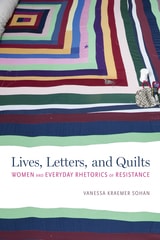
Lives, Letters, and Quilts
Women and Everyday Rhetorics of ResistanceVanessa Kraemer Sohan
University of Alabama Press, 2020
In Lives, Letters, and Quilts: Women and Everyday Rhetorics of Resistance, Vanessa Kraemer Sohan applies a translingual and transmodal framework informed by feminist rhetorical practice to three distinct case studies that demonstrate women using unique and effective rhetorical strategies in political, religious, and artistic contexts. These case studies highlight a diverse set of actors uniquely situated by their race, gender, class, or religion, but who are nevertheless connected by their capacity to envision and recontextualize the seemingly ordinary means and materials available to them in order to effectively persuade others.
The Great Depression provides the backdrop for the first case study, a movement whereby thousands of elderly citizens proselytized and fundraised for a monthly pension plan dreamt up by a California doctor in the hopes of lifting themselves out of poverty. Sohan investigates how the Townsend Plan’s elderly supporters—the Townsendites—worked within and across language, genre, mode, and media to enable them for the first time to be recognized by others, and themselves, as a viable political constituency.
Next, Sohan recounts the story of Quaker minister Eliza P. Kirkbride Gurney who met President Abraham Lincoln in 1862. Their subsequent epistolary exchanges concerning conscientious objectors made such an impression on him that one of her letters was rumored to be in his pocket the night of his assassination. Their exchanges and Gurney’s own accounts of her transnational ministry in her memoir provide useful examples of how, throughout history, women rhetors have adopted and transformed typically underappreciated forms of rhetoric—such as the epideictic—for their particular purposes.
The final example focuses on the Gee’s Bend quiltmakers—a group of African American women living in rural Alabama who repurpose discarded work clothes and other cast-off fabrics into the extraordinary quilts for which they are known. By drawing on the means and materials at hand to create celebrated works of art in conditions of extreme poverty, these women show how marginalized artisans can operate both within and outside the bounds of established aesthetic traditions and communicate the particulars of their experience across cultural and economic divides.
Living Chronic
Agency and Expertise in the Rhetoric of DiabetesLora Arduser
The Ohio State University Press, 2017
Diabetes, referred to as an epidemic for more than a decade, remains one of our most significant health issues in the twenty-first century. Because self-management is an important component of living with the disease, the biomedical concept of patient agency has long stressed notions of individual responsibility and autonomy. However, dramatic shifts in both health care and cultural practices call for a reassessment of traditional definitions of patient agency.
Lora Arduser’s Living Chronic: Agency and Expertise in the Rhetoric of Diabetes answers this call with a unique rhetorical examination of one of the most critical issues in contemporary health: how we live and work with being chronic. Through her perceptive analysis of the discourse of both people with diabetes and health care providers, Arduser presents a new model for patient agency—one that advocates for a relational, fluid concept of agency that blurs the boundaries between medical experts and patients. Her thought-provoking use of bodily and rhetorical plasticity crafts a multidimensional picture of patient agency that profoundly affects how rhetorical scholars, people living with chronic illness, and health care providers can forge patient-centered discourse and practices.
Living in the Rock N Roll Mystery
Reading Context, Self, and Others as CluesH. L. Goodall, Jr.
Southern Illinois University Press, 1991
Mystery, rather than “problem,” provides the context that the cultural ethnographer best uses to approach the experience of both the living and the writing of culture. In this work, H. L. Goodall, Jr., continues his discussion of the cultural ethnographer as detective through an investigation of what he calls the “rock n roll mystery.”
Using Bakhtin’s notion of “Carnival,” Goodall positions rock n roll as an important aspect of the American cultural experience using its lyrics and rhythm as a force of resistance to the dominant bureaucratic order. He argues that interpretive ethnography, where sentences use rhythms and emotions along with words to construct a work, parallels rock n roll in its creation of multiple voices struggling for creative and interpretive presence and space in the text. As there is no privileged text in the social life of rock n roll, there is no privileged voice in the writing of interpretive ethnography. It is, instead, a reading and writing method within the field of communication and the field of cultural studies that challenges the “existing wisdom.”
Goodall invites the reader to join him in the role of the detective who confronts, enters, and then participates in the mysteries of living. Through the use of his interpretive method, Goodall is able to move under the skin of experience to disclose the relationship among self, other(s), and context, an understanding only achieved by “going beneath the often cosmetic surfaces of cultural traffic to where symbols mingle with the driven stuff of life.” Because the “stuff of life” is laid out on the pages of this book, Goodall’s text is as compelling as a good novel and in some ways more intimate.
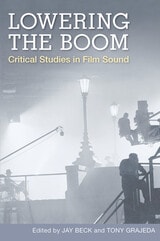
Lowering the Boom
Critical Studies in Film SoundEdited by Jay Beck and Tony Grajeda
University of Illinois Press, 2007
As the first collection of new work on sound and cinema in over a decade, Lowering the Boom addresses the expanding field of film sound theory and its significance in rethinking historical models of film analysis. The contributors consider the ways in which musical expression, scoring, voice-over narration, and ambient noise affect identity formation and subjectivity. Lowering the Boom also analyzes how shifting modulation of the spoken word in cinema results in variations in audience interpretation. Introducing new methods of thinking about the interaction of sound and music in films, this volume also details avant-garde film sound, which is characterized by a distinct break from the narratively based sound practices of mainstream cinema. This interdisciplinary, global approach to the theory and history of film sound opens the eyes and ears of film scholars, practitioners, and students to film's true audio-visual nature.
Contributors are Jay Beck, John Belton, Clark Farmer, Paul Grainge, Tony Grajeda, David T. Johnson, Anahid Kassabian, David Laderman, James Lastra, Arnt Maasø, Matthew Malsky, Barry Mauer, Robert Miklitsch, Nancy Newman, Melissa Ragona, Petr Szczepanik, Paul Théberge, and Debra White-Stanley.