Results by title
198 books match the query 'Community' and 7 start with l
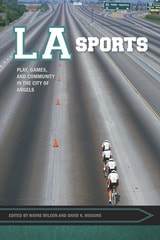
LA Sports
Play, Games, and Community in the City of AngelsWayne Wilson
University of Arkansas Press, 2018
LA Sports brings together sixteen essays covering various aspects of the development and changing nature of sport in one of America’s most fascinating and famous cities. The writers cover a range of topics, including the history of car racing and ice skating, the development of sport venues, the power of the Mexican fan base in American soccer leagues, the intersecting life stories of Jackie and Mack Robinson, the importance of the Showtime Lakers, the origins of Muscle Beach and surfing, sport in Hollywood films, and more.
[more]
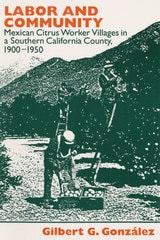
Labor and Community
Mexican Citrus Worker Villages in a Southern California County, 1900-1950Gilbert G. González
University of Illinois Press, 1994
The emergence, maturity, and decline of the southern California citrus industry is seen here through the network of citrus worker villages that dotted part of the state's landscape from 1910 to 1960. Labor and Community shows how Mexican immigrants shaped a partially independent existence within a fiercely hierarchical framework of economic and political relationships. González relies on a variety of published sources and interviews with longtime residents to detail the education of village children; the Americanization of village adults; unionization and strikes; and the decline of the citrus picker village and rise of the urban barrio. His insightful study of the rural dimensions of Mexican-American life prior to World War II adds balance to a long-standing urban bias in Chicano historiography.
[more]
Learning and Community
Jewish Supplementary Schools in the Twenty-First CenturyJack Wertheimer
Brandeis University Press, 2009
At a time of heightened interest in Jewish supplementary schooling, this volume offers a path-breaking examination of how ten diverse schools have remade themselves to face the new challenges of the twenty-first century. Each written by an academic observer with the help of an experienced educator, the chapters bring these schools vividly to life by giving voice to students, parents, teachers, school directors, lay leaders, local rabbis and other key participants. The goal of the book is to uncover the building blocks each school put into place to improve its delivery of a Jewish education. Employing qualitative research, Learning and Community is filled with moving and inspiring human-interest stories. Collectively, these portraits offer models of how schools of different sizes and configurations can maximize their impact, and in the process revitalize the form of religious and cultural education that engages the majority of Jewish children in the United States.
[more]
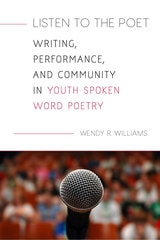
Listen to the Poet
Writing, Performance, and Community in Youth Spoken Word PoetryWendy R. Williams
University of Massachusetts Press, 2019
Youth spoken word poetry groups are on the rise in the United States, offering safe spaces for young people to write and perform. These diverse groups encourage members to share their lived experiences, decry injustices, and imagine a better future. At a time when students may find writing in school alienating and formulaic, composing in these poetry groups can be refreshingly relevant and exciting.
Listen to the Poet investigates two Arizona spoken word poetry groups—a community group and a high school club—that are both part of the same youth organization. Exploring the writing lives and poetry of several members, Wendy R. Williams takes readers inside a writing workshop and poetry slam and reveals that schools have much to learn about writing, performance, community, and authorship from groups like these and from youth writers themselves.
Listen to the Poet investigates two Arizona spoken word poetry groups—a community group and a high school club—that are both part of the same youth organization. Exploring the writing lives and poetry of several members, Wendy R. Williams takes readers inside a writing workshop and poetry slam and reveals that schools have much to learn about writing, performance, community, and authorship from groups like these and from youth writers themselves.
[more]
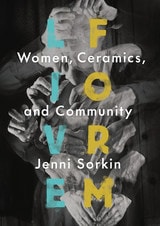
Live Form
Women, Ceramics, and CommunityJenni Sorkin
University of Chicago Press, 2016
Ceramics had a far-reaching impact in the second half of the twentieth century, as its artists worked through the same ideas regarding abstraction and form as those for other creative mediums. Live Form shines new light on the relation of ceramics to the artistic avant-garde by looking at the central role of women in the field: potters who popularized ceramics as they worked with or taught male counterparts like John Cage, Peter Voulkos, and Ken Price.
Sorkin focuses on three Americans who promoted ceramics as an advanced artistic medium: Marguerite Wildenhain, a Bauhaus-trained potter and writer; Mary Caroline (M. C.) Richards, who renounced formalism at Black Mountain College to pursue new performative methods; and Susan Peterson, best known for her live throwing demonstrations on public television. Together, these women pioneered a hands-on teaching style and led educational and therapeutic activities for war veterans, students, the elderly, and many others. Far from being an isolated field, ceramics offered a sense of community and social engagement, which, Sorkin argues, crucially set the stage for later participatory forms of art and feminist collectivism.
Sorkin focuses on three Americans who promoted ceramics as an advanced artistic medium: Marguerite Wildenhain, a Bauhaus-trained potter and writer; Mary Caroline (M. C.) Richards, who renounced formalism at Black Mountain College to pursue new performative methods; and Susan Peterson, best known for her live throwing demonstrations on public television. Together, these women pioneered a hands-on teaching style and led educational and therapeutic activities for war veterans, students, the elderly, and many others. Far from being an isolated field, ceramics offered a sense of community and social engagement, which, Sorkin argues, crucially set the stage for later participatory forms of art and feminist collectivism.
[more]
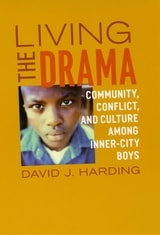
Living the Drama
Community, Conflict, and Culture among Inner-City BoysDavid J. Harding
University of Chicago Press, 2010
For the middle class and the affluent, local ties seem to matter less and less these days, but in the inner city, your life can be irrevocably shaped by what block you live on. Living the Drama takes a close look at three neighborhoods in Boston to analyze the many complex ways that the context of community shapes the daily lives and long-term prospects of inner-city boys.
David J. Harding studied sixty adolescent boys growing up in two very poor areas and one working-class area. In the first two, violence and neighborhood identification are inextricably linked as rivalries divide the city into spaces safe, neutral, or dangerous. Consequently, Harding discovers, social relationships are determined by residential space. Older boys who can navigate the dangers of the streets serve as role models, and friendships between peers grow out of mutual protection. The impact of community goes beyond the realm of same-sex bonding, Harding reveals, affecting the boys’ experiences in school and with the opposite sex. A unique glimpse into the world of urban adolescent boys, Living the Drama paints a detailed, insightful portrait of life in the inner city.
David J. Harding studied sixty adolescent boys growing up in two very poor areas and one working-class area. In the first two, violence and neighborhood identification are inextricably linked as rivalries divide the city into spaces safe, neutral, or dangerous. Consequently, Harding discovers, social relationships are determined by residential space. Older boys who can navigate the dangers of the streets serve as role models, and friendships between peers grow out of mutual protection. The impact of community goes beyond the realm of same-sex bonding, Harding reveals, affecting the boys’ experiences in school and with the opposite sex. A unique glimpse into the world of urban adolescent boys, Living the Drama paints a detailed, insightful portrait of life in the inner city.
[more]
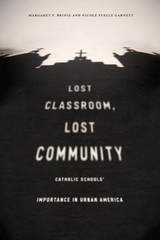
Lost Classroom, Lost Community
Catholic Schools' Importance in Urban AmericaMargaret F. Brinig and Nicole Stelle Garnett
University of Chicago Press, 2014
In the past two decades in the United States, more than 1,600 Catholic elementary and secondary schools have closed, and more than 4,500 charter schools—public schools that are often privately operated and freed from certain regulations—have opened, many in urban areas. With a particular emphasis on Catholic school closures, Lost Classroom, Lost Community examines the implications of these dramatic shifts in the urban educational landscape.
More than just educational institutions, Catholic schools promote the development of social capital—the social networks and mutual trust that form the foundation of safe and cohesive communities. Drawing on data from the Project on Human Development in Chicago Neighborhoods and crime reports collected at the police beat or census tract level in Chicago, Philadelphia, and Los Angeles, Margaret F. Brinig and Nicole Stelle Garnett demonstrate that the loss of Catholic schools triggers disorder, crime, and an overall decline in community cohesiveness, and suggest that new charter schools fail to fill the gaps left behind.
This book shows that the closing of Catholic schools harms the very communities they were created to bring together and serve, and it will have vital implications for both education and policing policy debates.
[more]