Results by title
264 books match the query 'Composition' and 6 start with l
Labor-Based Grading Contracts
Building Equity and Inclusion in the Compassionate ClassroomAsao B. Inoue
University Press of Colorado, 2023
Labor-Based Grading Contracts
Building Equity and Inclusion in the Compassionate Writing ClassroomAsao B. Inoue
University Press of Colorado, 2019
Learning from the Lived Experiences of Graduate Student Writers
Shannon Madden
Utah State University Press, 2020
Learning from the Lived Experiences of Graduate Student Writers is a timely resource for understanding and resolving some of the issues graduate students face, particularly as higher education begins to pay more critical attention to graduate student success. Offering diverse approaches for assisting this demographic, the book bridges the gap between theory and practice through structured examination of graduate students’ narratives about their development as writers, as well as researched approaches for enabling these students to cultivate their craft.
The first half of the book showcases the voices of graduate student writers themselves, who describe their experiences with graduate school literacy through various social issues like mentorship, access, writing in communities, and belonging in academic programs. Their narratives illuminate how systemic issues significantly affect graduate students from historically oppressed groups. The second half accompanies these stories with proposed solutions informed by empirical findings that provide evidence for new practices and programming for graduate student writers.
Learning from the Lived Experiences of Graduate Student Writers values student experience as an integral part of designing approaches that promote epistemic justice. This text provides a fresh, comprehensive, and essential perspective on graduate writing and communication support that will be useful to administrators and faculty across a range of disciplines and institutional contexts.
Contributors: Noro Andriamanalina, LaKela Atkinson, Daniel V. Bommarito, Elizabeth Brown, Rachael Cayley, Amanda E. Cuellar, Kirsten T. Edwards, Wonderful Faison, Amy Fenstermaker, Jennifer Friend, Beth Godbee, Hope Jackson, Karen Keaton Jackson, Haadi Jafarian, Alexandria Lockett, Shannon Madden, Kendra L. Mitchell, Michelle M. Paquette, Shelley Rodrigo, Julia Romberger, Lisa Russell-Pinson, Jennifer Salvo-Eaton, Richard Sévère, Cecilia D. Shelton, Pamela Strong Simmons, Jasmine Kar Tang, Anna K. Willow Treviño, Maurice Wilson, Anne Zanzucchi
Learning from the Mess
Method/ological Praxis in Rhetoric and Writing StudiesAshley J. Holmes
University Press of Colorado, 2024
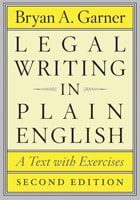
Legal Writing in Plain English, Second Edition
A Text with ExercisesBryan A. Garner
University of Chicago Press, 2013
Accessible and witty, Legal Writing in Plain English draws on real-life writing samples that Garner has gathered through decades of teaching experience. Trenchant advice covers all types of legal materials, from analytical and persuasive writing to legal drafting, and the book’s principles are reinforced by sets of basic, intermediate, and advanced exercises in each section.
In this new edition, Garner preserves the successful structure of the original while adjusting the content to make it even more classroom-friendly. He includes case examples from the past decade and addresses the widespread use of legal documents in electronic formats. His book remains the standard guide for producing the jargon-free language that clients demand and courts reward.
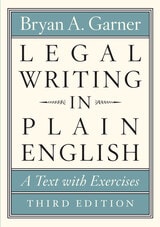
Legal Writing in Plain English, Third Edition
A Text with ExercisesBryan A. Garner
University of Chicago Press, 2023
Admirably clear, concise, down-to-earth, and powerful—all too often, legal writing embodies none of these qualities. Its reputation for obscurity and needless legalese is widespread. Since 2001, Bryan A. Garner’s Legal Writing in Plain English has helped address this problem by providing lawyers, judges, paralegals, law students, and legal scholars with sound advice and practical tools for improving their written work. Now the leading guide to clear writing in the field, this indispensable volume encourages legal writers to challenge conventions and offers valuable insights into the writing process: how to organize ideas, create and refine prose, and improve editing skills.
Accessible and witty, Legal Writing in Plain English draws on real-life writing samples that Garner has gathered through decades of teaching experience. Trenchant advice covers all types of legal materials, from analytical and persuasive writing to legal drafting, and the book’s principles are reinforced by sets of basic, intermediate, and advanced exercises in each section.
For this third edition, Garner has retained the structure of the previous versions, with updates and new material throughout. There are new sections on making your writing vivid and concrete and on using graphics to enhance your argument. The coverage and examples of key topics such as achieving parallelism, avoiding legalese, writing effective openers and summaries, and weaving quotations into your text have also been expanded. And the sample legal documents and exercises have been updated, while newly added checklists provide quick summaries of each section.
Altogether, this new edition will be the most useful yet for legal professionals and students seeking to improve their prose.