Results by title
77 books match the query 'Congress' and 5 start with l
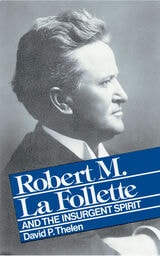
La Follette Insurgent Spirit
David P. Thelen
University of Wisconsin Press, 1986
Less than Meets the Eye
Foreign Policy Making and the Myth of the Assertive CongressBarbara Hinckley
University of Chicago Press, 1994
What Hinckley reveals is sharply at odds with conventional wisdom and unflattering to both the executive and the legislative branches of government. More than a critical reassessment, this book also proposes reforms than might result in real congressional participation in the making of foreign policy. With its insight into how our system of checks and balances works—and doesn't—this book takes a first step toward making the peoples' representatives accountable for crucial American interests in foreign matters.
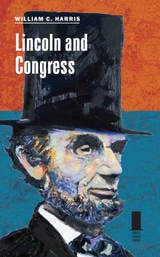
Lincoln and Congress
William C. Harris
Southern Illinois University Press, 2017
In Lincoln and Congress, William C. Harris reveals that the relationship between the president and Congress, though sometimes contentious, was cooperative rather than adversarial. During his time as president, Abraham Lincoln embodied his personal conviction that the nation’s executive should not interfere with the work of the legislature, and though often critical of him privately, in public congressional leaders compromised with and assisted the president to unite the North and minimize opposition to the war.
Despite the turbulence of the era and the consequent tensions within the government, the executive and legislative branches showed restraint in their dealings with each other. In fact, except in his official messages to Congress, Lincoln rarely lobbied for congressional action, and he vetoed only one important measure during his tenure as president. Many congressmen from Lincoln’s own party, although publicly supportive, doubted his leadership and sought a larger role for Congress in setting war policies. Though they controlled Congress, Republican legislators frequently differed among themselves in shaping legislation and in their reactions to events as well as in their relationships both with each other and with the president. Harris draws intriguing sketches of nineteenth-century congressional leaders and shows that, contrary to what historians have traditionally concluded, radical Republicans such as Representative Thaddeus Stevens and Senator Charles Sumner did not dominate their party or Congress. Harris includes the minority party’s role, showing that Northern Democrats and conservative Unionists of the border states generally opposed Republican policies but worked with them on support for the troops and on nonwar issues like the Pacific Railroad Bill.
Lincoln and Congress sheds new light on the influence of members of Congress and their relationship with Lincoln on divisive issues such as military affairs, finance, slavery, constitutional rights, reconstruction, and Northern political developments. Enjoyable both for casual Civil War readers and professional historians, this book provides an engaging narrative that helps readers redefine and understand the political partnership that helped the Union survive.
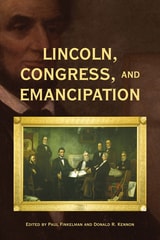
Lincoln, Congress, and Emancipation
Paul Finkelman
Ohio University Press, 2016
“When Lincoln took office, in March 1861, the national government had no power to touch slavery in the states where it existed. Lincoln understood this, and said as much in his first inaugural address, noting: ‘I have no purpose, directly or indirectly, to interfere with the institution of slavery in the States where it exists.’” How, then, asks Paul Finkelman in the introduction to Lincoln, Congress, and Emancipation, did Lincoln—who personally hated slavery—lead the nation through the Civil War to January 1865, when Congress passed the constitutional amendment that ended slavery outright?
The essays in this book examine the route Lincoln took to achieve emancipation and how it is remembered both in the United States and abroad. The ten contributors—all on the cutting edge of contemporary scholarship on Lincoln and the Civil War—push our understanding of this watershed moment in US history in new directions. They present wide-ranging contributions to Lincoln studies, including a parsing of the sixteenth president’s career in Congress in the 1840s and a brilliant critique of the historical choices made by Steven Spielberg and writer Tony Kushner in the movie Lincoln, about the passage of the Thirteenth Amendment.
As a whole, these classroom-ready readings provide fresh and essential perspectives on Lincoln’s deft navigation of constitutional and political circumstances to move emancipation forward.
Contributors: L. Diane Barnes, Jenny Bourne, Michael Burlingame, Orville Vernon Burton, Seymour Drescher, Paul Finkelman, Amy S. Greenberg, James Oakes, Beverly Wilson Palmer, Matthew Pinsker
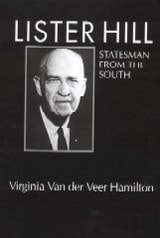
Lister Hill
Statesman from the SouthVirginia Van der Veer Hamilton
University of Alabama Press, 2004