Results by title
244 books match the query 'Crime' and 9 start with l
L.A. Private Eyes
Dahlia Schweitzer
Rutgers University Press, 2019
Watch a video of the author speaking about this topic: https://goo.gl/Xr9RFD
And also: https://www.dropbox.com/s/mkqw3mplruf7jje/Detective%20Talk%20Full.mp4?dl=0 (https://www.dropbox.com/s/mkqw3mplruf7jje/Detective%20Talk%20Full.mp4?dl=0)
Language of the Gun
Youth, Crime, and Public PolicyBernard E. Harcourt
University of Chicago Press, 2006
Home to over 150 repeat offenders ranging in age from twelve to seventeen, the Catalina Mountain School is made up of a particular stratum of boys—those who have committed the most offenses but will still be released upon reaching adulthood. In an effort to understand the symbolic and emotional language of guns and gun carrying, Harcourt interviewed dozens of these incarcerated Catalina boys. What do these youths see in guns? What draws them to handguns? Why do some of them carry and others not? For Harcourt, their often surprising answers unveil many of the presuppositions that influence our laws and policies.
Law and Disorder in the Postcolony
Edited by Jean Comaroff and John L. Comaroff
University of Chicago Press, 2006
Are postcolonies haunted more by criminal violence than other nation-states? The usual answer is yes. In Law and Disorder in the Postcolony, Jean and John Comaroff and a group of respected theorists show that the question is misplaced: that the predicament of postcolonies arises from their place in a world order dominated by new modes of governance, new sorts of empires, new species of wealth—an order that criminalizes poverty and race, entraps the “south” in relations of corruption, and displaces politics into the realms of the market, criminal economies, and the courts.
As these essays make plain, however, there is another side to postcoloniality: while postcolonies live in states of endemic disorder, many of them fetishize the law, its ways and itsmeans. How is the coincidence of disorder with a fixation on legalities to be explained? Law and Disorder in the Postcolony addresses this question, entering into critical dialogue with such theorists as Benjamin, Agamben, and Bayart. In the process, it also demonstrates how postcolonies have become crucial sites for the production of contemporary theory, not least because they are harbingers of a global future under construction.
Law and Order
Images, Meanings, MythsValverde, Mariana
Rutgers University Press, 2006
But with television courtrooms appearing more like the studio of The Jerry Springer Show than institutions of justice, and with weekly dramas seamlessly blending cutting-edge forensic science with exaggerated fictions, it calls to question: just what is it about these shows that has the public so captivated? And, what effects do the images of crime and order presented through the media have on society's view of the actual legal and criminal justice systems?
In Law and Order: Images, Meanings, Myths, Mariana Valverde draws on examples from film, television, and newspapers to examine these questions and to demonstrate how popular culture is creating an unrealistic view of crime and crime control. Valverde argues that understanding the impact of media representations of courtrooms, police departments, prisons, and the people who populate them is essential to comprehending the reality of criminal justice.
Introducing a wealth of resources in social and cultural studies along with suggestions for classroom discussions and assignments, this book pushes the field of criminology in new and exciting theoretical directions. It is essential reading for students and scholars of criminal justice and law.
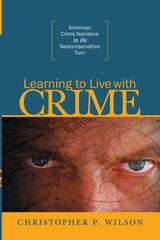
Learning to Live with Crime
American Crime Narrative in the Neoconservative TurnChristopher P. Wilson
The Ohio State University Press, 2010
Since the mid-1960s, the war on crime has reshaped public attitudes about state authority, criminal behavior, and the responsibilities of citizenship. But how have American writers grappled with these changes? What happens when a journalist approaches the workings of organized crime not through its legendary Godfathers but through a workaday, low-level figure who informs on his mob? Why is it that interrogation scenes have become so central to prime-time police dramas of late? What is behind writers’ recent fascination with “cold case” homicides, with private security, or with prisons?
In Learning to Live with Crime, Christopher P. Wilson examines this war on crime and how it has made its way into cultural representation and public consciousness. Under the sway of neoconservative approaches to criminal justice and public safety, Americans have been urged to see crime as an inevitable risk of modern living and to accept ever more aggressive approaches to policing, private security, and punishment. The idea has been not simply to fight crime but to manage its risks; to inculcate personal vigilance in citizens; and to incorporate criminals’ knowledge through informants and intelligence gathering. At its most scandalous, this study suggests, contemporary law enforcement has even come to mimic crime’s own operations.
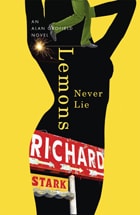
Lemons Never Lie
An Alan Grofield NovelRichard Stark
University of Chicago Press, 1971
Donald E. Westlake is one of the greats of crime fiction. Under the pseudonym Richard Stark, he wrote twenty-four fast-paced, hardboiled novels featuring Parker, a shrewd career criminal with a talent for heists. Using the same nom de plume, Westlake also completed a separate series in the Parker universe, starring Alan Grofield, an occasional colleague of Parker. While he shares events and characters with several Parker novels, Grofield is less calculating and more hot-blooded than Parker; think fewer guns, more dames.

Leopold and Loeb
THE CRIME OF THE CENTURYHal Higdon
University of Illinois Press, 1975
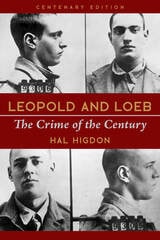
Leopold and Loeb
The Crime of the CenturyHal Higdon
University of Illinois Press, 2024
The 1924 murder of fourteen-year-old Bobby Franks by Nathan Leopold and Richard Loeb shocked the nation. One hundred years later, the killing and its aftermath still reverberate through popular culture and the history of American crime.
Hal Higdon’s true crime classic offers an unprecedented examination of the case. Higdon details Leopold and Loeb’s journey from privilege and promise to the planning and execution of their monstrous vision of the perfect crime. Drawing on secret testimony, Higdon follows the police investigation through the pair’s confessions of guilt and recreates the sensational hearing where Clarence Darrow, the nation’s most famous attorney, saved the pair from the death penalty.
In-depth and definitive, Leopold and Loeb tells the dramatic story of a notorious crime and its long afterlife in the American imagination.
Lily White
Christian Schünemann and Jelena Volic
Haus Publishing, 2021
Jelena Volić and Christian Schünemann’s latest thriller follows a case for criminologist Milena Lukin, the protagonist of their previous novels Cornflower Blue and Peony Red. Set in Belgrade, a city of flux between East and West, Lily White is a complex and riveting new story that once again will take Lukin to the dark heart of Serbia’s past.
Bouquets of white lilies are mysteriously laid in a Belgrade street where, years earlier, a small Romani boy was beaten to death by two youths. One of the attackers was apprehended and imprisoned. The other was allowed to flee and, after twenty-five years on the run, he returns to Belgrade to confront his past. Days later, his corpse is found floating in the Danube River. After a cursory investigation, the police declare it to have been suicide and close the case, but the dead man’s lawyer and the criminologist Milena Lukin begin an investigation of their own. They soon stumble upon a clue that leads them into the darkest recesses of Serbian politics and to the root of a murder that shaped the fate of a country.