Results by title
193 books match the query 'Cultural & Regional' and 6 start with l

Let Me Live
Angelo Herndon
University of Michigan Press, 2007
Let Me Live tells the remarkable story of Angelo Herndon, a coal miner who worked as a labor organizer in Alabama and Georgia in the 1930s. Herndon led a racially integrated march of the unemployed in 1932 and was subsequently arrested when Communist Party literature was found in his bedroom. His trial made only small headlines at first, but eventually an international campaign to free him emerged, thanks to the efforts of the Communist Party and of labor unions interested in protecting the right to organize in the South. Herndon was finally set free by the U.S. Supreme Court, with the help of well-known leaders including C. Vann Woodward, Thurgood Marshall, A. Philip Randolph, and Whitney North Seymour, Sr.
Written while Herndon was in prison, Let Me Live tells the story behind his arrest and his struggle through the courts. It also describes his early life as a young boy in poverty, as a laborer in the Kentucky mines, and as a construction gang worker and traces the birth and development of his passion for the Communist Party. Originally published in 1937, this is the first new edition of Let Me Live since 1969, when Howard N. Meyer rescued it from obscurity. The book features texts from the Georgia and U.S. Supreme Court decisions, the text of Herndon’s speech, and newspaper editorials from the era. A substantive and thought-provoking introduction by Marlon B. Ross of the University of Virginia sheds light on this unique story and its importance to our understanding of the intersection of race and class in America—past and present.
“A book which every thoughtful American may do well to read. It is moving and challenging as the story of one man’s life and the question of one man’s fate.”
—New York Times
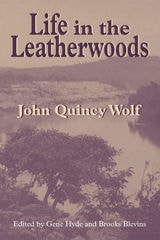
Life in the Leatherwoods
New EditionJohn Quincy Wolf
University of Arkansas Press, 2000
Originally published by Memphis State University Press in 1974, this new edition includes additional writings of John Q. Wolf and a continuation of the autobiographical narrative after his 1887 move to Batesville. Wolf’s writings are valuable resources for southern historians, folklorists, general readers, and scholars of Ozarkiana because they provide a rare glimpse into the social and family life of a largely misunderstood and stereotyped people—the independent hill farmers of the Arkansas Ozarks of the 1870s and 1880s. With Life in the Leatherwoods, Wolf bestows a benediction upon a society that existed vibrantly and humorously in his memory—one that has now forever disappeared from the American countryside.
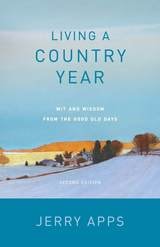
Living a Country Year
Wit and Wisdom from the Good Old DaysJerry Apps
Wisconsin Historical Society Press, 2018
“Even with the all the hard work, we had more time (perhaps we took more time) to enjoy what was all around us: nights filled with starlight, days with clear blue skies and puffy clouds. Wonderful smells everywhere—fresh mown hay, wildflowers, and apple blossoms. Interesting sounds—the rumble of distant thunder, an owl calling in the woods, a flock of Canada geese winging over in the fall.”
In this paperback edition of a beloved Jerry Apps classic, the rural historian tells stories from his childhood days on a small central Wisconsin dairy farm in the 1930s and 1950s. From a January morning memory of pancakes piled high after chores, to a June day spent learning to ride a pony named Ginger, Jerry moves through the turn of the seasons and teaches gentle lessons about life on the farm. With recipes associated with each month and a new introduction exclusive to this 2nd edition, Living a Country Year celebrates the rhythms of rural life with warmth and humor.

Looking for Carrascolendas
From a Child's World to Award-Winning TelevisionBy Aida Barrera
University of Texas Press, 2001
If your childhood friends were Agapito, the bombastic, bilingual lion; Campamocha, the fix-it man; Caracoles, the restaurant owner; Uncle Andy, the shoe seller; Berta and Dyana, the life-size dolls; and Señorita Barrera, then you grew up watching Carrascolendas. This award-winning show, which originally aired on PBS in the 1970s and was subsequently broadcasted throughout the country in the 1980s and 1990s, was the first Spanish and English children's educational television program broadcast to national audiences in the United States.
In this engagingly written memoir, creator-producer Aida Barrera describes how the mythical world of Carrascolendas grew out of her real-life experiences as a Mexican American child growing up in the Valley of South Texas. She recalls how she drew on those early experiences to create television programming that specifically addressed the needs of Hispanic children, even as it remained accessible and entertaining to children of other cultural backgrounds.
In addition to her personal story, Barrera recounts the long-term struggles for network acceptance and funding that made the production of Carrascolendas something of a miracle. This off-camera story adds an important chapter to the history of Anglo-Mexican cultural politics during the 1970s. Given the fact that Latino characters are still under- and stereotypically represented on network television, Carrascolendas remains an important reminder of what is possible and what has been lost in authentically multicultural television programming.
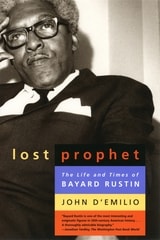
Lost Prophet
The Life and Times of Bayard RustinJohn D'Emilio
University of Chicago Press, 2004
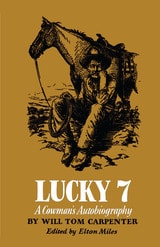
Lucky 7
A Cowman's AutobiographyBy Will Tom Carpenter
University of Texas Press, 1957
"No. 7"—as Carpenter, the youngest of seven children, called himself—was born in Missouri in 1854 and moved west with his family, first to Kansas, then to the settlements near Pikes Peak, and finally, in 1872, to Texas with his elder brother. From the time he made his first cattle drive, he wanted no other life but that of herding longhorns across the free and flat grasslands of the West. His schooling was the trail, the campfire, the saddle. In 1900, after a full and active life, he retired to his own ranch west of the Pecos. As the years passed, he sadly watched the fences go up and the free range disappear. Thus this book came to be written from the longing memory of a time-stranded cowman. He tells his story in the hard-punching, gritty language, direct humor, and attachment to bald fact and frank opinion that characterize the true Westerner.
Elton Miles has provided an introduction that fills in the details of Carpenter's life and completes a "vivid picture of the genuine old-time cowman," as Southwest Review observed.