Results by title
240 books match the query 'Diaries' and 5 start with l
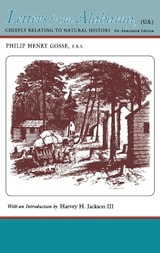
Letters from Alabama
Chiefly Relating to Natural HIstoryPhilip Henry Gosse, introduction by Harvey H. Jackson III, edited by Virginia Hamilton
University of Alabama Press, 1993
A naturalist's captivating portrait of Alabama's wildlife, landscapes, and people.
Philip Henry Gosse (1810-1888), a British naturalist, left home at age 17 and made his way to Alabama in 1838, where he had heard educated people were in demand. He was employed by Judge Reuben Saffold at Pleasant Hill in Dallas County as a teacher for about a dozen children of local landowners, but his principal interest was natural history. During the eight months he lived in th Black Belt he watched, listened, thought, took notes, and made sketches--activities that eventually led to Letters from Alabama. He lived among Alabamians, talked and listened to them, saw them at their best and their worst, and came to understand their hopes and fears. They were a part of the natural world, and he paid attention to them as any good scientist would. With the skills of a scientist and the temperament of an artist, Gosse set down an account of natural life in frontier Alabama that has no equal. Written to no one in particular, a common literary device of the period, the letters were first published in a magazine, and in 1859 appeared as a book. By that time Gosse was an established scholar and one of England’s most noted scientific illustrators.

Life of the 381st Bomb Group
The World War II Diary of Eighth Air Force Chaplain James Good BrownBob Korkuc
University of Missouri Press, 2026
While working on his first book, Bob Korkuc became intimately familiar with the 381st Bombardment Group of the Mighty Eighth Air Force and met the group’s chaplain, James Good Brown. Brown kept a diary during his time with the bomb group (1943 to 1945) in which he chronicled the daily experiences of the men.
Years after the war, Brown self-published his diary, which today is hard to find. Through his friendship with Brown, Korkuc gained access to and chose to edit the original docu - ment so that more readers might appreciate this insightful wartime eyewitness account.
Serving in his early forties alongside men twenty years his junior—whom he called the “Mighty Men of the 381st”—Brown took part in morning briefings, shared meals with crews, and anxiously awaited their return from dangerous daylight bombing missions. Flying as a noncombatant, an unnecessary eleventh crewmember, Brown describes his own observations of a Flying Fortress combat mission over Germany. Writing with extraordinary candor, Brown documents the inner workings of a bomb group that flew 297 combat missions over Europe, providing vivid character assessments of his fellow airmen and capturing both their victories and devastating losses.
In addition to judiciously editing Brown’s original diary for readability, Korkuc created a unique appendix, which reveals the fate of every airman who served with Brown. The immediacy of Brown’s narration combined with Korkuc’s meticulous editing make this a promising new resource for scholars and general readers alike.
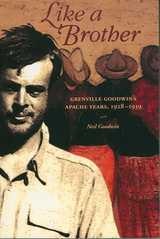
Like a Brother
Grenville Goodwin’s Apache Years, 1928-1939Neil Goodwin
University of Arizona Press, 2004
Assembled by Goodwin's son Neil, who never knew his father, these writings are gathered in thematic chapters that extend Neil Goodwin's earlier work, The Apache Diaries, and shed light on Grenville Goodwin's deepening understanding of the Apache people and their culture, and of the wrenching problems which reservation life forced on them. In two of the chapters Neil tells how he retraced his father's search for the Sierra Madre Apache, re-discovering abandoned Apache campsites and conveying even more personally than his father's diaries what was for both father and son the adventure of a lifetime. Other chapters trace Goodwin's interest in children of the Sierra Madre Apaches who were captured in Mexican raids on these camps during the early decades of the twentieth century. The full stories of the lives of three of these children are for the first time pieced together from newly gathered research.
Grenville was quiet, self-effacing and rarely revealed his inner life, but one chapter affords a closer look: a portrait of his marriage to Neil's mother, Jan. Her diary entries, juxtaposed with her vivid poetry and her paintings and drawings, illuminate her relationship with Grenville and throw his elusive personality into deeper relief than his own writings do. Here too are letters from Goodwin's Apache friends that paint a powerful and poignant portrait of their daily lives and of their relationship with him. Goodwin's daily diary excerpts relate his own experiences on the San Carlos Apache reservation from 1928 to 1936: what was happening at the store, how the cattle were doing, who was in jail, and thousands of other details that give readers a sharp sense of what the reservation was like in the 1930s. As these writings also show, Goodwin was powerfully drawn to Apache spirituality and became steeped in their sacred knowledge. His simple description of a day in the life of an Apache family captures the expression of this spirituality in the rhythms of everyday life, whether greeting the rising sun, curing an injury, plowing the earth, or simply being good to one's family.
More than half a century after his death, Grenville Goodwin continues to be regarded as one of the most enigmatic and romantic figures in American anthropology. Like a Brother gives us a fuller understanding of the man and his work as it broadens our knowledge of Apache history and culture.
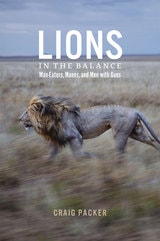
Lions in the Balance
Man-Eaters, Manes, and Men with GunsCraig Packer
University of Chicago Press, 2015
Monsters take many forms: from man-eating lions to the people who hunt them, from armed robbers to that midnight knock at the door of a cheap hotel room in Dar es Salaam. And celebrated biologist Craig Packer has faced them all. Head on.
With Lions in the Balance, Packer takes us back into the complex, tooth-and-claw world of the African lion, offering revealing insights into both the lives of one of the most iconic and dangerous animals on earth and the very real risks of protecting them. A sequel to his prize-winning Into Africa—which gave many readers their first experience of fieldwork in Africa, of cooperative lions on dusty savannas, and political kidnappings on the shores of Lake Tanganyika—this new diary-based chronicle of cutting-edge research and heartbreaking corruption will both alarm and entertain. Packer’s story offers a look into the future of the lion, one in which the politics of conservation will require survival strategies far more creative and powerful than those practiced anywhere in the world today.
Packer is sure to infuriate millionaires, politicians, aid agencies, and conservationists alike as he minces no words about the problems he encounters. But with a narrative stretching from far flung parts of Africa to the corridors of power in Washington, DC, and marked by Packer’s signature humor and incredible candor, Lions in the Balance is a tale of courage against impossible odds, a masterly blend of science, adventure, and storytelling, and an urgent call to action that will captivate a new generation of readers.

Love and Power in the Nineteenth Century
The Marriage of Violet BlairVirginia Jeans Laas
University of Arkansas Press, 1998
Winner, 1999 Missouri Conference on History Book Award
This fascinating biography of a marriage in the Gilded Age closely examines the dynamic flow of power, control, and love between Washington blue blood Violet Blair and New Orleans attorney Albert Janin. Based on their voluminous correspondence as well as Violet’s extensive diaries, it offers a thoroughly intimate portrait of a fifty-four-year union which, in many ways, conformed to societal strictures, yet always created its own definition of itself in order to fit the flux of needs of both husband and wife.
Central to their story is Violet’s fierce determination to maintain her autonomy within the patriarchic institution of marriage. An enduring belle who thought, talked, and acted with the assurance and self-confidence of one whose wishes demanded obedience, she rejected the Victorian ideal of women as silent, submissive consorts. Yet her feminism was a private one, not played out on a public stage but kept to the confines of her own daily life and marriage.
With abundant documentary evidence to draw upon, Laas ties this compelling story to broader themes of courtiship behavior, domesticity, gender roles, extended family bonds, elitism, and societal stereotyping. Deeply researched and beautifully written, Love and Power in the Nineteenth Century has the dual virtue of making an important historical contribution while also appealing to a broad popular audience.