Results by title
204 books match the query 'Direction & Production' and 5 start with l
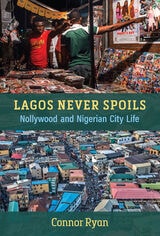
Lagos Never Spoils
Nollywood and Nigerian City LifeConnor Ryan
University of Michigan Press, 2023
Winner of the Society for Cinema and Media Studies, Media Industries Scholarly Interest Group Outstanding Book Award
The slogan “Lagos shall not spoil,” found in print media, political campaigns, and common conversation, represents a shared expression of the optimism the city embodies. However, on city streets the phrase also appears scrawled in irreverent variations—“Lagos cannot spoil more than this!”—that meet the frustrations of city life with irony. In both cases, the slogan captures the resilience and persistence with which residents of Lagos live on, despite it all. This book examines the circumstances that make it possible for residents to persist in pursuing their various projects and for the city to remain a platform that supports these projects and creates space for even more to emerge. Author Connor Ryan argues that residents continually work to combine contingency and endurance in opportunistic ways that make the city work for them, and as such, Lagos never spoils: it endures.
What makes Lagos remarkable is what residents have made of it, and Nollywood—the industry and the body of films—both embodies and represents this continual urban transformation. Lagos Never Spoils traces how Nollywood arose from the social milieu of Lagos and, in turn, generates a repertoire of stories, images, styles, and sentiments with which audiences come to grips with city life. The book traces the evolution of the screen media industry in Lagos and explores how this corresponds with historical phases in the city’s representation onscreen. It discusses important urban spaces of production and consumption, including historic movie halls, video marketplaces, film sets, and multiplex cinemas. Across six chapters, it attends to celluloid films about oil-boom wealth, television sitcoms about urban tricksters, video melodramas about urban crisis, glossy romantic comedies about young professionals, and dark thrillers on streaming platforms about the pleasure of moral transgression. In this fashion, the book offers new approaches to the interpretation of screen texts produced in and about Lagos, a place that is today the most influential image of West African city life.
Liberating Hollywood
Women Directors and the Feminist Reform of 1970s American CinemaSmukler, Maya M
Rutgers University Press, 2019
Liberating Hollywood examines the professional experiences and creative output of women filmmakers during a unique moment in history when the social justice movements that defined the 1960s and 1970s challenged the enduring culture of sexism and racism in the U.S. film industry. Throughout the 1970s feminist reform efforts resulted in a noticeable rise in the number of women directors, yet at the same time the institutionalized sexism of Hollywood continued to create obstacles to closing the gender gap. Maya Montañez Smukler reveals that during this era there were an estimated sixteen women making independent and studio films: Penny Allen, Karen Arthur, Anne Bancroft, Joan Darling, Lee Grant, Barbara Loden, Elaine May, Barbara Peeters, Joan Rivers, Stephanie Rothman, Beverly Sebastian, Joan Micklin Silver, Joan Tewkesbury, Jane Wagner, Nancy Walker, and Claudia Weill. Drawing on interviews conducted by the author, Liberating Hollywood is the first study of women directors within the intersection of second wave feminism, civil rights legislation, and Hollywood to investigate the remarkable careers of these filmmakers during one of the most mythologized periods in American film history.
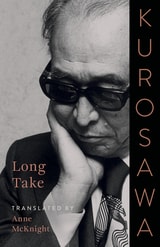
Long Take
Akira Kurosawa
University of Minnesota Press, 2025
A multifaceted portrait of the great Japanese director
For years, Akira Kurosawa resisted writing about himself. “It would turn out to be nothing but talk about movies,” he said. “In other words, take myself, subtract movies, and the result is zero.” The memoir he finally started serializing in 1978, Something like an Autobiography, ended with Rashomon, the film that launched him on the world’s stage in 1950. Long Take, first published in Japan shortly after Kurosawa’s death in 1998, at last tells the story of the rest of his life.
By turns intimate, provocative, and revealing, Long Take creates a dynamic portrait of Kurosawa from his own writings; his conversations with writer Inoue Hisashi and director Yamada Yōji; and essays by his daughter and colleague Kurosawa Kazuko, who details the collaborative history of the “Kurosawa crew.” It features a wealth of industry lore, cultural reference points, inside jokes with other filmmakers and writers, and backstories for his own productions, from the earliest to the last. Of particular interest to all cinephiles is an annotated list of Kurosawa’s 100 favorite films.
A survey of Kurosawa’s prodigious career, this book situates the visionary in the media milieu of his youth, in the literature and performing arts of twentieth-century Japan and Hollywood, and among the myriad films he loved, admired, and referenced, including Japanese silent film and comedy as well as productions from India, Iran, and Soviet-era Russia. Now available to English readers for the first time, Long Take offers a lasting picture of the peerless filmmaker in his element.
Lucrecia Martel
Gerd Gemünden
University of Illinois Press, 2019
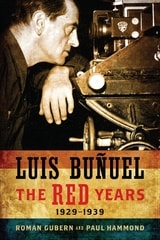
Luis Buñuel
The Red Years, 1929–1939Román Gubern
University of Wisconsin Press, 2011
The turbulent years of the 1930s were of profound importance in the life of Spanish film director Luis Buñuel (1900–1983). He joined the Surrealist movement in 1929 but by 1932 had renounced it and embraced Communism. During the Spanish Civil War (1936–39), he played an integral role in disseminating film propaganda in Paris for the Spanish Republican cause.
Luis Buñuel: The Red Years, 1929–1939 investigates Buñuel’s commitment to making the politicized documentary Land without Bread (1933) and his key role as an executive producer at Filmófono in Madrid, where he was responsible in 1935–36 for making four commercial features that prefigure his work in Mexico after 1946. As for the republics of France and Spain between which Buñuel shuttled during the 1930s, these became equally embattled as left and right totalitarianisms fought to wrest political power away from a debilitated capitalism.
Where it exists, the literature on this crucial decade of the film director’s life is scant and relies on Buñuel’s own self-interested accounts of that complex period. Román Gubern and Paul Hammond have undertaken extensive archival research in Europe and the United States and evaluated Buñuel’s accounts and those of historians and film writers to achieve a portrait of Buñuel’s “Red Years” that abounds in new information.