Results by title
436 books match the query 'Disability' and 17 start with l
Language Attitudes in the American Deaf Community
Joseph C. Hill
Gallaudet University Press, 2012
In a diverse signing community, it is not unusual to encounter a wide variety of expression in the types of signs used by different people. Perceptions of signing proficiency often vary within the community, however. Conventional wisdom intimates that those who learned at an early age at home or in school know true standard American Sign Language, while those who learned ASL later in life or use contact or coded signs are considered to be less skillful. Joseph Christopher Hill’s new study Language Attitudes in the American Deaf Community explores the linguistic and social factors that govern such stereotypical perceptions of social groups about signing differences.
Hill’s analysis focuses on affective, cognitive, and behavioral types of evaluative responses toward particular language varieties, such as ASL, contact signing, and Signed English. His work takes into account the perceptions of these signing types among the social groups of the American Deaf community that vary based on generation, age of acquisition, and race. He also gauges the effects of social information on these perceptions and the evaluations and descriptions of signing that results from their different concepts of a signing standard. Language Attitudes concludes that standard ASL’s value will continue to rise and the Deaf/Hearing cultural dichotomy will remain relevant without the occurrence of a dramatic cultural shift.
Language and the Law in Deaf Communities
Ceil Lucas
Gallaudet University Press, 2003
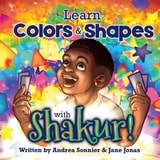
Learn Colors and Shapes with Shakur!
A Shakur Series Board BookAndrea Sonnier
Gallaudet University Press, 2024
About the Shakur Series:
The Shakur Series features Black deaf characters who use American Sign Language, offering a unique and inclusive reading experience for children. The vibrant illustrations showcase a signing family and will captivate young minds, while the engaging text reinforces learning. These charming board books contain positive messages and practical lessons, support early childhood development, and encourage children to explore the world with Shakur. This series honors and celebrates Black deaf experiences through everyday adventures that will resonate with young children and their families.
Published in partnership with The Laurent Clerc National Deaf Education Center.
Learning from the High Priestess
Affect, Femme Care, and Somatic PracticeAnn Cvetkovich
Duke University Press, 2026
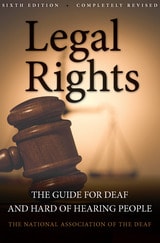
Legal Rights, 6th Ed.
The Guide for Deaf and Hard of Hearing PeopleGallaudet University Press, 2015
The new Legal Rights also explains the significant amendments to these laws, including the ADA Amendments Act (ADAAA) and new regulations to its Title II concerning public entities and Title III pertaining to public accommodations and commercial facilities. The reauthorization of IDEA expanded the No Child Left Behind Act requirement for highly qualified teachers to all students with disabilities. This new edition also tracks the trend of passing a Deaf and Hard of Hearing Children’s Bill of Rights in a growing number of state legislatures.
This completely new resource also delineates new legislation such as the Twenty-First Century Communications Video and Accessibility Act, which ensures access to the newest communications technology for deaf and hard of hearing people. Legal Rights also includes information on the use of interpreters in the legal system, securing its position as the most comprehensive reference of legal information for deaf and hard of hearing people now available.
Lend Me Your Ear
Brenda Jo Brueggemann
Gallaudet University Press, 1999
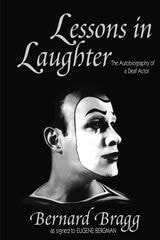
Lessons in Laughter
The Autobiography of a Deaf ActorBernard Bragg
Gallaudet University Press, 1989
To succeed as an actor is a rare feat. To succeed as a deaf actor is nothing short of amazing. Lessons in Laughter is the story of Bernard Bragg and his astonishing lifelong achievements in the performing arts.
Born deaf of deaf parents, Bernard Bragg has won international renown as an actor, director, playwright, and lecturer. Lessons in Laughter recounts in stories that are humorous, painful, touching, and outrageous, the growth of his dream of using the beauty of sign language to act. He starred in his own television show “The Quiet Man,” helped found The National Theatre of the Deaf, and traveled worldwide to teach his acting methods.

Let's Cook!
The Chang Family Series Board BookYoumee Lee
Gallaudet University Press, 2025
Let's Explore!
The Chang Family Series Board BookYoumee Lee
Gallaudet University Press, 2025
Let's Make!
The Chang Family Series Board BookYoumee Lee
Gallaudet University Press, 2025
Let's Share!
The Chang Family Series Board BookYoumee Lee
Gallaudet University Press, 2025
Let's Sleep!
The Chang Family Series Board BookYoumee Lee
Gallaudet University Press, 2025
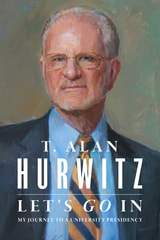
Let’s Go In
My Journey to a University PresidencyT. Alan Hurwitz
Gallaudet University Press, 2020
Additional images, videos, and supplemental readings are available at the Gallaudet University Press/Manifold online platform.
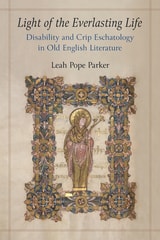
Light of the Everlasting Life
Disability and Crip Eschatology in Old English LiteratureLeah Pope Parker
University of Michigan Press, 2025
From disability metaphors to narratives structured around bodies presented as aberrant, early medieval English thoughtworlds conveyed the promise of resurrection and the hope of salvation through crip and disabled bodies. Light of the Everlasting Life argues that early medieval Christian eschatology, as manifested in Old English literary texts, was a crip eschatology: a theology of the afterlife that relied upon disabled bodies and concepts related to disability in order to convey promises of resurrection and salvation. In addition to demonstrating how literature manifested theological approaches to the afterlife, Leah Pope Parker articulates the ways of thinking about bodies and disability that were available to ordinary early medieval people, many of whom experienced their bodies in ways that resonate with what we call disability today, but who rarely appear in the historical record.
By analyzing Old English texts, including Alfredian translations, Ælfric’s saints’ lives, and poetry from the Exeter and Vercelli Books, Parker introduces novel ways of characterizing disability’s effects in literature. “Spiritual prosthesis” reveals rhetorical, narrative, and theological reliance upon disability to convey the promise of a Christian afterlife. “Systems of aberrance” emerge as a result, in which bodies marked as deviant—including disabled, monstrous, heroic, saintly, and dead bodies—form a network of embodiments that reinforce the narratives they inhabit and that of Christian salvation history. Locating crip eschatology in early medieval literature, Light of the Everlasting Life rewrites standard histories of disability, of the body, and of medieval Christian eschatology.
Linguistics of American Sign Language
An Introduction, 6th Ed.Julie A. Hochgesang
Gallaudet University Press, 2026
Grounded in the scholarship and reflecting contemporary developments in the field of signed language linguistics, the sixth edition of Linguistics of American Sign Language provides a clear, comprehensive, and fresh introduction to the structure of ASL. Focusing on language in everyday contexts, this new edition treats ASL as a dynamic system shaped by the diversity of its communities.
Organized into two parts, Linguistics of American SignLanguage begins by exploring fundamental concepts of language within communities, addressing language features, registers, variation and historical change, multilingualism, ideologies, and discourse. This first section sets the stage for in-depth analysis into core areas of linguistic study: syntax, phonology, and morphology. New content provides depth, exploring topics such as the representation of signed languages in texts, corpus linguistics, heritage-language signers, and Black ASL. To show how language is used by multilingual and multimodal individuals within their communities, the book pairs discussion with “grounding texts,” videos of ASL within varied authentic settings.
Linguistics of American Sign Language is supported by a companion website that provides access to the grounding texts and supplementary materials, including downloadable resources for hands-on analysis such as annotated videos and readings. Designed for readers with no background in linguistics, each unit opens with guided questions to prompt reflection and concludes with exercises and recommended readings.
Refining the standard for sign language scholarship, the sixth edition of Linguistics of American Sign Language guides readers beyond technical analysis to explore ASL as a vibrant system rooted in community, culture, and language.
Literacy and Deaf People
Cultural and Contextual PerspectivesBrenda Jo Brueggemann
Gallaudet University Press, 2004
This compelling collection advocates for an alternative view of deaf people’s literacy, one that emphasizes recent shifts in Deaf cultural identity rather than a student’s past educational context as determined by the dominant hearing society. Divided into two parts, the book opens with four chapters by leading scholars Tom Humphries, Claire Ramsey, Susan Burch, and volume editor Brenda Jo Brueggemann. These scholars use diverse disciplines to reveal how schools where deaf children are taught are the product of ideologies about teaching, about how deaf children learn, and about the relationship of ASL and English.
Part Two features works by Elizabeth Engen and Trygg Engen; Tane Akamatsu and Ester Cole; Lillian Buffalo Tompkins; Sherman Wilcox and BoMee Corwin; and Kathleen M. Wood. The five chapters contributed by these noteworthy researchers offer various views on multicultural and bilingual literacy instruction for deaf students. Subjects range from a study of literacy in Norway, where Norwegian Sign Language recently became the first language of instruction for deaf pupils, to the difficulties faced by deaf immigrant and refugee children who confront institutional and cultural clashes. Other topics include the experiences of deaf adults who became bilingual in ASL and English, and the interaction of the pathological versus the cultural view of deafness. The final study examines literacy among Deaf college undergraduates as a way of determining how the current social institution of literacy translates for Deaf adults and how literacy can be extended to deaf people beyond the age of 20.
Loneliness and Its Opposite
Sex, Disability, and the Ethics of EngagementDon Kulick and Jens Rydström
Duke University Press, 2015
Loneliness and Its Opposite documents how two countries generally imagined to be progressive engage with these questions in very different ways. Denmark and Sweden are both liberal welfare states, but they diverge dramatically when it comes to sexuality and disability. In Denmark, the erotic lives of people with disabilities are acknowledged and facilitated. In Sweden, they are denied and blocked. Why do these differences exist, and how do both facilitation and hindrance play out in practice?
Loneliness and Its Opposite charts complex boundaries between private and public, love and sex, work and intimacy, and affection and abuse. It shows how providing disabled adults with access to sexual lives is not just crucial for a life with dignity. It is an issue of fundamental social justice with far reaching consequences for everyone.