Results by title
447 books match the query 'Eastern' and 11 start with l
Labour Statistics for a Market Economy
Challenges and Solutions in the Transition Countries of Central and Eastern Europe and the Former Soviet UnionIgor Chernyshev
Central European University Press, 1995
Late Enlightenment
Emergence of the Modern 'National Idea'Marius Turda
Central European University Press, 2006
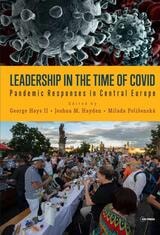
Leadership in the Time of Covid
Pandemic Responses in Central EuropeMilada Polisenská
Central European University Press, 2023
The Covid pandemic has put all modern societies to a serious test of resilience. The interdisciplinary research on which this book is based examined how four European governments behaved in these circumstances. During the months of the crisis, the team of experts coordinated by the editors of this volume took a close look at the decision-making processes in the Czech Republic, Hungary, Poland, and Slovakia – the so-called Visegrad Four.
The inquiries focused on experiences from the academic, health, economic and social fields. The methods of comparison included surveys, interviews, discourse analysis, for which the adaptive leadership theory provided the conceptual framework.
The conclusions are both academic and practical. Aside the description of the pandemic responses, the research had a formative dimension: how can an adaptive leadership approach better help societies manage the health and societal impacts of similar challenges? The spectrum of emerging anti-democratic tendencies in the region provided the specific context of the exercise. The four states face varying degrees of democratic backsliding as well as illiberal influences that have affected their response to the pandemic, which gives this research on the Visegrad Four a worldwide resonance.
Learning to Change
The Experience of Transforming Education in South East EuropeTerrice Bassler
Central European University Press, 2005
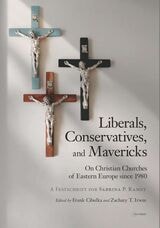
Liberals, Conservatives, and Mavericks
On Christian Churches of Eastern Europe since 1980. A Festschrift for Sabrina P. RametFrank Cibulka
Central European University Press, 2025
No Church is monolithic—this is the preliminary premise of this volume on the public place of religion in a representative number of post-communist countries. The studies confirm that within any religious organization we can expect to find fissures, factions, theological or ideological quarrels, and perhaps even competing interest groups, such as missionary workers, regular clergy versus secular clergy, and sometimes even competing ecclesiastical hierarchies. The main focus of the book rests on the divisions arising within select Christian Churches, as they confront the processes of secularization and atheization. The coverage area includes Russia and the Ukraine, East-Central Europe and South-Eastern Europe. Some chapters focus on individual clergy who challenge the mainstream of their given Church either from a more liberal or from a more conservative perspective, while others deal with the divisive forces impacting the religious organizations.
This festschrift to honor Sabrina Ramet’s seminal contribution to the study of religion in the politics of the communist and post-communist world, brings together several generations of scholars from a variety of countries, both those well established in their fields of study as well as young promising academics.
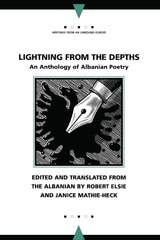
Lightning from the Depths
An Anthology of Albanian PoetryRobert Elsie and Janice Mathie-Heck
Northwestern University Press, 2008
If a people
Have no poets
And no poetry of their own
For a National Anthology
Then treachery and barking
Will do the trick
With these words, a challenge is laid down in this new volume of Albanian poetry. Albania, however, has a dynamic tradition of literature. Lightning from the Depths is the first English collection to present the full range of Albanian verse. Albanian literature has had many lives. The early Christian traditions disappeared as Islam and the Ottoman Empire took over. Muslim literature, too, withered when the nation strove to become an independent European country. The beginnings of a modern tradition were quashed by the Stalinists. All along this rocky path, poets have turned the political strife, poverty, and isolation their nation has often experienced into culture, both celebrating and questioning the society in which they live. Lightning from the Depths opens readers’ eyes to a new political and cultural world populated artists who can spin despair into poetry.
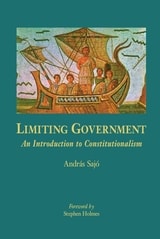
Limiting Government
An Introduction to ConstitutionalismAndrás Sajó
Central European University Press, 1999
Until the previous decade, constitutionalism in Eastern Europe was considered to be an outmoded concept of the nineteenth century. Changes in the region, however, have brought back the fundamental question of the need to restrict government power through social self-binding.
This book discusses the mechanisms of such restriction, including different forms of the separation of powers and constitutional review. It relates the theoretical and practical importance of the issue to the present world-wide discontent with majoritarian democracy and the growing disrepute of parliaments. Increasing executive efficiency is, however, a threat to fundamental rights, and the battlecry of efficiency is often only a means to new despotism and inefficiency. A careful re-evaluation of the concept of constitutionalism assists in the search for a useful balance between majoritarianism and rights, and in the avoidance of all forms of public tyranny.
Written in non-technical language and using the most important English, American, French, and German examples of constitutional history, the book also examines East European (in particular, Russian) and Latin American examples, in part to illustrate certain dead-ends in constitutional development. It is intended to be an introduction for all those concerned with liberty.
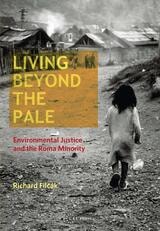
Living beyond the Pale
Environmental Justice and the Roma MinorityRichard Filcák
Central European University Press, 2012
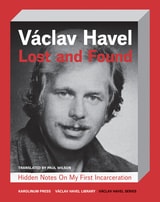
Lost and Found
Hidden Notes on My First IncarcerationVáclav Havel
Karolinum Press, 2026
An English translation of a lost manuscript of reflections from former Czech dissident Václav Havel.
In the fall of 1977, after the dramatic events of the “Year of Charter 77,” Václav Havel wrote a report recounting the first hours after the Charter 77 Declaration, the four months of investigative detention imposed on him by the communist regime, his release, and the agonizing self-examination that followed. In this text, the former dissident describes not only the investigation but also the Faustian guilt he felt after promising to scale back his political activities in exchange for his freedom. As he later recalled in a book-length interview with journalist Karel Hvíždala titled Dálkový výslech (Long-distance interrogation), he hid the roughly one-hundred-page manuscript somewhere, admitting: “I don’t know where it is anymore. Maybe I’ll find it someday.” He never did. The manuscript resurfaced only recently, discovered among the papers of his close friend Zdenek Urbánek. Fragmentary yet strikingly immediate, the text has been reconstructed and published by the Václav Havel Library, with the English translation appearing on the occasion of the world-renowned intellectual’s ninetieth birthday.
Lost in Transition
Ethnographies of Everyday Life after CommunismKristen Ghodsee
Duke University Press, 2011
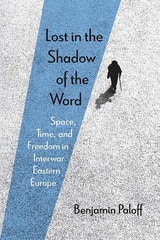
Lost in the Shadow of the Word
Space, Time, and Freedom in Interwar Eastern EuropeBenjamin Paloff
Northwestern University Press, 2016
Scholars of modernism have long addressed how literature, painting, and music reflected the radical reconceptualization of space and time in the early twentieth century—a veritable revolution in both physics and philosophy that has been characterized as precipitating an “epistemic trauma” around the world. In this wide-ranging study, Benjamin Paloff contends that writers in Central and Eastern Europe felt this impact quite distinctly from their counterparts in Western Europe. For the latter, the destabilization of traditional notions of space and time inspired works that saw in it a new kind of freedom. However, for many Central and Eastern European authors, who were writing from within public discourses about how to construct new social realities, the need for escape met the realization that there was both nowhere to escape to and no stable delineation of what to escape from. In reading the prose and poetry of Czech, Polish, and Russian writers, Paloff imbues the term “Kafkaesque” with a complexity so far missing from our understanding of this moment in literary history.