Results by title
728 books match the query 'Economic aspects' and 24 start with l
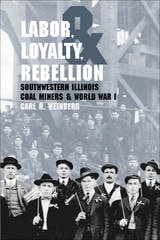
Labor, Loyalty, and Rebellion
Southwestern Illinois Coal Miners & World War ICarl R. Weinberg
Southern Illinois University Press, 2005
On April 5, 1918, as American troops fought German forces on the Western Front, German American coal miner Robert Prager was hanged from a tree outside Collinsville, Illinois, having been accused of disloyal utterances about the United States and chased out of town by a mob. In Labor, Loyalty, and Rebellion: Southwestern Illinois Coal Miners and World War I, Carl R. Weinberg offers a new perspective on the Prager lynching and confronts the widely accepted belief among labor historians that workers benefited from demonstrating loyalty to the nation.
The first published study of wartime strikes in southwestern Illinois is a powerful look at a group of people whose labor was essential to the war economy but whose instincts for class solidarity spawned a rebellion against mine owners both during and after the war. At the same time, their patriotism wreaked violent working-class disunity that crested in the brutal murder of an immigrant worker. Weinberg argues that the heightened patriotism of the Prager lynching masked deep class tensions within the mining communities of southwestern Illinois that exploded after the Great War ended.
Land and the Given Economy
The Hermeneutics and Phenomenology of DwellingTodd S. Mei
Northwestern University Press, 2017
Alarming environmental degradation makes ever more urgent the reconciliation of political economy and sustainability. Land and the Given Economy examines how the landed basis of human existence converges with economics, and it offers a persuasive new conception of land that transcends the flawed and inadequate accounts in classical and neoclassical economics.
Todd S. Mei grounds this work in a rigorous review of problematic economic conceptions of land in the work of John Locke, Adam Smith, David Ricardo, John Stuart Mill, Karl Marx, Henry George, Alfred Marshall, and Thorstein Veblen.
Mei then draws on the thought of Martin Heidegger to posit a philosophical clarification of the meaning of land—its ontological nature. He argues that central to rethinking land is recognizing its unique manner of being, described as its "givenness." Concluding with a discussion of ground rent, Mei reflects on specific strategies for incorporating the philosophical account of land into contemporary economic policies.
Revivifying economic frameworks that fail to resolve the impasse between economic development and sustainability, Land and the Given Economy offers much of interest to scholars and readers of philosophy, environmentalism, and the full spectrum of political economy.
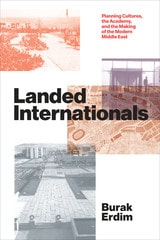
Landed Internationals
Planning Cultures, the Academy, and the Making of the Modern Middle EastBy Burak Erdim
University of Texas Press, 2020
2022 On the Brinck Book Award, University of New Mexico School of Architecture + Planning
Special Mention, First Book Prize, International Planning History Society
Landed Internationals examines the international culture of postwar urban planning through the case of the Middle East Technical University (METU) in Ankara, Turkey. Today the center of Turkey's tech, energy, and defense elites, METU was founded in the 1950s through an effort jointly sponsored by the UN, the University of Pennsylvania, and various governmental agencies of the United States and Turkey. Drawing on the language of the UN and its Technical Assistance Board, Erdim uses the phrase "technical assistance machinery" to encompass the sprawling set of relationships activated by this endeavor.
Erdim studies a series of legitimacy battles among bureaucrats, academics, and other professionals in multiple theaters across the political geography of the Cold War. These different factions shared a common goal: the production of nationhood—albeit nationhood understood and defined in multiple, competing ways. He also examines the role of the American architecture firm Skidmore, Owings, and Merrill; the New York housing policy guru Charles Abrams; the UN and the University of Pennsylvania; and the Turkish architects Altuğ and Behruz Çinici. In the end, METU itself looked like a model postwar nation within the world order, and Erdim concludes by discussing how it became an important force in transnational housing, planning, and preservation in its own right.
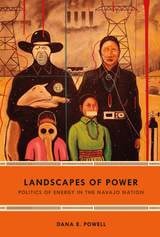
Landscapes of Power
Politics of Energy in the Navajo NationDana E. Powell
Duke University Press, 2018
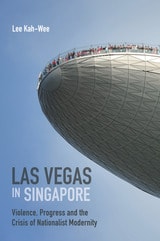
Las Vegas in Singapore
Violence, Progress and the Crisis of Nationalist ModernityLee Kah-Wee
National University of Singapore Press, 2018
The first history begins in colonial Singapore in the 1880s, when British administrators revised gambling laws in response to the political threat posed by Chinese-run gambling syndicates. Following the tracks of these punitive laws and practices, the book moves into the 1960s when the newly independent city-state created a national lottery while criminalizing both organized and petty gambling in the name of nation-building. The second history shifts the focus to corporate Las Vegas in the 1950s when digital technology and corporate management practices found each other on the casino floor. Tracing the emergence of the specialist casino designer, the book reveals how casino development evolved into a highly rationalized spatial template designed to maximize profits. Today an iconic landmark of Singapore, Marina Bay Sands is also an artifact of these two histories, an attempt by Singapore to normalize what was once criminalized in its nationalist history.
Lee Kah-Wee argues that the historical project of the control of vice is also about the control of space and capital. The result is an uneven landscape where the legal and moral status of gambling is contingent on where it is located. As the current wave of casino expansion spreads across Asia, he warns that these developments should not be seen as liberalization but instead as a continuation of the project of concentrating power by modern states and corporations.
Last Best Gifts
Altruism and the Market for Human Blood and OrgansKieran Healy
University of Chicago Press, 2006
Last Best Gifts offers a fresh perspective on this ethical dilemma by examining the social organization of blood and organ donation in Europe and the United States. Gifts of blood and organs are not given everywhere in the same way or to the same extent—contrasts that allow Kieran Healy to uncover the pivotal role that institutions play in fashioning the contexts for donations. Procurement organizations, he shows, sustain altruism by providing opportunities to give and by producing public accounts of what giving means. In the end, Healy suggests, successful systems rest on the fairness of the exchange, rather than the purity of a donor’s altruism or the size of a financial incentive.
Law and Happiness
Edited by Eric A. Posner and Cass R. Sunstein
University of Chicago Press, 2010
Since the earliest days of philosophy, thinkers have debated the meaning of the term happiness and the nature of the good life. But it is only in recent years that the study of happiness—or “hedonics”—has developed into a formal field of inquiry, cutting across a broad range of disciplines and offering insights into a variety of crucial questions of law and public policy.
Law and Happinessbrings together the best and most influential thinkers in the field to explore the question of what makes up happiness—and what factors can be demonstrated to increase or decrease it. Martha Nussbaum offers an account of the way that hedonics can productively be applied to psychology, Cass R. Sunstein considers the unexpected relationship between happiness and health problems, Matthew Adler and Eric A. Posner view hedonics through the lens of cost-benefit analysis, David A. Weisbach considers the relationship between happiness and taxation, and Mark A. Cohen examines the role crime—and fear of crime—can play in people’s assessment of their happiness, and much more.
The result is a kaleidoscopic overview of this increasingly prominent field, offering surprising new perspectives and incisive analyses that will have profound implications on public policy.
Law and Public Choice
A Critical IntroductionPhilip P. Frickey and Daniel A. Farber
University of Chicago Press, 1991
“Law and Public Choice is a most valuable contribution to the burgeoning literature. It
should be of great interest to lawyers, political scientists, and all others interested in issues at the intersection of government and law.”—Cass R. Sunstein, University of Chicago Law
School
Law and Transaction Costs in the Ancient Economy
Dennis P. Kehoe, David M. Ratzan, and Uri Yiftach, editors
University of Michigan Press, 2015
Law and the Rural Economy in the Roman Empire
Dennis P. Kehoe
University of Michigan Press, 2010
The economy of the Roman Empire was predominantly agrarian: Roman landowners, agricultural laborers, and small tenant farmers were highly dependent upon one another for assuring stability. By examining the property rights established by the Roman government, in particular the laws concerning land tenure and the contractual relationships between wealthy landowners and the tenant farmers to whom they leased their land, Dennis P. Kehoe is able to demonstrate how the state fostered economic development and who benefited the most. In this bold application of economic theory, Kehoe explores the relationship between Roman private law and the development of the Roman economy during a crucial period of the Roman Empire, from the second to the fourth century C.E. Kehoe is able to use the laws concerning land tenure, and the Roman government's enforcement of those laws, as a window through which to develop a more comprehensive view of the Roman economy. With its innovative application of the methodologies of law and economics and the New Institutional Economics Law and the Rural Economy in the Roman Empire is a groundbreaking addition to the study of the Roman economy.
Dennis P. Kehoe is Professor of Classical Studies at Tulane University. He is the author of several books, including Investment, Profit, and Tenancy: The Jurists and the Roman Agrarian Economy(University of Michigan Press, 1997).
"Kehoe brings his deep expertise in Roman land tenure systems and his broad knowledge of the methodologies of New Institutional Economics to bear on questions of fundamental importance regarding the relationship of Roman law and society. Was governmental policy on agriculture designed to benefit large landowners or small farmers? What impact did it have on the rural economy? The fascinating answers Kehoe provides in this pathbreaking work should occasion a major reassessment of such problems by social and legal historians."
---Thomas McGinn, Department of Classical Studies at Vanderbilt University, and author of The Economy of Prostitution in the Roman World: A Study of Social History and the Brothel and Prostitution, Sexuality, and the Law in Ancient Rome
"A ground-breaking study using the principles of New Institutional Economics to analyze the impact of legal policy in balancing the interests of Roman tenant-farmers and landowners in the 2-4 centuries C.E. Kehoe's book will be essential reading for historians of the Roman Empire, demonstrating how the government overcame challenges and contradictions as it sought to regulate this enormous sector of the economy."
---Susan D. Martin, Department of Classics, University of Tennessee
"In Law and the Rural Economy, Kehoe brings to life the workings of the ancient economy and the Roman legal system. By analyzing interactions between the imperial government, landlords, and tenant farmers in provinces across the Empire, Kehoe opens insights into imperial economic policy. He handles a variety of challenging sources with mastery and wit, and his knowledge of scholarship is extensive and thorough, covering ancient history, textual problems in the sources, legal history and, perhaps most impressively, the modern fields of economic theory and 'law and economics.' Kehoe's innovative and sophisticated methodology sets his work apart. The book will make an important contribution to our understanding of access to the law and the effectiveness of the legal system, important topics for scholars of law, ancient and modern."
---Cynthia J. Bannon, Department of Classical Studies, Indiana University
Lawsuits in a Market Economy
The Evolution of Civil LitigationStephen C. Yeazell
University of Chicago Press, 2018
Lawsuits in a Market Economy explains how contemporary civil litigation in the United States works and how it has changed over the past century. The book corrects common misconceptions—some of which have proved remarkably durable even in the face of contrary evidence—and explores how our constitutional structure, an evolving economy, and developments in procedural rules and litigation financing systems have moved us from expecting that lawsuits end in trial and judgments to expecting that they will end in settlements. Yeazell argues that today’s system has in some ways overcome—albeit inconsistently—disparities between the rich and poor in access to civil justice. Once upon a time, might regularly triumphed over right. That is slightly less likely today—even though we continue to witness enormous disparities in wealth and power.
The book concludes with an evaluation of recent changes and their possible consequences.
Least Cost Analysis of Social Landscapes
Archaeological Case StudiesDevin A. White
University of Utah Press, 2012
A growing number of archaeologists are applying Geographic Information Science (GIS) technologies to their research problems and questions. Advances in GIS and its use across disciplines allows for collaboration and enables archaeologists to ask ever more sophisticated questions and develop increasingly elaborate models on numerous aspects of past human behavior. Least cost analysis (LCA) is one such avenue of inquiry. While least cost studies are not new to the social sciences in general, LCA is relatively new to archaeology; until now, there has been no systematic exploration of its use within the field.
This edited volume presents a series of case studies illustrating the intersection of archaeology and LCA modeling at the practical, methodological, and theoretical levels. Designed to be a guidebook for archaeologists interested in using LCA in their own research, it presents a wide cross-section of practical examples for both novices and experts. The contributors to the volume showcase the richness and diversity of LCA’s application to archaeological questions, demonstrate that even simple applications can be used to explore sophisticated research questions, and highlight the challenges that come with injecting geospatial technologies into the archaeological research process.

Leave Me Alone and I'll Make You Rich
How the Bourgeois Deal Enriched the WorldDeirdre Nansen McCloskey and Art Carden
University of Chicago Press, 2020
For readers looking for a distillation of McCloskey’s magisterial work, Leave Me Alone and I’ll Make You Rich is what you’ve been waiting for. In this lively volume, McCloskey and the economist and journalist Carden bring together the trilogy’s key ideas and its most provocative arguments. The rise of the west, and now the rest, is the story of the rise of ordinary people to a dignity and liberty inspiring them to have a go. The outcome was an explosion of innovation after 1800, and a rise of real income by an astounding 3,000 percent. The Great Enrichment, well beyond the conventional Industrial Revolution, did not, McCloskey and Carden show, come from the usual suspects, capital accumulation or class struggle. It came from the idea of economic liberty in Holland and the Anglosphere, then Sweden and Japan, then Italy and Israel and China and India, an idea that bids fair in the next few generations to raise up the wretched of the earth. The original shift to liberalism arose from 1517 to 1789 from theological and political revolutions in northwest Europe, upending ancient hierarchies. McCloskey and Carden contend further that liberalism and “innovism” made us better humans as well as richer ones. Not matter but ideas. Not corruption but improvement.
Leave Me Alone and I’ll Make You Rich draws in entertaining fashion on history, economics, literature, philosophy, and popular culture, from growth theory to the Simpsons. It is the perfect introduction for a broad audience to McCloskey’s influential explanation of how we got rich. At a time when confidence in the economic system is under challenge, the book mounts an optimistic and persuasive defense of liberal innovism, and of the modern world it has wrought.
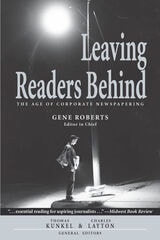
Leaving Readers Behind
The Age of Corporate NewspaperingGene Roberts
University of Arkansas Press, 2001
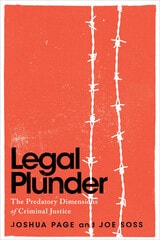
Legal Plunder
The Predatory Dimensions of Criminal JusticeJoshua Page and Joe Soss
University of Chicago Press, 2025
A searing, historically rich account of how US policing and punishment have been retrofitted over the last four decades to extract public and private revenues from America’s poorest and most vulnerable communities.
Alongside the rise of mass incarceration, a second profound and equally disturbing development has transpired. Since the 1980s, US policing and punishment have been remade into tools for stripping resources from the nation’s most oppressed communities and turning them into public and private revenues. Legal Plunder analyzes this development’s origins, operations, consequences, and the political struggles that it has created.
Drawing on historical and contemporary evidence, including original ethnographic research, Joshua Page and Joe Soss examine the predatory dimensions of criminal legal governance to show how practices that criminalize, police, and punish have been retrofitted to siphon resources from subordinated groups, subsidize governments, and generate corporate profits. As tax burdens have declined for the affluent, this financial extraction—now a core function of the country’s sprawling criminal legal apparatus—further compounds race, class, and gender inequalities and injustices. Legal Plunder shows that we can no longer afford to overlook legal plunder or the efforts to dismantle it.

Let Them Eat Junk
How Capitalism Creates Hunger and ObesityRobert Albritton
Pluto Press, 2009
Respected economist Robert Albritton argues that the capitalist system, far from delivering on the promise of cheap, nutritious food for all, has created a world where 25% of the world population are over-fed and 25% are hungry. This malnourishment of 50% of the world's population is explained systematically, a refreshing change from accounts that focus on cultural factors and individual greed. Albritton details the economic relations and connections that have put us in a situation of simultaneous oversupply and undersupply of food.
This explosive book provides yet more evidence that the human cost of capitalism is much bigger than those in power will admit.
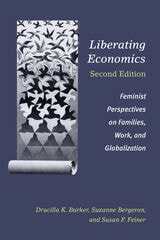
Liberating Economics, Second Edition
Feminist Perspectives on Families, Work, and GlobalizationDrucilla K. Barker, Suzanne Bergeron, and Susan F. Feiner
University of Michigan Press, 2021
With all new and updated chapters, the second edition of Liberating Economics examines recent trends in inequality, global indebtedness, crises of care, labor precarity, and climate change. Taking an interdisciplinary and intersectional feminist approach, the new edition places even more emphasis on the ways that gender, race, class, sexuality, and nationality shape the economy. It also highlights the centrality of social reproduction in economic systems and makes connections between the economic circumstances of women in global North and global South. Throughout, the authors reject the idea that there is no alternative to our current neoliberal market economy and offer alternative ways of thinking about and organizing economic systems in order to achieve gender-equitable outcomes.
Written in an accessible and engaging style, this book will be of interest to students and scholars across a range of fields, policymakers, and any reader interested in creating just futures.
Liberating Economics
Feminist Perspectives on Families, Work, and GlobalizationDrucilla K. Barker and Susan F. Feiner
University of Michigan Press, 2004
Rooted in the two disciplines, this book draws on the rich tradition of interdisciplinary work in feminist social science scholarship to construct a parallel between the notions that the "personal is political" and "the personal is economic."
Drucilla K. Barker is Professor of Economics and Women's Studies, Hollins University.
Susan F. Feiner is Associate Professor of Economics and Women's Studies, University of Southern Maine.
Life beside Bars
Confinement and Capital in an American Prison TownHeath Pearson
Duke University Press, 2024
Lincoln and Reconstruction
John C. Rodrigue
Southern Illinois University Press, 2013
Although Abraham Lincoln dominates the literature on the American Civil War, he remains less commonly associated with reconstruction. Previous scholarly works touch on Lincoln and reconstruction, but they tend either to speculate on what Lincoln might have done after the war had he not been assassinated or to approach his reconstruction plans merely as a means of winning the war. In this thought-provoking study, John C. Rodrigue offers a succinct but significant survey of Lincoln’s wartime reconstruction initiatives while providing a fresh interpretation of the president’s plans for postwar America.
Revealing that Lincoln concerned himself with reconstruction from the earliest days of his presidency, Rodrigue details how Lincoln’s initiatives unfolded, especially in the southern states where they were attempted. He explores Lincoln’s approach to various issues relevant to reconstruction, including slavery, race, citizenship, and democracy; his dealings with Congressional Republicans, especially the Radicals; his support for and eventual abandonment of colonization; his dealings with the border states; his handling of the calls for negotiations with the Confederacy as a way of reconstructing the Union; and his move toward emancipation and its implications for his approach to reconstruction.
As the Civil War progressed, Rodrigue shows, Lincoln’s definition of reconstruction transformed from the mere restoration of the seceded states to a more fundamental social, economic, and political reordering of southern society and of the Union itself. Based on Lincoln’s own words and writings as well as an extensive array of secondary literature, Rodrigue traces the evolution of Lincoln’s thinking on reconstruction, providing new insight into a downplayed aspect of his presidency.
Lineages of Despotism and Development
British Colonialism and State PowerMatthew Lange
University of Chicago Press, 2009
Traditionally, social scientists have assumed that past imperialism hinders the future development prospects of colonized nations. Challenging this widespread belief, Matthew Lange argues in Lineages of Despotism and Development that countries once under direct British imperial control have developed more successfully than those that were ruled indirectly.
Combining statistical analysis with in-depth case studies of former British colonies, this volume argues that direct rule promoted cogent and coherent states with high levels of bureaucratization and inclusiveness, which contributed to implementing development policy during late colonialism and independence. On the other hand, Lange finds that indirect British rule created patrimonial, weak states that preyed on their own populations. Firmly grounded in the tradition of comparative-historical analysis while offering fresh insight into the colonial roots of uneven development, Lineages of Despotism and Development will interest economists, sociologists, and political scientists alike.
Linked Labor Histories
New England, Colombia, and the Making of a Global Working ClassAviva Chomsky
Duke University Press, 2008
Chomsky examines labor and management at two early-twentieth-century Massachusetts factories: one that transformed the global textile industry by exporting looms around the world, and another that was the site of a model program of labor-management collaboration in the 1920s. She follows the path of the textile industry from New England, first to the U.S. South, and then to Puerto Rico, Japan, Mexico, Central America, the Caribbean, and Colombia. She considers how towns in Rhode Island and Massachusetts began to import Colombian workers as they struggled to keep their remaining textile factories going. Most of the workers eventually landed in service jobs: cleaning houses, caring for elders, washing dishes.
Focusing on Colombia between the 1960s and the present, Chomsky looks at the Urabá banana export region, where violence against organized labor has been particularly acute, and, through a discussion of the AFL-CIO’s activities in Colombia, she explores the thorny question of U.S. union involvement in foreign policy. In the 1980s, two U.S. coal mining companies began to shift their operations to Colombia, where they opened two of the largest open-pit coal mines in the world. Chomsky assesses how different groups, especially labor unions in both countries, were affected. Linked Labor Histories suggests that economic integration among regions often exacerbates regional inequalities rather than ameliorating them.

Living Worth
Value and Values in Global Pharmaceutical MarketsStefan Ecks
Duke University Press, 2022

Loving Sports When They Don't Love You Back
Dilemmas of the Modern FanBy Jessica Luther and Kavitha A. Davidson
University of Texas Press, 2020
Triumphant wins, gut-wrenching losses, last-second shots, underdogs, competition, and loyalty—it’s fun to be a fan. But when a football player takes a hit to the head after yet another study has warned of the dangers of CTE, or when a team whose mascot was born in an era of racism and bigotry takes the field, or when a relief pitcher accused of domestic violence saves the game, how is one to cheer? Welcome to the club for sports fans who care too much.
In Loving Sports When They Don’t Love You Back, acclaimed sports writers Jessica Luther and Kavitha A. Davidson tackle the most pressing issues in sports, why they matter, and how we can do better. For the authors, “sticking to sports” is not an option—not when our taxes are paying for the stadiums, and college athletes aren’t getting paid at all. But simply quitting a favorite team won’t change corrupt and deplorable practices, and the root causes of many of these problems are endemic in our wider society. An essential read for modern fans, Loving Sports When They Don’t Love You Back challenges the status quo and explores how we might begin to reconcile our conscience with our fandom.