Results by title
64 books match the query 'Ecuador' and 4 start with l
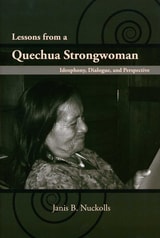
Lessons from a Quechua Strongwoman
Ideophony, Dialogue, and PerspectiveJanis B. Nuckolls
University of Arizona Press, 2010
This book is a fascinating look at ideophones—words that communicate succinctly through imitative sound qualities. They are at the core of Quechua speakers’ discourse—both linguistic and cultural—because they allow agency and reaction to substances and entities as well as beings. Nuckolls shows that Luisa Cadena’s utterances give every individual, major or minor, a voice in her narrative. Sometimes as subtle as a barely felt movement or unintelligible sound, the language supports an amazingly wide variety of voices.
Cadena’s narratives and commentaries on everyday events reveal that sound imitation through ideophones, representations of dialogues between humans and nonhumans, and grammatical distinctions between a speaking self and an other are all part of a language system that allows for the possibility of shared affects, intentions, moral values, and meaningful, communicative interactions between humans and nonhumans.
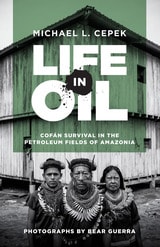
Life in Oil
Cofán Survival in the Petroleum Fields of AmazoniaBy Michael L. Cepek, Photographs by Bear Guerra
University of Texas Press, 2018
Oil is one of the world’s most important commodities, but few people know how its extraction affects the residents of petroleum-producing regions. In the 1960s, the Texaco corporation discovered crude in the territory of Ecuador’s indigenous Cofán nation. Within a decade, Ecuador had become a member of OPEC, and the Cofán watched as their forests fell, their rivers ran black, and their bodies succumbed to new illnesses. In 1993, they became plaintiffs in a multibillion-dollar lawsuit that aims to compensate them for the losses they have suffered. Yet even in the midst of a tragic toxic disaster, the Cofán have refused to be destroyed. While seeking reparations for oil’s assault on their lives, they remain committed to the survival of their language, culture, and rainforest homeland.
Life in Oil presents the compelling, nuanced story of how the Cofán manage to endure at the center of Ecuadorian petroleum extraction. Michael L. Cepek has lived and worked with Cofán people for more than twenty years. In this highly accessible book, he goes well beyond popular and academic accounts of their suffering to share the largely unknown stories that Cofán people themselves create—the ones they tell in their own language, in their own communities, and to one another and the few outsiders they know and trust. Their words reveal that life in oil is a form of slow, confusing violence for some of the earth’s most marginalized, yet resilient, inhabitants.
Living with Lupus
Women and Chronic Illness in EcuadorBy Ann Miles
University of Texas Press, 2013
Once associated only with the wealthy and privileged in Latin America, lifelong illnesses are now emerging among a wider cross section of the population as an unfortunate consequence of growing urbanization and increased life expectancy. One of these diseases is the chronic autoimmune disorder lupus erythematosus. Difficult to diagnose and harder still to effectively manage, lupus challenges the very foundations of women’s lives, their real and imagined futures, and their carefully constructed gendered identities. While the illness is validated by medical science, it is poorly understood by women, their families, and their communities, which creates multiple tensions as women attempt to make sense of an unpredictable, expensive, and culturally suspect medically managed illness.
Living with Lupus vividly chronicles the struggles of Ecuadorian women as they come to terms with the experience of debilitating chronic illness. Drawing on years of ethnographic research, Ann Miles sensitively portrays the experiences and stories of Ecuadorian women who suffer with the intractable and stigmatizing disease. She uses in-depth case histories, rich in ethnographic detail, to explore not only how chronic illness can tear at the seams of women’s precarious lives, but also how meanings are reconfigured when a biomedical illness category moves across a cultural landscape. One of the few books that deals with the meanings and experiences of chronic illness in the developing world, Living with Lupus contributes to our understanding of a significant global health transition.
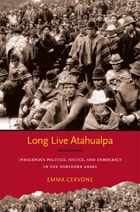
Long Live Atahualpa
Indigenous Politics, Justice, and Democracy in the Northern AndesEmma Cervone
Duke University Press, 2012
Cervone describes how the Inca Atahualpa contested racial subordination by intervening in matters of resource distribution, justice, and cultural politics. Considering local indigenous politics and indigenous mobilization at the national and international levels, she explains how, beginning in the 1960s, state-led modernization created political openings by generating new economic formations and social categories. Long Live Atahualpa sheds new light on indigenous peoples operating at the crossroads of global capitalism and neoliberal reforms as they redefine historically rooted relationships of subordination.