Results by title
218 books match the query 'Education, Higher' and 5 start with l
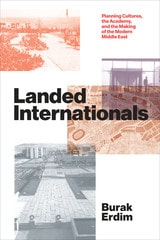
Landed Internationals
Planning Cultures, the Academy, and the Making of the Modern Middle EastBy Burak Erdim
University of Texas Press, 2020
2022 On the Brinck Book Award, University of New Mexico School of Architecture + Planning
Special Mention, First Book Prize, International Planning History Society
Landed Internationals examines the international culture of postwar urban planning through the case of the Middle East Technical University (METU) in Ankara, Turkey. Today the center of Turkey's tech, energy, and defense elites, METU was founded in the 1950s through an effort jointly sponsored by the UN, the University of Pennsylvania, and various governmental agencies of the United States and Turkey. Drawing on the language of the UN and its Technical Assistance Board, Erdim uses the phrase "technical assistance machinery" to encompass the sprawling set of relationships activated by this endeavor.
Erdim studies a series of legitimacy battles among bureaucrats, academics, and other professionals in multiple theaters across the political geography of the Cold War. These different factions shared a common goal: the production of nationhood—albeit nationhood understood and defined in multiple, competing ways. He also examines the role of the American architecture firm Skidmore, Owings, and Merrill; the New York housing policy guru Charles Abrams; the UN and the University of Pennsylvania; and the Turkish architects Altuğ and Behruz Çinici. In the end, METU itself looked like a model postwar nation within the world order, and Erdim concludes by discussing how it became an important force in transnational housing, planning, and preservation in its own right.
Liberal Education Public Interest
James O. Freedman
University of Iowa Press, 2003
In 1996 James Freedman published Idealism and Liberal Education, which discussed the ideals that shaped his life as an intellectual, a law professor, and a college and university president. In this new collection of essays, he convincingly explores his firm belief that a liberal education is the “surest instrument yet devised for developing those civilizing qualities of mind and character that enable men and women to lead satisfying lives and to make significant contributions to a democratic society.”
Freedman concentrates directly upon the problems facing university presidents and all university administrators. A passionate and beautifully written argument for the benefits of a liberal education, this book
Liberating Service Learning and the Rest of Higher Education Civic Engagement
Randy Stoecker
Temple University Press, 2016
Randy Stoecker has been “practicing” forms of community-engaged scholarship, including service learning, for thirty years now, and he readily admits, “Practice does not make perfect.” In his highly personal critique, Liberating Service Learning and the Rest of Higher Education Civic Engagement, the author worries about the contradictions, unrealized potential, and unrecognized urgency of the causes as well as the risks and rewards of this work.
Here, Stoecker questions the prioritization and theoretical/philosophical underpinnings of the core concepts of service learning: 1. learning, 2. service, 3. community, and 4. change. By “liberating” service learning, he suggests reversing the prioritization of the concepts, starting with change, then community, then service, and then learning. In doing so, he clarifies the benefits and purpose of this work, arguing that it will create greater pedagogical and community impact.
Liberating Service Learning and the Rest of Higher Education Civic Engagement challenges—and hopefully will change—our thinking about higher education community engagement.

Librarians and Instructional Designers
Collaboration and InnovationJoe Eshleman
American Library Association, 2016
Limits of the Numerical
The Abuses and Uses of QuantificationEdited by Christopher Newfield, Anna Alexandrova, and Stephen John
University of Chicago Press, 2022
Numbers are both controlling and fragile. They drive public policy, figuring into everything from college rankings to vaccine efficacy rates. At the same time, they are frequent objects of obfuscation, manipulation, or outright denial. This timely collection by a diverse group of humanists and social scientists challenges undue reverence or skepticism toward quantification and offers new ideas about how to harmonize quantitative with qualitative forms of knowledge.
Limits of the Numerical focuses on quantification in several contexts: climate change; university teaching and research; and health, medicine, and well-being more broadly. This volume shows the many ways that qualitative and quantitative approaches can productively interact—how the limits of the numerical can be overcome through equitable partnerships with historical, institutional, and philosophical analysis. The authors show that we can use numbers to hold the powerful to account, but only when those numbers are themselves democratically accountable.