Results by title
198 books match the query 'Educational Policy & Reform' and 7 start with l
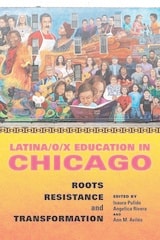
Latina/o/x Education in Chicago
Roots, Resistance, and TransformationEdited by Isaura Pulido, Angelica Rivera, and Ann M. Aviles
University of Illinois Press, 2022
Insightful and enlightening, Latina/o/x Education in Chicago brings to light the ongoing struggle for educational equity in the Chicago Public Schools.
Learning in Depth
A Simple Innovation That Can Transform SchoolingKieran Egan
University of Chicago Press, 2011
For generations, schools have aimed to introduce students to a broad range of topics through curriculum that ensure that they will at least have some acquaintance with most areas of human knowledge by the time they graduate. Yet such broad knowledge can’t help but be somewhat superficial—and, as Kieran Egan argues, it omits a crucial aspect of true education: deep knowledge.
Real education, Egan explains, consists of both general knowledge and detailed understanding, and in Learning in Depth he outlines an ambitious yet practical plan to incorporate deep knowledge into basic education. Under Egan’s program, students will follow the usual curriculum, but with one crucial addition: beginning with their first days of school and continuing until graduation, they will eachalso study one topic—such as apples, birds, sacred buildings, mollusks,circuses, or stars—in depth. Over the years, with the help and guidance of their supervising teacher, students will expand their understanding of their one topic and build portfolios of knowledge that grow and change along with them. By the time they graduate each student will know as much about his or her topic as almost anyone on earth—and in the process will have learned important, even life-changing lessons about the meaning of expertise, the value of dedication, and the delight of knowing something in depth.
Though Egan’s program may be radical in its effects, it is strikingly simple to implement—as a number of schools have already discovered—and with Learning in Depth as a blueprint, parents, educators, and administrators can instantly begin taking the first steps toward transforming our schools and fundamentally deepening their students’ minds.
Learning to Leave
The Irony of Schooling in a Coastal CommunityMichael Corbett
West Virginia University Press, 2020
Learning versus the Common Core
Nicholas Tampio
University of Minnesota Press, 2019
An open challenge to Common Core’s drive for uniformity
Nicholas Tampio watched as his kindergartner’s class shifted from one where teachers, aides, parents, and students worked hard to create a rewarding educational experience to one in which teachers delivered hours-long lectures using packaged lesson plans. Learning versus the Common Core explains how standards-based education reform is transforming nearly every aspect of public education by looking closely at the standards, the agenda of people pushing standards-based reform, and how these fit within a global pattern of education reform. With a nod to the philosophy of John Dewey, Tampio concludes with a vision of what democratic education can look like today—and how people can form rhizomatic alliances across different political and ethical backgrounds to fight the Common Core.
Forerunners: Ideas First
Short books of thought-in-process scholarship, where intense analysis, questioning, and speculation take the lead
Listening to Our Elders
Working and Writing for ChangeSamantha Blackmon, Cristina Kirklighter, and Steve Parks, eds.
Utah State University Press, 2011
In 2011, the National Council of Teachers of English (NCTE) turned one hundred years old. But our profession is endlessly beginning, constantly transforming itself and its purpose as new voices and identities claim their rights in our classrooms and in our country. The recognition of such claims, however, does not occur without a struggle, without collective work.
Listening to our Elders attempts to capture the history of those collective moments where teachers across grade levels and institutions of higher education organized to insure that the voices, heritages, and traditions of their students and colleagues were recognized within our professional organizations as a vital part of our classrooms and our discipline. In doing so, Listening to Our Elders demonstrates this recognition was not always easily given. Instead, whether the issue was race, sexuality, class, or disability, committed activist organizations have often had to push against the existing limits of our field and its organizations to insure a broader sense of common responsibility and humanity was recognized.
Listening to Our Elders features interviews with Malea Powell (Native American Caucus), Joyce Rain Anderson (Native American Caucus), Jeffery Paul Chan (Asian/Asian American), James Hill (Black Caucus), James Dolmage (Committee for Disability Issue in College Composition), Geneva Smitherman (Language Policy Commitee), Carlota Cárdenas de Dwyer (Latino/a Caucus), Victor Villanueva (Latino/a Caucus), Louise Dunlap (Progressive Caucus), Karen Hollis (Progressive Caucus), Louie Crew (Queer Caucus), William Thelin (Working Class Culture and Pedagogy SIG), Bill Macauley (Working Class Culture and Pedagogy SIG).
Living with Moral Disagreement
The Enduring Controversy about Affirmative ActionMichele S. Moses
University of Chicago Press, 2016
Central to Moses’s analysis is the argument that we need to understand disagreements about affirmative action as inherently moral, products of conflicts between deeply held beliefs that shape differing opinions on what justice requires of education policy. As she shows, differing opinions on affirmative action result from different conceptual values, for instance, between being treated equally and being treated as an equal or between seeing race-consciousness as a pernicious political force or as a necessary variable in political equality. As Moses shows, although moral disagreements about race-conscious policies and similar issues are often seen as symptoms of dysfunctional politics, they in fact create rich opportunities for discussions about diversity that nourish democratic thought and life.
Lost Classroom, Lost Community
Catholic Schools' Importance in Urban AmericaMargaret F. Brinig and Nicole Stelle Garnett
University of Chicago Press, 2014
More than just educational institutions, Catholic schools promote the development of social capital—the social networks and mutual trust that form the foundation of safe and cohesive communities. Drawing on data from the Project on Human Development in Chicago Neighborhoods and crime reports collected at the police beat or census tract level in Chicago, Philadelphia, and Los Angeles, Margaret F. Brinig and Nicole Stelle Garnett demonstrate that the loss of Catholic schools triggers disorder, crime, and an overall decline in community cohesiveness, and suggest that new charter schools fail to fill the gaps left behind.
This book shows that the closing of Catholic schools harms the very communities they were created to bring together and serve, and it will have vital implications for both education and policing policy debates.